
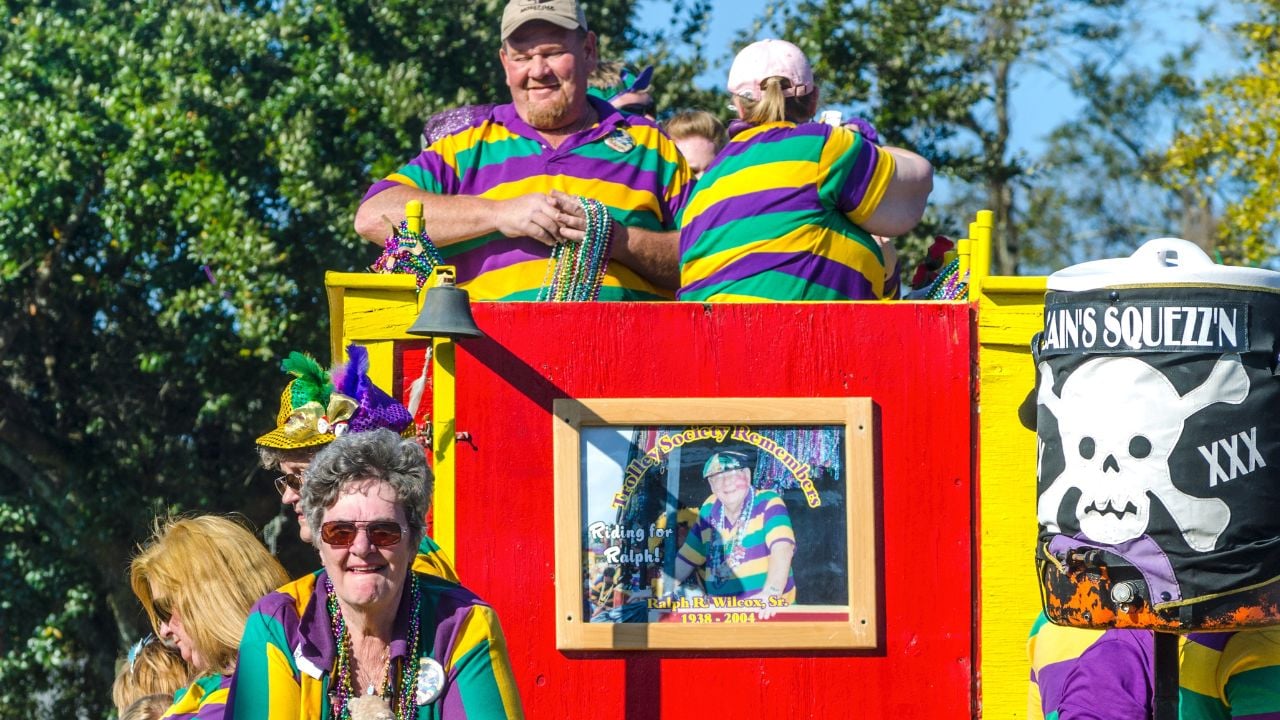
8 Mobile Traditions the Rest of Alabama Doesn’t Quite Get

Mobile does some things its own way, and it’s been that way for a very long time.
Alabamians from other parts of the state may hear about a few of these traditions and wonder what they’re missing.
Here’s a look at the Mobile customs that don’t always make sense outside the city.
1. Fat Tuesday Holiday
Mobile’s Fat Tuesday holiday is written into state law.
Section 1-3-8, the same law that lists Christmas Day and the Fourth of July, deems Mardi Gras a holiday in Mobile and Baldwin counties.
State offices close in those counties that day.
If you work in a state office in Mobile County, that Tuesday is your day off.
If you work in a state office in Baldwin County, the same goes for you.
Many people elsewhere in the state are surprised that a parade day comes with a day off.
Only two counties are named.
2. MoonPie Over Mobile
Mobile’s MoonPie tradition runs from the parade route to the top of a 34-story building.
Riders on Mobile’s floats are said to throw half a million MoonPies during Mardi Gras, according to the Mobile Carnival Museum.
Mystic societies, the secret organizations behind the parades, adopted the MoonPie while looking for a friendlier throw than a box of Cracker Jack.
Expect MoonPies alongside the beads if you stand along a parade route.
MoonPie Over Mobile held its first giant MoonPie drop on December 31, 2008.
At midnight, the MoonPie drops 317 feet in 60 seconds from the 34th floor of the RSA Trustmark building.
If you ring in the new year in Mobile, you watch a pie fall instead of a ball.
The electronic MoonPie is 12 feet tall and weighs 600 pounds.
3. Azalea Trail Maids
The Azalea Trail Maids grew out of a plan to line Mobile’s streets with azaleas.
The Mobile Junior Chamber of Commerce started that project in 1929, according to the maids’ website.
By 1949, the first official Azalea Trail Court had formed from senior girls at Mobile County high schools.
Selection looks at community service, leadership and academic achievement.
The maids represent Mobile at local, state and national events, so you may meet a maid outside the city.
If you meet an Azalea Trail Maid, you’ll know her by the pastel dress.
Fifty seniors make the court.
4. Carnival Since 1703
Carnival in Mobile has run annually since 1703, according to the Encyclopedia of Alabama.
It’s the oldest regular celebration of its kind in the United States that marks the start of Lent.
Visit Mobile bills the city as the birthplace of America’s original Mardi Gras.
If you grew up elsewhere in Alabama, many of the people around you likely think of New Orleans first.
If you visit the Mobile Carnival Museum, you can walk through 14 galleries on that history.
In February 2026, Alabama’s U.S. House delegation backed a resolution calling Mobile the “Birthplace of Mardi Gras.”
Smithsonian magazine noted in 2023 that many people consider Mobile the birthplace of Mardi Gras, and that New Orleans has an origin story too.
Psst! How much do you know about Mobile’s history? Take our quiz and see if you can ace it.
Quiz
Mobile Pop Quiz
Answer nine questions on Mobile’s ships, forts and firsts. We bet you can’t get them all right. Prove us wrong?
The wreck of the Clotilda, a ship that brought 110 Africans to Mobile in 1860, was officially announced as found in what year?
5. Joe Cain Day
Joe Cain Day in Mobile honors a local clerk named Joseph Stillwell Cain.
In 1866, according to the Encyclopedia of Alabama, Cain led a parade through the occupied city dressed as a character called Chief Slackabamarinico.
After the Civil War, his parade signaled the return of the city's parading.
If you're planning around it, Visit Mobile says Joe Cain Day falls on the Sunday before Fat Tuesday.
Joe Cain Day began after Cain was reburied in 1966.
On that Sunday, a group of women called the Merry Widows dress in black and mourn him at Church Street Graveyard, where he is buried.
If you're at the graveyard that day, you'll see veiled women dressed in mourning.
The widows lament his loss.
6. Mobile Bay Jubilee
Mobile Bay's jubilee is a summer event that sends fish and crustaceans onto the shore.
The city of Fairhope says jubilees happen when oxygen-poor bottom water moves upward and forces bottom-type fish and crustaceans ashore.
If you've never heard the cry of "Jubilee," it's one that Mobile Bay residents eagerly await each summer.
You'd need an overcast or cloudy day, a light wind from the east, a calm bay surface and a rising tide.
Jubilees may affect the Eastern Shore from Daphne to Mullet Point, about 15 miles.
Many people think jubilees of this size happen in only two places in the world: Tokyo Bay in Japan and Mobile Bay.
7. King Felix's Arrival
King Felix III arrives in Mobile by yacht on Lundi Gras, the Monday before Fat Tuesday.
The Mobile Carnival Museum says he and his knights come from the Isle of Joy and land at the foot of Government Street.
Then the mayor hands him the key to the city.
If you want to see him come ashore, head to Mobile Landing at the foot of Government Street.
If you visit the museum at 355 Government Street, you can see crowns, scepters and robes worn by former monarchs.
The first recorded king, Felix I, dates to 1872.
Mobile's 2027 Mardi Gras Dates
Visit Mobile lists the 2027 Mardi Gras season in Mobile as January 22 through February 9.
Fat Tuesday falls on February 9, and Joe Cain Day lands on Sunday, February 7.
That puts Lundi Gras, the day King Felix arrives, on Monday, February 8.
8. Cowbellion Parade
The Cowbellion parade began in Mobile in the early 1830s, on New Year's Eve.
A cotton broker named Michael Krafft and some friends held a spontaneous parade through downtown Mobile carrying rakes, cowbells and other farm tools, according to the Encyclopedia of Alabama.
Krafft called the group the Cowbellion de Rakin Society, formed to celebrate the coming year.
Cowbells led the way.
The parade became an annual affair with costumes and masks, and by 1840 it included themed parades.
If you're in Mobile in January 2027, Visit Mobile says over 40 parades will roll through downtown and across the area.
If you're tracing the mystic societies behind today's parades, the Mobile Carnival Museum credits the Cowbellions as the first mystic society in the country.
By the 1850s, several Cowbellions had migrated to New Orleans, where they continued their traditions.
9 Things Alabama Parents Won't Say to a Grandparent's Face

A grandmother in Mobile lays a fussy grandbaby down for a nap on their stomach.
Her daughter says nothing, then waits until the car leaves the driveway.
9 Things Alabama Parents Won't Say to a Grandparent's Face
8 Alabama Church Cookbook Recipes Nobody Makes From Scratch Anymore
The cookbooks survived.
The scratch cooking inside them mostly didn't.
8 Alabama Church Cookbook Recipes Nobody Makes From Scratch Anymore
