
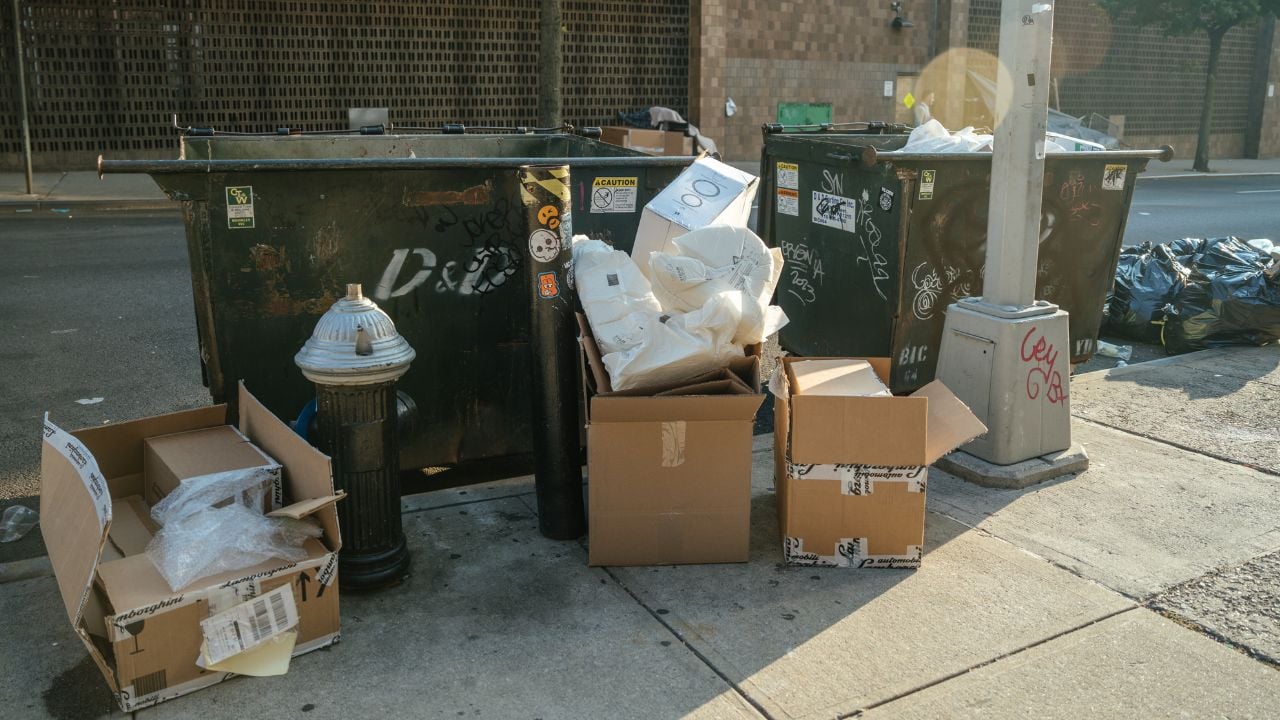
8 New York City Trash Rules That Sound Fake but Aren’t

New York City sells an official trash can, and buying the wrong type can cost a building money.
It’s rat-resistant by design and government-mandated for certain buildings.
These are the New York City sanitation rules that sound made up until you check DSNY’s own website.
Note: This is general information, not legal advice. Sanitation rules and fines are subject to change, so confirm the current requirements with the New York City Department of Sanitation (DSNY).
1. Your Trash Has a Curfew
New York City doesn’t let anyone drag a trash bag to the curb whenever the mood strikes.
Small buildings with an approved bin can bring it out starting at 6 PM the night before pickup.
Bigger buildings still setting loose bags directly on the sidewalk have to wait until 8 PM.
That’s a curfew, for garbage.
Everything has to be at the curb by midnight so the overnight trucks can find it, and DSNY treats the early side of that window the same way it treats the late side.
2. Your Bin Has to Be Official
A lid alone no longer satisfies New York City’s trash rules.
One bin, no substitutes.
DSNY spent a 2023 request for proposals designing a bin, then unveiled the official NYC Bin in 2024, built rat-resistant and sized to fit the mechanical arms on new collection trucks.
It costs about $50 for the most common size, and it sells at Home Depot stores across the city, no city office visit required.
New York City will even pay some homeowners back.
Owners of one- and two-family homes who get the School Tax Relief (STAR) property tax benefit can apply for a reimbursement through the city’s Department of Finance after they buy the bin.
What New York City’s Bin Fines Add Up To
New York City’s bin mandate carries escalating fines for small buildings that skip it.
DSNY charges $50 for a first violation, $100 for a second, and $200 for every violation after that.
Full enforcement of the official NYC Bin requirement begins September 8, 2026, so any other lidded bin, however new, stops satisfying the rule after that date.
3. Composting Isn’t Optional
Food scraps can no longer just ride out with the rest of New York City’s household trash.
The city’s Zero Waste Act made curbside composting mandatory at every residential building in the five boroughs, not just the buildings that already cared.
Skip it, and DSNY can fine a small building $25 for a first offense and a bigger building up to $100, with the number rising higher for repeat violations.
Not a suggestion.
A brown bin, or an owner’s own labeled container, now has to sit on the sidewalk next to the black bin every collection day.
Residents now have to sort food scraps out of the regular trash bag entirely.
4. Your Mattress Needs a Sealed Bag
A mattress or box spring at New York City’s curb has to be sealed inside a plastic bag before DSNY will touch it.
The rule targets bed bugs, not tidiness.
DSNY requires the seal to keep an infestation from spreading between apartments and collection trucks.
Skip it, and the fine rises to $300.
No bag, no pickup.
The mattress gets left sitting exactly where it was dropped.
Rugs and carpets face a milder version of the same rule.
They have to be rolled up and tied with twine before New York City will collect them at all.
5. Electronics Skip the Trash
An old laptop or a broken TV can’t ride out with New York City’s regular trash at all.
New York State banned it back in 2015, and the list is longer than many people guess: Monitors, printers, fax machines, and cable boxes all count.
Set an old TV or laptop out with the regular trash.
It can draw a $100 fine on the spot.
Businesses have it worse.
State regulators can charge a company up to $25,000 a day for the same mistake. The goal is keeping lead and mercury out of landfills, not just tidy curbs.
6. Your Cardboard Isn’t Recycling Until It’s Flat
A shipping box tossed whole into New York City’s recycling doesn’t count as recycled at all.
DSNY requires corrugated cardboard to be flattened, bundled, and tied with twine before it goes out.
Set it out next to a bin or bag.
It never goes inside either.
New York City also bans the obvious workaround.
A resident can’t use a cardboard box itself as a recycling bin, DSNY’s own rule says so directly.
Psst! How much do you know about New York City’s recycling rules? Flip each card and see how many you can call correctly.
7. Your Empty Bin Can’t Live on the Sidewalk
An empty trash bin doesn’t get to stay on New York City’s sidewalk once the truck has come and gone.
DSNY requires bins to be stored inside, or in alleyways, courtyards, or other outdoor space away from the public sidewalk.
If a building has nowhere else to put it, the bin can sit within three feet of the building.
It still has to leave room for pedestrians to pass.
DSNY checks for exactly that.
Leave it sprawled across the sidewalk instead, and New York City treats it as a violation like any other.
8. Your Fridge Needs an Appointment
New York City won’t just haul away an old refrigerator or air conditioner on a regular collection day.
Anything holding refrigerant gas needs a chlorofluorocarbon (CFC) recovery appointment first, booked free through 311, so a technician can drain the gas safely before the truck ever touches it.
No appointment, no pickup.
Skip that step and DSNY leaves the appliance right at the curb.
New York City also requires the hinges and locks off a fridge or freezer before it goes out. DSNY still enforces that child-safety rule today, decades after it was written.
Up to 10 appliances can ride on a single appointment, so a building emptying out several units at once doesn’t need to call 311 ten separate times.
Newer units running on R600a or R32 refrigerant carry a yellow warning sticker and don’t qualify for DSNY’s free pickup at all, so those go back to the manufacturer or a private hauler instead.
10 Words New Yorkers Use That Confuse Everyone Else

Many people outside New York City assume it has one accent and one set of words for everything.
New York City alone splits into a handful of them, and the words that give a newcomer away have nothing to do with trash day.
10 Words New Yorkers Use That Confuse Everyone Else
9 Things New York Landlords Can Legally Do That Renters Assume Are Illegal
Trash day rules aren’t the only New York City fine print that catches residents by surprise.
A landlord’s side of the rulebook holds just as many moves tenants assume are against the law and aren’t.
9 Things New York Landlords Can Legally Do That Renters Assume Are Illegal
