
8 Texas Dance Halls Texans Assume Everyone Knows About

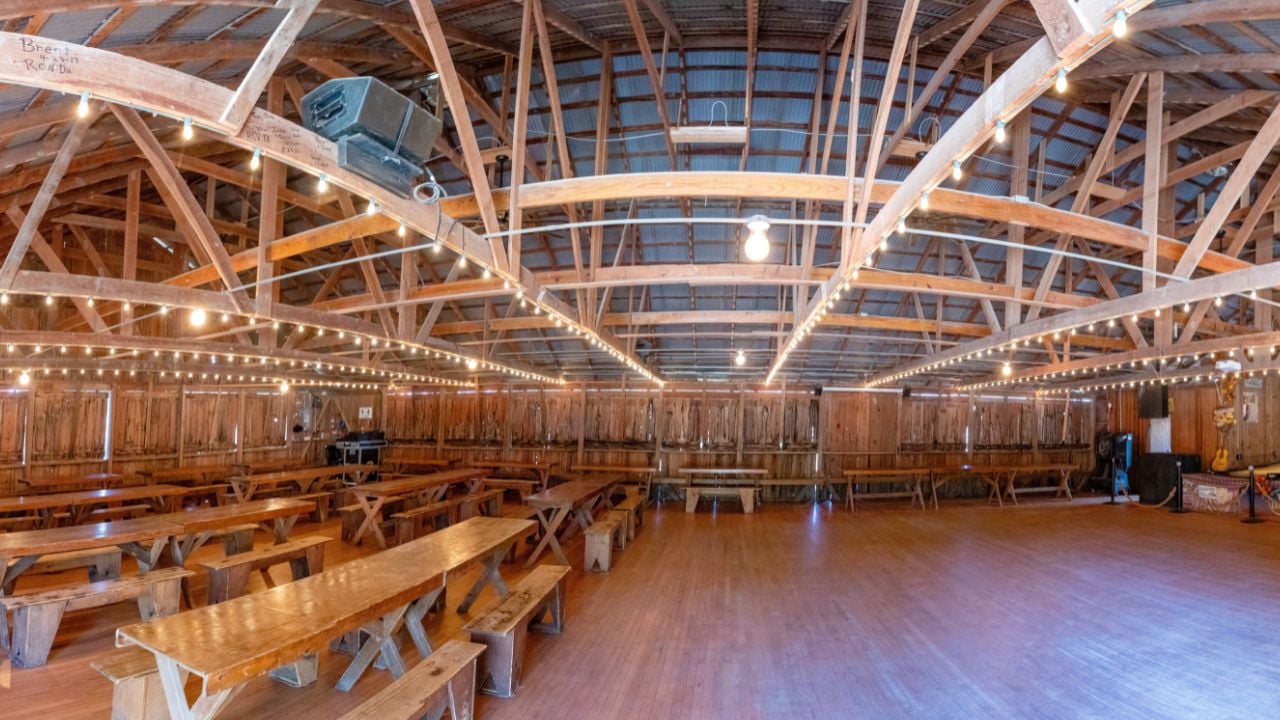
Texas built as many as 1,000 dance halls between the mid-1800s and mid-1900s. A 2017 National Trust for Historic Preservation count found fewer than 400 still standing.
Locals treat the survivors as common knowledge.
But that’s not always the case.
These are the Texas dance halls Texans assume everyone knows about.
1. Twin Sisters Dance Hall
Twin Sisters Dance Hall has hosted a public dance on the first Saturday of nearly every month since German immigrant families built it in 1870.
That’s a lot of Saturdays.
Regulars from Blanco County show up in jeans and boots without a second thought.
Twin Sisters bans outside ice chests, wine, and beer.
Bar sales inside keep the roof paid for.
A nonprofit board runs the hall today, and it doubles as a wedding venue and community space between dance nights.
Twin Sisters draws a full parking lot on the first Saturday of the month while sitting outside every major published ranking of Texas dance halls.
2. Swiss Alp Hall
Swiss Alp Hall in Fayette County went up in 1901, when Charles Bruns built a 7,000-square-foot hall next to his general store.
The German Lutheran settlement around it already carried the name Swiss Alp.
Bob Wills and Adolph Hofner both played the 3,000-square-foot wood floor inside during the western swing era.
That lineup still holds up.
The hall passed from the Bruns family to the Tietjens in 1933, and from the Tietjens to the Ustynik family in 2005.
The Ustynik family still runs Swiss Alp Hall today, booking the same wood floor for weddings and community gatherings.
Statewide guides that name Gruene Hall, Floore’s, and Luckenbach almost never mention Swiss Alp, even though its floor has outlasted several of the halls those guides do cover.
3. Anhalt Hall
Anhalt Hall began in 1879 as a small meeting hall for the Germania Farmer Verein, a German immigrant benevolent society in Comal County.
The group added a 6,000-square-foot oak dance floor in 1908, and the building now sits on the National Register of Historic Places.
George Strait played Anhalt Hall once in 1978, fronting the Ace in the Hole Band at a Smithson Valley High School FFA (Future Farmers of America) dance.
Jerry Jeff Walker also played the room.
That’s quite a guest list.
The Verein still throws Maifest and Oktoberfest every year.
Anhalt Hall has never turned up on a single published ranking of Texas’s best dance halls, despite the National Register listing and Strait’s early stop there.
What Anhalt Hall’s Register Listing Doesn’t Do
Anhalt Hall’s spot on the National Register of Historic Places sounds like a shield.
The listing by itself doesn’t stop a private owner from altering or tearing down the building.
Extra federal review only kicks in when a project uses federal money or a federal permit, according to the National Park Service.
4. John T. Floore Country Store
Floore’s Country Store and dance hall opened in Helotes in 1946, when John T. Floore left a manager’s job at a San Antonio movie theater to build it.
He built what he advertised as the largest patio in the Southwest.
Floore later signed Willie Nelson to play the venue monthly for years, on the condition Nelson skip other stages nearby.
Nelson kept showing up.
Floore sold the store in 1973, and three more owners have kept the dance floor running since, with a group of San Antonio investors in charge today.
A state historical marker went up outside in 2006.
National honky-tonk write-ups tend to skip past Helotes for Austin, even though San Antonio-area two-steppers treat a Friday night at Floore’s as ordinary.
5. Sons of Hermann Hall
Sons of Hermann Hall opened in Dallas’s Deep Ellum neighborhood in 1911, built by a German fraternal lodge that still owns it.
The building has held a bowling alley, a singing society’s rehearsals, and a scene from the movie RoboCop.
That’s a strange resume.
Swing dancers still fill the floor many weeks at Swingin’ at the Sons, the hall’s recurring swing night.
Sons of Hermann Hall still belongs to that same fraternal lodge, which runs the dance nights as a side project to its regular business rather than as a tourist draw.
6. Coupland Dancehall
Coupland Dancehall traces back to a 1904 drug store building and a 1910 building next door that later became a 7,000-square-foot dance floor.
The venue built a following as a small-town stop for touring country acts and hosted a scene from HBO’s Love & Death.
None of that saved it in 2025.
The dancehall closed that October after its owners announced a final season, and it looked like the end for a building many nearby residents never had a reason to visit.
New owners, Haute Spot and Lightstream Presents, reopened Coupland Dancehall the next month with Aaron Watson headlining.
Two-steppers around Austin talk about Coupland like it never left.
It almost did.
Many people who don’t live nearby have never heard the town’s name.
7. Luckenbach Dance Hall
Luckenbach Dance Hall stood by the late 1800s, and the community rebuilt it in the 1930s with a new maple floor.
Waylon Jennings, featuring Willie Nelson, turned the tiny community into a household name with “Luckenbach, Texas (Back to the Basics of Love).”
The song spent six weeks at No. 1 on the country charts in 1977.
Waylon never liked it.
Many people who can hum that chorus have no idea the hall in it still stands and still books bands.
It sits behind a general store and a post office, all still standing on the same few acres.
Musicians keep booking Luckenbach, and people keep assuming every visitor already knows it is more than a lyric.
8. Quihi Gun Club and Dance Hall
Quihi Gun Club and Dance Hall started in 1890, when German settlers on Quihi Creek in Medina County formed a shooting club.
The club built a dance floor alongside its rifle range.
Dances still run every second and fourth Saturday of the month.
Cards don’t work there.
The bar and the door both run on cash only.
Flooding has forced rebuilds over the decades, and the current building sits six feet off the ground because of it.
Generations of the same Medina County families have celebrated weddings and birthdays on that dance floor.
A statewide tourism brochure has never once mentioned any of it.
Psst! How much do you know about Texas dance hall history and etiquette? Flip each card below and see how many you can call correctly.
The Halls That Didn’t Survive
A National Trust for Historic Preservation count found fewer than 400 of Texas’s historic dance halls still standing, out of as many as 1,000 originally built.
Kendalia Halle, a century-old hall in Kendall County, didn’t make the cut.
Its owners closed the doors in 2024.
They never explained why.
By the next year, they had put the 120-year-old building up for sale at $669,000, with no reopening announced.
Texas Dance Hall Preservation, a nonprofit founded in 2007, works to land National Register status and restoration money for halls before they reach Kendalia’s spot.
The same National Trust count found roughly a quarter of Texas’s surviving dance halls at risk of closing for good.
9 Words That Mean Something Completely Different in Texas

Texas has 254 counties, more than any other state, and somewhere between one county line and the next, an ordinary English word starts meaning something else.
A transplant usually finds out mid-sentence, in front of people who assumed everybody already knew.
9 Words That Mean Something Completely Different in Texas
8 Storm Repair Scams That Follow Every Texas Hurricane
A Dallas-Fort Worth roofing company collected close to $500,000 from Texas homeowners for storm repairs it never finished, and the case is still moving through the court system.
These are the scams that come back to Texas neighborhoods every hurricane season, right on schedule.
