

8 Things Arizona Storage Managers Judge About a Renter

Renting a storage unit is simple: Pick a size, sign the paperwork, and start unloading.
But while you’re sizing up the unit, the person behind the counter is sizing you up.
These are the things Arizona storage managers judge about a renter.
Note: This is general information, not legal advice. Arizona’s self-storage lien and auction rules are subject to change, so confirm the current requirements with the facility’s rental agreement.
1. Whether You Choose Climate Control
Self-storage managers watch which unit type a renter picks before they discuss anything else.
Phoenix’s normal July high tops 106 degrees, and storage-industry estimates put a non-climate-controlled unit’s interior at roughly 30 degrees hotter than the air outside its metal walls.
That math puts a standard Arizona unit well past 130 degrees on a summer afternoon.
Vinyl records warp long before that point, and the glue holding old wood furniture together lets go too.
A renter who skips the climate upgrade while checking in a guitar, a box of photos, or a stack of records has already made a choice.
The manager reads it before anyone says a word.
2. Your Monsoon Timing
For storage managers, monsoon season brings a different kind of renter through the gate.
The monsoon season stretch runs June 15 through September 30, and Arizona’s weather turns fast inside it.
A drive-up unit takes the brunt of a monsoon storm, since wind-driven rain finds the gaps around an overhead door faster than it finds a climate-controlled hallway.
Trade coverage of self-storage water damage lists stains, peeling paint, and warped flooring as the marks it leaves behind.
Storage managers watch a drive-up unit through that whole stretch.
That damage shows there first.
3. Your Vehicle and RV Paperwork
Self-storage managers’ attention shifts the moment a renter parks a vehicle, a recreational vehicle (RV), or a boat instead of stacking boxes.
A 2024 change to Arizona’s lien law, House Bill 2087, lets a facility hire a towing company once a renter sits in default for more than 30 days.
The operator has to give at least 10 days’ notice first, naming the tow company.
After that, the facility isn’t liable for whatever happens to the vehicle.
That law is why registration, insurance, and proof of ownership matter at move-in, not just at the end.
Hand over clean paperwork on a boat or a truck, and a manager files it away without a second thought.
That ends the review.
Show up without it, and a manager remembers.
4. What You Say You Need It For
The reason a renter gives for renting shapes how long a storage manager expects the unit to stay full.
One self-storage operator’s intake data found 37 percent of renters cited clearing out excess belongings, while 34 percent were in the middle of a move.
Nearly three-quarters said they were storing furniture and boxes, and about one in six needed room for business inventory.
Managers plan around each of those answers differently.
Psst! How storage-savvy are you? Run through this checklist and see how many boxes you check.
5. Whether You Have a Valid ID Ready
Managers ask for identification before handing over a gate code, and they notice how a renter handles that moment.
Screening guidance in the industry tells staff to require an unexpired driver’s license, a government ID, a military ID, or a passport, never a work badge.
A renter who pulls one out without missing a beat reads as routine.
A renter who stalls, argues, or offers something else instead becomes a manager’s problem to solve later.
That’s the whole test.
6. Whether Your Story Matches Your Unit
A locked door blocks a storage manager’s view, so managers read whatever leaks out around it instead.
Industry accounts describe renters who claimed ordinary household goods and turned out to be storing spoiled food.
A few documented cases even describe renters living out of the unit.
A smell, a sound, or a report from a neighboring renter is usually what gives it away.
Every Arizona lease bans perishables and living quarters for a reason.
Not much stays hidden long.
7. What Your Lock Says on a Walk-Through
On a routine walk, a manager checks every unit’s lock without opening a single door.
Trade guidance on abandonment reviews flags a missing lock as one of the clearest signs a renter has stopped coming back.
A renter’s lock still hanging in place usually means the account is still active, even in a rough month.
That’s a good sign.
8. How Fast You Answer the First Notice
The clock starts for a storage manager the moment a renter’s payment doesn’t come through.
Delinquency guidance for the industry tells operators to reach out at the very first missed payment, before a pattern even forms.
Arizona law backs up why that first response matters.
A facility can’t foreclose the lien until a renter sits in default for more than 30 days.
A renter who calls back after that first notice, even just to ask for a few more days, reads as someone planning to stay.
That silence means something else.
How Arizona’s Default Timeline Adds Up
State law spells out exactly how many days of silence a renter gets before a storage unit can reach a sale.
Arizona’s Default Timeline, Spelled Out
Arizona sets a hard floor on how long a renter’s default has to run before a self-storage facility can act.
A facility can foreclose the lien only after a renter sits more than 30 days past due.
The first notice goes out by verified mail or email, and a second one follows at least seven days later.
That second notice has to give at least 14 more days to pay before a sale can happen.
Add it up, and a renter needs at least 51 days of silence before an Arizona storage unit ever reaches a sale.
What Happens at the Actual Auction
Arizona storage managers still have work to do once that 51-day window closes.
If a stored vehicle is involved, the facility has to notify any lienholder already on record, by verified mail, at least 10 days ahead of the sale.
The sale itself has to be commercially reasonable.
Arizona law spells out exactly what that means: A sale with five or more bidders unrelated to the facility in attendance counts as commercially reasonable automatically.
Many renters never see it.
A renter who never answers any of the notices along the way is the only reason it ever gets this far.
Arizona’s rules don’t require a bidder to know anything about a unit’s history, only to show up and bid on what’s visible from the doorway.
Whoever wins hauls away the boxes, the furniture, and whatever else nobody picked up in time.
8 Arizona Water Rights Rules Rural Property Owners Get Wrong
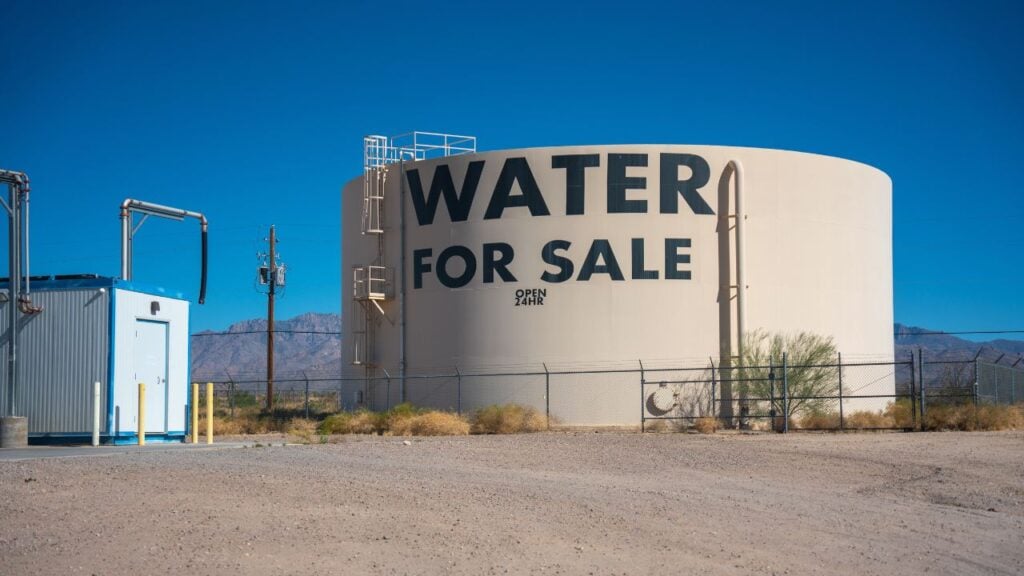
A drill rig can put a well on almost any rural Arizona property.
That well doesn’t make the water underneath it yours to sell, and a handful of other Arizona water rules trip up rural landowners the same way.
8 Arizona Water Rights Rules Rural Property Owners Get Wrong
9 Arizona Foods and Drinks Visitors Order Wrong Every Time

A burrito tumbling into a deep fryer at Tucson’s El Charro Café in 1922 is supposed to have given Arizona the chimichanga, curse word and all.
Almost every visitor manages to order one by name, and almost none order it, or the rest of the state’s plate, the way locals do.
