
8 Things California Residents Should Never Take From Someone’s Curb

A driver in Sacramento pulls her pickup to the curb on recycling day, eyeing a neighbor’s blue bin stuffed with flattened boxes and aluminum cans.
She figures trash day makes everything fair game.
California law says otherwise the moment those cans hit the bin.
These are the things California residents should never grab off someone else’s curb, no matter how free the pile looks.
Note: This is general information, not legal advice. Curbside, recycling, municipal waste, possession, and product-safety rules vary by city and county across California and are subject to change.
Trash Already Out for Pickup
California cities claim curbside trash piles the same way they claim curbside recycling bins, good find or not.
Los Angeles Municipal Code Section 66.01 bars anyone besides the city or a permitted hauler from removing or hauling solid waste along a city street.
The same rule covers a couch or mattress dragged out for a scheduled bulk-item pickup.
Other California cities run their own versions of that rule, so a pile that looks abandoned in one city can still legally belong to a hauler in the next city over.
Check before loading your trunk.
Recycling Bin Contents
California’s recycling bins aren’t up for grabs the moment they hit the curb, even on a street already crowded with other people’s giveaways.
State law treats them as the property of a city or county’s authorized recycling agent from the second they’re set out, per Section 41950 of the Public Resources Code.
Anyone besides that agent who pulls out paper, plastic, cardboard, or aluminum has broken the law.
No exceptions.
A hauler that takes the matter to court can collect treble damages, or a civil penalty of up to $5,000 for a repeat offense within 12 months, whichever is greater.
Los Angeles County repeats that number right on its bin labels, warning residents that pulling recyclables from a cart is punishable by a fine that steep.
That’s serious money for a stack of flattened boxes.
What Counts as ‘Free’ in California
California draws a clear line between a curbside pile someone means to give away and trash or recycling that’s simply waiting for its scheduled pickup.
A handwritten “free” sign, or an item set noticeably apart from the regular trash, usually signals genuine abandonment, the kind a resident can legally take.
A closed garbage bag, a full recycling bin, or an untagged bulk-item pile almost always still belongs to somebody, whether that’s the original owner, the city, or a licensed hauler.
When there’s no sign either way, the safer assumption in California is that it isn’t free yet.
Old TVs and Computer Monitors
Old TVs and computer monitors count as hazardous waste the moment California residents set them out, not ordinary junk.
The state’s Electronic Waste Recycling Act classifies any screen larger than four inches, measured diagonally, as a hazardous waste once it’s discarded, according to the Department of Toxic Substances Control.
That means screens generally, not just TVs: Old computer monitors, laptops, and tablets, plus the boxy tube TVs that still turn up on California curbs decades after anyone bought one.
Pick one up, and the job of legally recycling the lead and mercury inside it becomes the taker’s problem instead of the state’s collection program.
Not a free upgrade.
Fridges, Freezers, and AC Units
Refrigerators, freezers, and window air conditioners set out at a California curb hide a hazard that has nothing to do with dents or missing shelves.
Federal Clean Air Act Section 608 requires a certified technician to reclaim the refrigerant inside with special recovery equipment before the unit can be legally scrapped or resold.
It’s a rule California enforces through the Air Resources Board and CalRecycle’s universal waste program.
That’s federal law.
A unit sitting at the curb with its refrigerant still inside hasn’t been cleared for pickup, whatever the handwritten sign says.
Haul it home, and an illegal refrigerant release becomes the taker’s problem, not the previous owner’s, so read the tag before loading anything into the trunk.
Propane Tanks and Paint Cans
Propane tanks, paint cans, and other chemical containers should never sit in a regular trash pile in California to begin with: State rules ban household hazardous waste like propane cylinders and leftover paint from ever going into a curbside trash or recycling container.
None of it belongs there.
Anything matching that description sitting at a curb was almost certainly dumped illegally, not set out through any approved program.
A pressurized tank or a half-full can of solvent is also a fire and chemical risk riding home in the back seat.
Leave it where it sits.
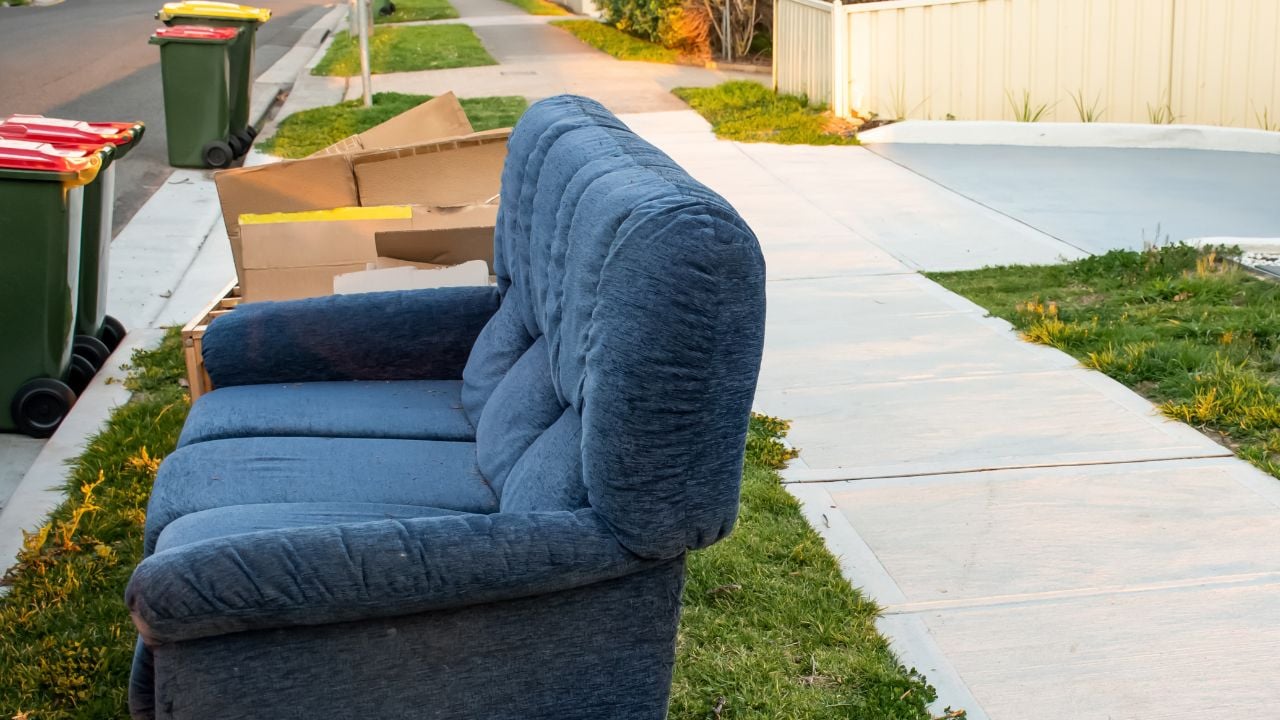
A Curbside Mattress or Couch
A mattress or couch sitting at a California curb can look perfectly clean and still be dangerous to bring home.
Why?
The EPA warns that discarded furniture is one of the most common ways bed bugs spread from one household to the next, and the insects can go months without feeding.
A piece that sat at the curb for a week can still carry a live infestation inside the seams.
Pest control companies see the same pattern every summer: Someone grabs a couch off a sidewalk, and an infestation moves in within days.
Not worth the risk.
Pills Left in Curbside Furniture
Pills sometimes turn up inside furniture left at a California curb, tucked in a nightstand drawer or a kitchen junk drawer nobody emptied.
Finding a pill bottle inside doesn’t make keeping it legal.
California Section 11350 of the Health and Safety Code makes possessing certain prescription drugs classified as controlled substances, like opioid painkillers or benzodiazepines, that weren’t prescribed to you a crime.
Even finding the bottle yourself doesn’t clear you.
That applies whether the pills came from a stranger’s dresser or a friend’s medicine cabinet, no matter how the bottle ended up on the sidewalk.
Leave it shut.
A Used Car Seat
A used car seat set out at a California curb comes with no way to check its history.
No paperwork, no guarantee.
The National Highway Traffic Safety Administration’s own car seat checklist warns against one with a missing label, an unknown crash history, or an expired manufacture date, since any of those can keep it from protecting a child in a crash.
A curbside seat carries none of that history, and stress fractures inside the plastic shell often don’t show up to the naked eye.
A car seat is one of the few curbside finds where saving money isn’t worth the gamble.
Buy new instead.
How to Spot a Legitimate Giveaway
California residents can protect themselves by checking for a few signs before loading anything into a trunk.
A handwritten “free” sign taped to an item is a strong signal the owner meant to give it away, while a bare pile with no note at all is more of a coin flip.
Signs matter.
Psst! How much do you know about curbside law and giveaway culture in California? Take our quiz and see how many you can get right.
Quiz
California Curb Culture IQ
Answer these questions on curbside law, giveaway culture, and California trivia many residents never learn. We bet you can’t get them all right. Prove us wrong?
In the 1988 case California v. Greenwood, the U.S. Supreme Court ruled on which curbside activity?
Many California cities also require residents to schedule a bulk-item pickup in advance through 311 or a city sanitation site, and crews often tag approved piles with a sticker or a pickup window.
An untagged pile sitting out well before that scheduled date is more likely still private property than an approved giveaway.
11 Things Californians Miss Most After They Leave the State

Leaving California looks great on a spreadsheet, with a smaller mortgage and a two-car garage waiting at the other end of the drive.
Then February hits, and the strawberries in a new home state's produce aisle taste like water, right alongside a dozen other small things nobody warns a person about.
11 Things Californians Miss Most After They Leave the State
9 Ways to Spot a California Transplant Anywhere in America

A California habit doesn't check the calendar once it moves out of state, whether that's reapplying sunscreen in December or flinching at a four-way stop.
Some habits follow a person for years, long after the moving truck is unpacked and the license plate has changed.
