
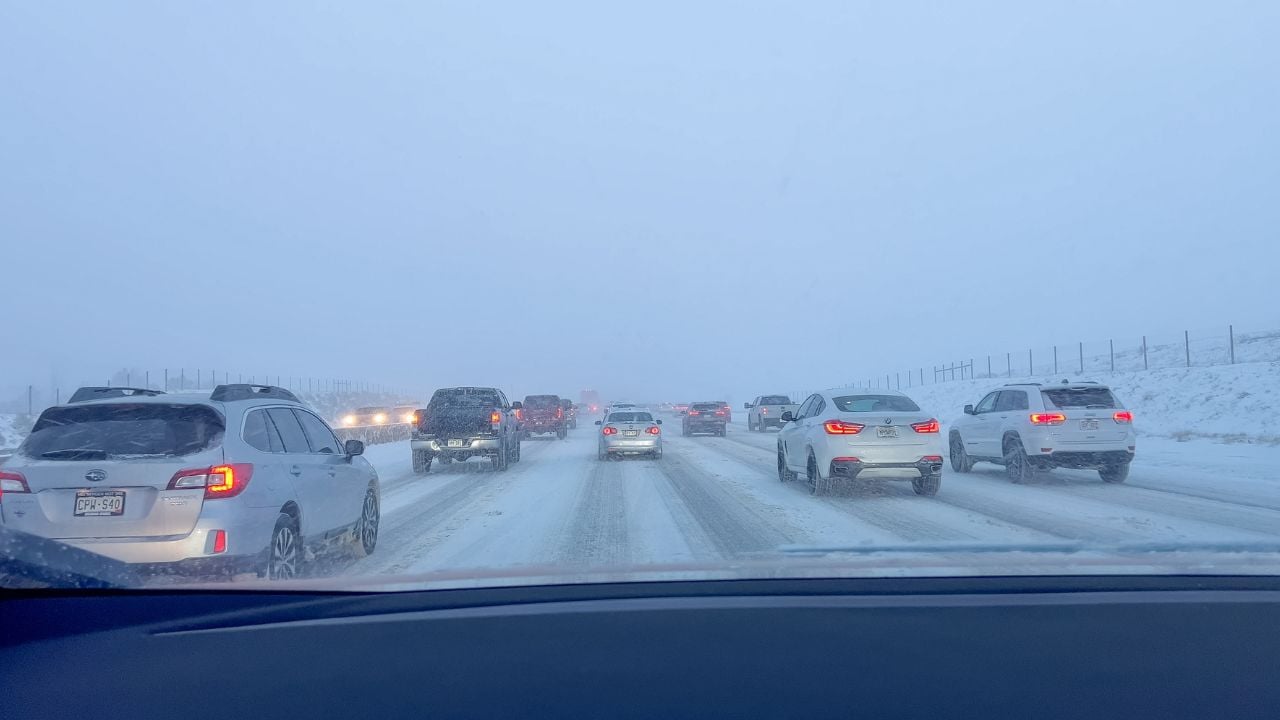
8 Things Every Coloradan Knows About Driving I-70 in Winter

Pass a line of snowplows working together on I-70, and you could get a ticket.
Coloradans know rules like that before they head into the mountains. Visitors don’t always.
Here’s what every Coloradan knows about driving I-70 in winter.
Note: This is general information, not legal advice. Driving rules and fines are subject to change, so confirm the current requirements with the Colorado Department of Transportation.
1. Traction Law Season
On I-70, the Traction Law is in effect every year from Sept. 1 through May 31.
The Colorado Department of Transportation (CDOT) says that covers the I-70 Mountain Corridor between Dotsero and Morrison.
That’s nine months.
The law can apply on other state highways too when weather or road conditions require.
If you’re not driving a commercial vehicle, the law applies to you.
The penalty is a $100 fine and a $33 surcharge.
If you fail to comply and a travel lane closes as a result, the fine can reach $500 plus a $157 surcharge.
What Passes the Traction Law
You pass the Traction Law with winter, all-weather rated or mud and snow (M+S) tires on a four-wheel-drive or all-wheel-drive vehicle.
Winter tires carry the mountain-snowflake icon.
Each tire needs a tread depth of at least 3/16-inch.
If your vehicle falls short on tires or drive type, you need tire chains or an approved alternative traction device on two or more drive tires.
2. Chain Law
During a severe winter storm, CDOT can put the Passenger Vehicle Chain Law in effect on any state highway, I-70 included.
That’s the final safety measure before the highway closes.
While it’s in effect, every vehicle, yours included, needs chains or an approved alternative traction device.
That means four-wheel drive too.
You’ll see the restriction announced on highway signs and in traffic alerts.
Trucks follow the Must Carry Law, signed in 2024, which requires commercial drivers to carry chains from Sept. 1 to May 31.
If a truck blocks the roadway ahead of you, its driver can face a fine of up to $1,000 plus a surcharge.
When storms hit, truck drivers often have to pull into chain stations.
Colorado has 130 designated chain stations, and 22 are on I-70’s mountain corridor.
3. Tandem Snowplow Law
Passing a snowplow on I-70 is a Class A traffic infraction when the plow is displaying its lights and working in tandem with one or more other plows.
Tandem means the plows are arranged diagonally.
The law covers plows operated by state, county or local agencies.
A Class A traffic infraction carries fines of $15 to $100 plus a surcharge, and the Colorado Division of Motor Vehicles may add points to your license.
Passing plows in that formation is dangerous because you could meet whiteout conditions and ridges of snow between lanes.
Plows drop de-icer and sand, so stay back 3 to 4 car lengths.
4. Ski Traffic Peaks
CDOT says I-70’s heaviest traffic comes around holidays, school breaks and weekends in January and February.
Westbound traffic typically peaks on Friday afternoons between 2 and 7 p.m.
Eastbound, it’s Sundays between 3 and 6 p.m.
Traffic starts to build as early as 11:30 a.m.
That’s before lunch.
If you can, plan your departure for midweek or the early morning hours.
If you’re heading home, you can stay in the mountains for dinner, or stay Sunday night and drive back Monday morning.
Psst! How much do you know about Colorado’s Interstates and the Eisenhower Tunnel? Take our quiz and see how many you can get right.
Quiz
Colorado Interstate Trivia
Answer these questions on Colorado’s Interstates and the Eisenhower Tunnel. We bet you can’t get them all right. Prove us wrong?
Contractors bid on the tunnel we now call the Eisenhower Tunnel under what earlier name?
5. Tunnel Metering
I-70 traffic stops at the Eisenhower-Johnson Memorial Tunnel when volume exceeds capacity, or when accidents or weather back cars up into it.
That's called safety metering, since each tunnel has only two lanes and no pull-outs or shoulders.
Eastbound metering happens primarily on weekends, usually on Sunday afternoons.
You can expect heavier-than-usual traffic from January to March.
If you're driving east on a Sunday afternoon, you may hit a stop.
Those stops typically last 15 to 20 minutes.
The catch?
For every minute traffic is stopped, it can take as much as eight minutes to get the backed-up line moving again.
Many locals time the drive home with that wait in mind.
6. Hazmat Escort Stops
On I-70, the Eisenhower-Johnson Memorial Tunnel is off limits to trucks carrying hazardous materials, which must use Loveland Pass (US 6).
In winter, closures of the pass send those trucks through the tunnel.
Timing matters.
CDOT escorts waiting hazmat loads through, usually at the top of the hour.
Each escort means a closure of about 15 minutes.
If you reach the tunnel near the top of the hour in winter, you may wait out a closure.
7. Avalanche Closures
When avalanche danger is high, CDOT can close I-70 at the location of an avalanche path to run avalanche control.
Crews bring down the unstable snow and clear all snow and debris before reopening the highway.
In February 2025, crews cleared 15 slide paths that had reached the roadway along I-70 after successive storms.
How long do closures last?
There's no way to estimate that, since it's impossible to predict how much snow will come down during a control mission.
If an avalanche reaches your vehicle, stay inside with the windows up and turn off the engine so carbon monoxide doesn't fill the car.
Then call for help on a cell phone.
Plan ahead in winter by keeping extra food, water, warm clothes and blankets in your vehicle.
8. COtrip and 511
You can check I-70 road and weather conditions at COtrip.org or by calling 511.
You can subscribe to alerts to get updates sent to you.
Then there's the radio.
Tune in to CDOT's Mountain Travel Radio on COtrip.org to find out when safety metering is taking place.
Metering notices also go up on electronic message signs on I-70 and on any available electronic signs on US 6 and Colorado Highway 9 in Summit County.
9 Things Coloradans Should Keep in Their Car From October On

A car still packed for summer road trips can turn into a problem fast on the first mountain grade that ices over.
These are the things Coloradans should keep in the car from October on.
9 Things Coloradans Should Keep in Their Car From October On
10 Things Coloradans Say That Baffle Everyone Else

A cousin visiting from Ohio listens to a Coloradan describe a weekend plan and catches maybe half of it.
Many Coloradan words trace back to ski runs, drought summers, and mining camps.
