
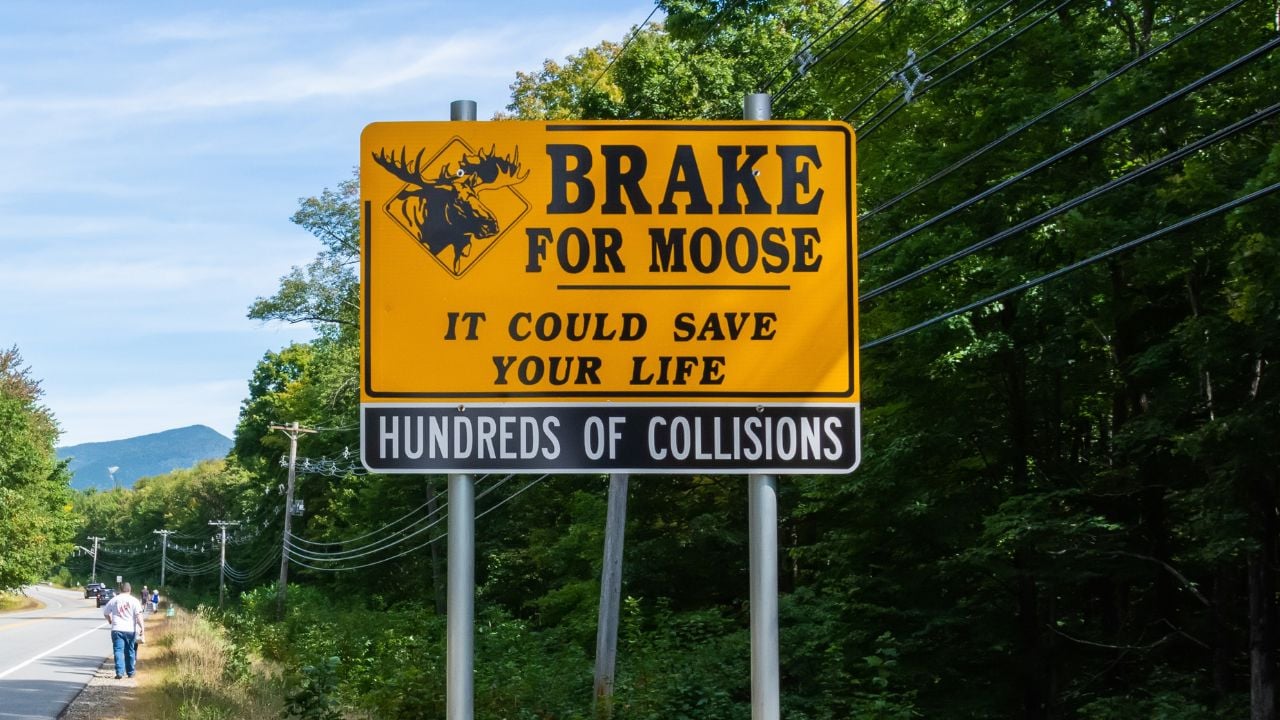
8 Things Granite Staters Know About Moose That Out-of-Staters Don’t

A moose’s eyes won’t always shine back in your headlights because its head sits too high for the beams to reach.
You learn things like that from sharing New Hampshire’s roads with moose.
Here’s what Granite Staters know about moose that out-of-staters don’t.
1. Winter Ticks
Fish and Game says winter ticks cause deaths among young moose when an animal has 30,000 or more of them.
A University of New Hampshire study followed 179 radio-marked moose calves in New Hampshire and Maine from 2014 to 2016.
Winter ticks were the primary cause of a 70 percent death rate among those calves.
The calves averaged 47,371 winter ticks each.
Ticks on that scale cause emaciation and severe metabolic imbalance from blood loss.
If you’re in the woods in fall, winter ticks are climbing vegetation to find a host.
Winter ticks rarely bite and feed on humans.
2. Road Salt
Fish and Game says moose venture onto roadways to eat the salt residue left from winter surface treatments.
In the five years leading up to May 2026, the state averaged 64 moose-vehicle collisions a year.
May through October are high-risk months for those collisions.
They happen statewide on all types of roads.
Many of those collisions occur at dusk and at night.
Drive so you can stop within the zone of your headlights.
3. Eye Shine
Moose stand about 6 feet tall at the shoulder.
Moose eyes do reflect light, but your headlights won’t reach that high.
Moose don’t always look at an approaching vehicle.
Many Granite Staters know to scan the roadside instead of waiting for glowing eyes, and some out-of-staters expect the glow.
Driving Where Moose Cross
Moose are hard to see at night because headlights often reveal only their legs, which are the same color as the pavement.
A moose’s height also means that in a crash, the bulk of the animal falls on the windshield and roof.
Moose won’t necessarily stop when they see you coming.
Fish and Game says to try not to drive faster than 55 mph.
Speed and the severity of an accident are strongly correlated.
Use high beams whenever possible.
If a moose is near the road, stop the car if necessary and wait.
4. Population Slide
Moose were close to gone from New Hampshire in the mid-1800s, when fewer than 15 existed.
Then came the rebound.
The population peaked in the late 1990s at 7,000 to 8,000 animals.
By May 2026, the state’s estimate had dropped to about 3,000.
If you’re picturing the herd of the 1990s, you’re picturing more than twice as many moose.
5. Brainworm
Moose face a parasite called brainworm that barely bothers white-tailed deer.
A deer you see in the woods may be carrying it.
Infected moose develop neurologic impairment and die.
Fish and Game says high deer density can mean more brainworm infection and more moose deaths.
That density may keep the moose population low.
6. Permit Lottery
The state’s 2026 moose hunt came down to 33 permits and 5,914 applicants.
The overall odds were 1 in 109 for residents and 1 in 495 for nonresidents.
Still, out-of-staters won permits too, from Connecticut, Georgia, Rhode Island, Virginia, Washington and Wyoming.
You don’t have to live in the state to enter.
The entry fee is $15 for residents and $25 for nonresidents.
A bonus point system improves your chances for each consecutive year you enter and aren’t selected.
In 2025, residents with a total of 22 points had a 1 in 36 chance of being drawn, compared with 1 in 110 overall.
7. Shrinking Hunt
New Hampshire has held an annual moose hunt since 1988, when the state issued 75 permits for a three-day hunt in the North Country.
That’s down to 33 permits for 2026, the same number as in 2025.
The 2026 season was set at nine days, October 17 to 25.
In 2025, lottery-selected hunters harvested 23 moose.
If you win a permit, you can hunt with a subpermittee and a guide.
8. November Antlers
Moose breeding season, called the rut, runs from mid-September through mid-October.
Bulls start dropping their antlers in November.
If you spot a young bull in winter, he may still have his antlers.
Adult bulls’ antlers may weigh up to 40 pounds.
Psst! How much do you know about moose? Take our quiz and see if you can ace it.
Quiz
Moose Country Quiz
Answer nine questions on moose in New Hampshire and across North America. We bet you can’t get them all right. Prove us wrong?
About how many pounds of twigs and leaves does an adult moose eat in a day?
Habitat and Range
Moose occur throughout the state and are most numerous north of the White Mountains.
If you want to find a moose, look near young forest, the regenerating kind that stands 1 to 12 feet tall.
That young growth gives moose abundant vegetation to eat.
Older stands give them cover to rest.
A moose's home range runs from less than one square mile to more than 25, depending on the season.
Moose are often seen near water, and they swim well enough to dive.
How Biologists Count
If you wonder how the state keeps tabs on its moose, Fish and Game monitors the population every year using sightings by deer hunters.
Aerial infrared thermal imagery put that method to the test.
The test validated deer hunter sighting rates as an accurate way to measure change.
Work in Vermont found that the sighting rate tends to underestimate moose density.
9 Signs Someone Was Raised in New Hampshire No Matter Where They Live Now
One New Hampshire quirk sets the state apart from the rest of the country.
Grow up with it, and the habits it builds follow you to a new state.
9 Signs Someone Was Raised in New Hampshire No Matter Where They Live Now
6 Town Meeting Habits That Give Away a Lifelong New Hampshirite
At a town meeting, a lifelong resident can stand out without saying a word.
The giveaway is how they handle the room.
6 Town Meeting Habits That Give Away a Lifelong New Hampshirite
