
8 Things Nebraskans Know About Wind That Nobody Believes Until They Move There

Nebraskans don’t just talk about the weather.
They talk about the wind.
Newcomers may laugh at first, until they’ve chased their trash can down the block.
Here’s what locals know about Nebraska wind that’s hard to believe until you live there.
1. Wind-Built Ground
Wind laid down much of the ground under your feet.
The U.S. Geological Survey says more than three-quarters of Nebraska is covered by sediment, mostly wind-blown sand and silt.
Many people expect soil to stay where it started.
Nebraska’s Sandhills cover 19,300 square miles of the north-central part of the state.
According to the University of Nebraska–Lincoln, they form the largest stabilized dune field in the Western Hemisphere.
Wind drove the sand into those dunes.
If you drive through the Sandhills, you may see sand bluestem and Indian grass covering the dunes.
2. April’s Peak
In western Nebraska, the National Weather Service in North Platte says spring typically has the greatest wind speeds.
April is the windiest month on average.
If you move to western Nebraska in spring, you’ll arrive when the wind is usually strongest.
North Platte’s National Weather Service office issued five High Wind Warnings in April 2022, which it calls the most in recent history.
The peak gust in North Platte during the April 22 to 24 event was 71 mph.
Multiple fires started across western and north central Nebraska during that event.
What a High Wind Warning Takes
A High Wind Warning means sustained winds above 40 mph, or gusts of 58 mph without thunderstorms, according to the National Weather Service in North Platte.
A thunderstorm with winds of at least 58 mph counts as severe.
3. Plains Versus River Valleys
The open, flat Plains of central and eastern Nebraska have the highest wind speeds in the state, according to wind maps published by the Nebraska Energy Office in 2005.
If you live there, the maps predict average speeds of 7.5 to 8.0 meters a second in most places, modeled 50 meters above the ground.
That’s roughly 17 to 18 mph, at a height of about 164 feet.
If you live along the Platte, Elkhorn, Republican or Missouri River, the state’s weakest wind comes at annual averages of 6.0 to 7.0 meters a second at that height.
4. Thunderstorm Damage
One line of thunderstorms pushed wind to 92 mph near Denton in Lancaster County on July 31, 2024, according to the National Weather Service in Omaha.
Another gust of 90 mph came east-northeast of Omaha in Douglas County.
If you live in Lancaster or Douglas County, both gusts came in your county.
Both went well past the line for a severe thunderstorm.
Winds blew the roof off a commercial building in Waterloo.
That line of storms left damage across about 230 miles.
Psst! How much do you know about Nebraska’s wind and weather? Take our quiz and see if you can ace it.
Quiz
Nebraska Wind IQ
Answer these questions on Nebraska’s wind, from dunes to blizzards. We bet you can’t get them all right. Prove us wrong?
The biggest dunes in the Sandhills can reach up to about how many feet high?
5. Blizzard Gusts
A Blizzard Warning for your area calls for sustained winds or frequent gusts of 35 mph or greater, plus considerable falling and/or blowing snow.
Many Nebraskans judge a storm by its wind more than its snow.
Snowfall in the January 22, 2018 blizzard ranged from 10 to 18 inches in northeast Nebraska to as little as an inch in parts of southeast Nebraska.
Gusts reached 60 mph at Norfolk Airport and 58 mph at Lincoln Airport that day, according to the National Weather Service in Omaha.
Numerous roads were eventually closed in northeast Nebraska.
6. Shelterbelts
Wind-driven dust storms picked up large quantities of topsoil during Nebraska's droughts of the late 1920s and 1930s, according to History Nebraska.
One answer was a federal tree-planting program, which put over 4,000 miles of windbreaks across Nebraska in eight years.
Nebraska had 500 more miles of shelterbelts than any other state in the Prairie State Forestry Project.
The Nebraska Forest Service says a windbreak of 30-foot trees measurably lowers wind speeds up to 900 feet downwind.
If you spot a long row of trees beside a field, you may be looking at a windbreak.
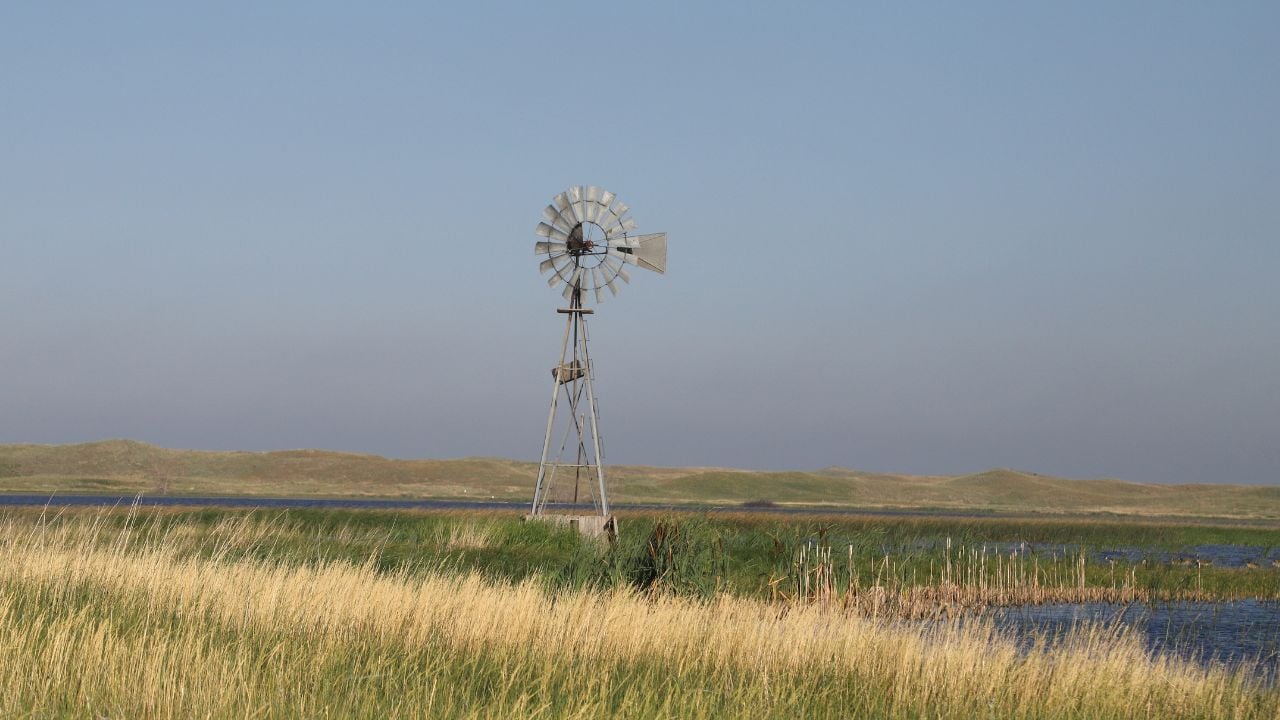
7. Pioneer Windmills
Windmills were in common use in Nebraska by the 1870s, according to Nebraska Studies.
Windmills often dwarfed the houses.
If you had a well with a windmill attached, you could supply water to people and animals in whatever quantity was needed.
Windmills of the era had names like The Dandy, Everlasting, Favorite and Aquarius the Water Bearer.
8. Wind-Generated Electricity
Among Nebraska's sources of electricity in 2024, wind ranked second at 31.94 percent of generation, state data show.
If you read the state's table, coal comes first at 43.92 percent.
Nuclear power is third, at 16.37 percent.
Farm Wind Chargers
Wind also powered the lights on at least one Nebraska farm, according to a 1945 photo record from the Cheyenne County Historical Society and Museum.
The photo shows a two-bladed windmill towering over the white, two-story farmhouse of George and Mabel Jung, with a second, smaller windmill nearby.
The wind charger generated 32 volts of electricity for lights.
Extra power was stored in glass batteries in the attic of the house.
If you had lived on that farm, your lights would have run on 32-volt power from the wind charger.
Notes with the photo say electric power lines didn't reach farms in that area's outlying precincts until 1945 to 1947 or later.
Ainsworth and Thunderhead
The 36-turbine wind facility near Ainsworth began commercial operation on October 1, 2005.
Each turbine has a maximum capacity of 1,650 kilowatts, for a total of 59.4 megawatts.
Its average annual output could power 19,000 homes.
Thunderhead Wind has 108 turbines with a combined 300 megawatts in Antelope, Holt, and Wheeler Counties.
The facility became commercially operational in 2022, and its average annual output could equal the electricity used by approximately 115,000 Nebraska residences in a year.
5 Nebraska Runza Rules Nebraskans Enforce Without Saying So

Runza comes with a set of unwritten rules.
They cover what to call it, what the name means and where it fits on game day.
