
8 Things Wyoming Ranchers Wish Weekend Visitors Understood

The USDA counted about 1.16 million head of cattle in Wyoming as of January 1, nearly double the number of people in the state.
That ratio isn’t trivia.
It’s the reason a set of ranch-country habits still catches weekend visitors off guard, and why getting one wrong can carry a fine.
These are the things Wyoming ranchers wish weekend visitors understood.
Note: This is general information, not legal advice. Property, trespass, and livestock laws vary by county and are subject to change.
1. Livestock on the Road, No Fluke
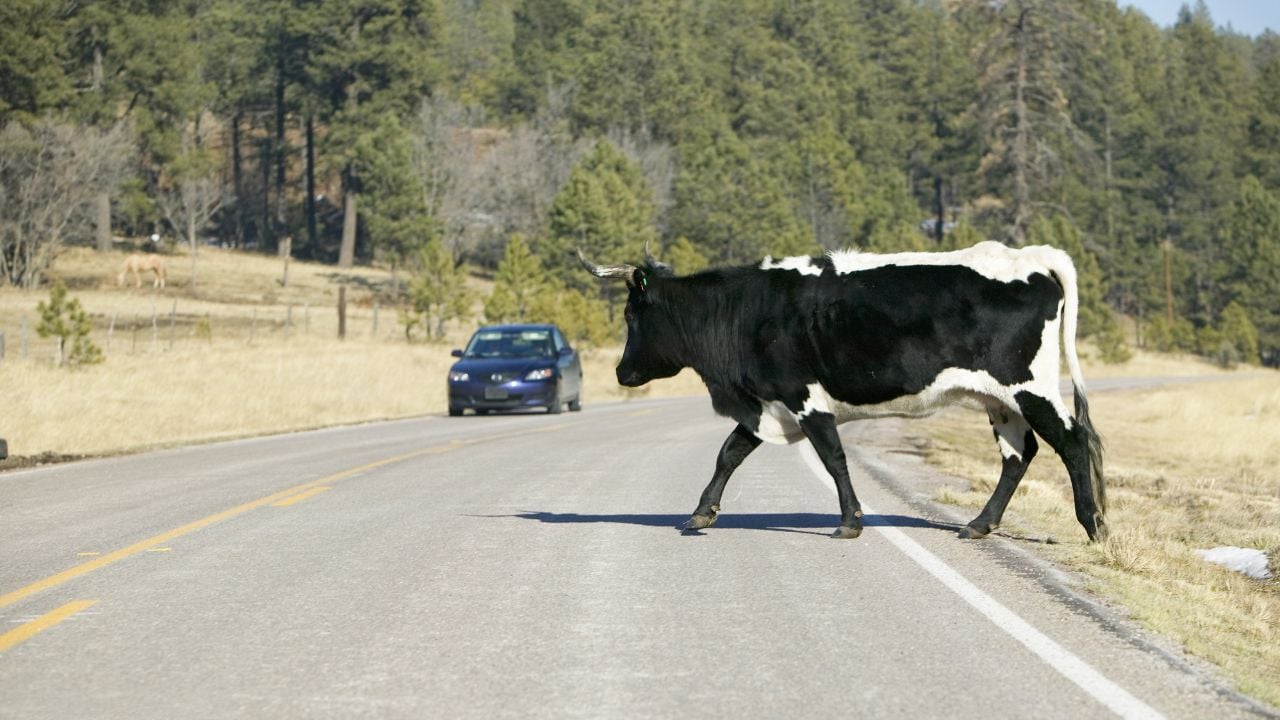
Wyoming ranchers already know what surprises many weekend visitors: A cow standing in the middle of a state highway usually isn’t a mistake.
Wyoming is a fence-out state for cattle and bison.
That means state law puts the job of avoiding the animals on the driver, not on the rancher who owns them.
That surprises almost every out-of-stater.
Not Every Wyoming Road Follows the Same Rule
Wyoming’s open range rule isn’t universal.
Counties can form a herd district when at least 75% of the landowners, together holding at least 75% of the district’s land, petition for one.
Inside that district, the rule flips.
The livestock owner answers for any animal that gets loose, no matter whose fence failed.
2. Highway Cattle Drives, Not a Delay
For Wyoming ranchers, fall means trailing thousands of cattle across public highways the same way their families always have.
The Hoback Basin roundup near Jackson has moved cattle down from the mountains this way for about 90 years.
Highway signs flash “Cows on Road” during the drive, and a truck with its lights flashing follows the herd to warn traffic.
Not everyone slows down.
Two Wyoming ranch dogs have been killed by drivers who wouldn’t ease off during livestock drives on public roads.
That pushed ranchers to launch a petition called Flo’s Law in January 2026, asking for a 25 mph limit and a $3,000 fine near active drives.
A good cow dog can do the work of several cowboys.
A rancher can’t just replace one at the nearest store.
3. Keeping Gates Closed
A single gate left open can unravel a Wyoming rancher’s whole afternoon.
State law backs that up.
Leaving open a gate or fence bars that cross a private road, stream, or ditch is a misdemeanor in Wyoming, carrying a fine up to $750.
A rancher who loses an afternoon rounding up cattle that wandered through a gate a hiker left open doesn’t see it as a small slip.
It’s hours of work, undone.
4. The Legal Risk of Off-Leash Dogs
Wyoming ranchers worry about a loose dog near the herd more than almost anything else on a cattle-country road.
State law allows a livestock owner to kill a dog caught actively chasing or injuring their animals.
The owner who kills it isn’t liable to the dog’s owner when the dog’s vicious behavior, or the actual damage or danger it posed, can be shown.
That’s not an idle threat.
It’s the actual law behind why ranchers take a loose dog seriously.
A spooked, running herd can trample calves, snap fences, and end up right back on the highway.
Psst! How much do you know about ranch life in Wyoming? Tap each card below and see how many you get right.
5. Guardian Dogs on the Clock
A Wyoming ranch’s guardian dogs, breeds like Great Pyrenees and Akbash, live out on the range with the herd on purpose, sometimes for weeks at a stretch.
Sweetwater County’s sheriff’s office has had to remind the public to stop removing the dogs from Bureau of Land Management (BLM) land and national forest land.
Well-meaning visitors mistake them for strays and load them into a truck, which leaves the flock undefended and can undo months of training.
Leave them working.
6. Where Corner-Crossing Rules Stop
Wyoming ranchers on the state’s checkerboarded rangeland draw a hard line between a legal corner crossing and a hand on their fence.
It’s the boundary they wish every visitor already knew.
The checkerboard pattern dates to 19th-century railroad land grants that left alternating square-mile sections of public and private ground across the West.
That pattern locks an estimated 2.44 million acres of Wyoming’s public land behind private corners with no direct road or trail in.
A federal appeals court ruled in 2024 that stepping corner to corner between two public sections, without ever touching private ground, isn’t trespassing.
The U.S. Supreme Court left that ruling in place in October 2025, declining to hear a Wyoming ranch owner’s appeal.
State lawmakers failed to update the law to match the federal court’s decision during the 2026 legislative session.
Ranching groups pushed hard to make sure any new law kept corner-crossers off the fence itself, not just off the ground.
A hand on the wire is exactly what that line rules out.
Not even for balance.
7. Slow-Moving Farm Equipment on the Highway
On Wyoming’s rural highways, ranchers move tractors, hay balers, and stock trailers down the same roads everyone else drives.
State law requires slow farm equipment to carry a bright orange slow-moving-vehicle emblem because it’s allowed to share the road at low speed.
The rancher isn’t stalling.
A stock trailer loaded with cattle can’t safely speed up for a passing lane, so the wait for a straightaway is the price of sharing rural highways.
8. Tracing a Wandering Calf to an Owner
Every animal on a Wyoming ranch traces back to one owner through a registered brand, even a calf that’s wandered a mile from the nearest fence.
That system exists because Wyoming still requires brand inspection any time livestock changes hands or crosses a county line.
There are no exceptions.
Find a calf alone along a back road, and state law has an actual next step.
Report it to a Wyoming Livestock Board brand inspector, not a rescue mission.
A brand does more than prove ownership on paper.
It’s often the fastest way a stray calf gets back to its actual owner before a predator, a summer highway, or the cold finds it first.
The Longest-Running Cattle Drive in America
About 1.16 million cattle share Wyoming’s roads and rangeland with a human population that sits under 589,000, nearly double the state’s people.
That scale is easiest to see in the Upper Green River Valley, where ranchers still run what the news program 60 Minutes called the longest-running cattle drive left in America.
The Green River Drift covers about 70 miles and moves more than 7,000 cattle onto national forest land each spring.
That has been the practice since the hard winter of 1889.
Eleven ranching families keep the drift going today, down from more than 20 in the early 1990s.
The miles haven’t shrunk.
They pay the U.S. Forest Service about $1.35 a month for every cow-calf pair grazing 127,000 acres of national forest.
That fee hasn’t kept pace with cattle prices.
The Green River Drift holds a spot on the National Register of Historic Places.
11 Things Wyomingites Do While Grocery Shopping That Drive Everyone Else Nuts

Grocery runs in Wyoming should be simple: Grab a cart, load up the week’s meals, and head to checkout.
Instead, a few habits turn the aisles into a kind of obstacle course for everyone else in line.
11 Things Wyomingites Do While Grocery Shopping That Drive Everyone Else Nuts
14 Skills Wyoming Teens Had Before Smartphones Took Over

Teens used to need more than a fully charged phone to get through a normal week.
They fixed things, cooked full meals, and found their way around town without a single map app open.
