
8 Upstate New York Towns Even New Yorkers Forget Exist

A waterfall in New York’s Finger Lakes region drops 215 feet, over 30 feet taller than Niagara Falls.
Many New Yorkers have never heard of it.
These are the upstate towns that New Yorkers, from the city and country alike, forget or never knew existed.
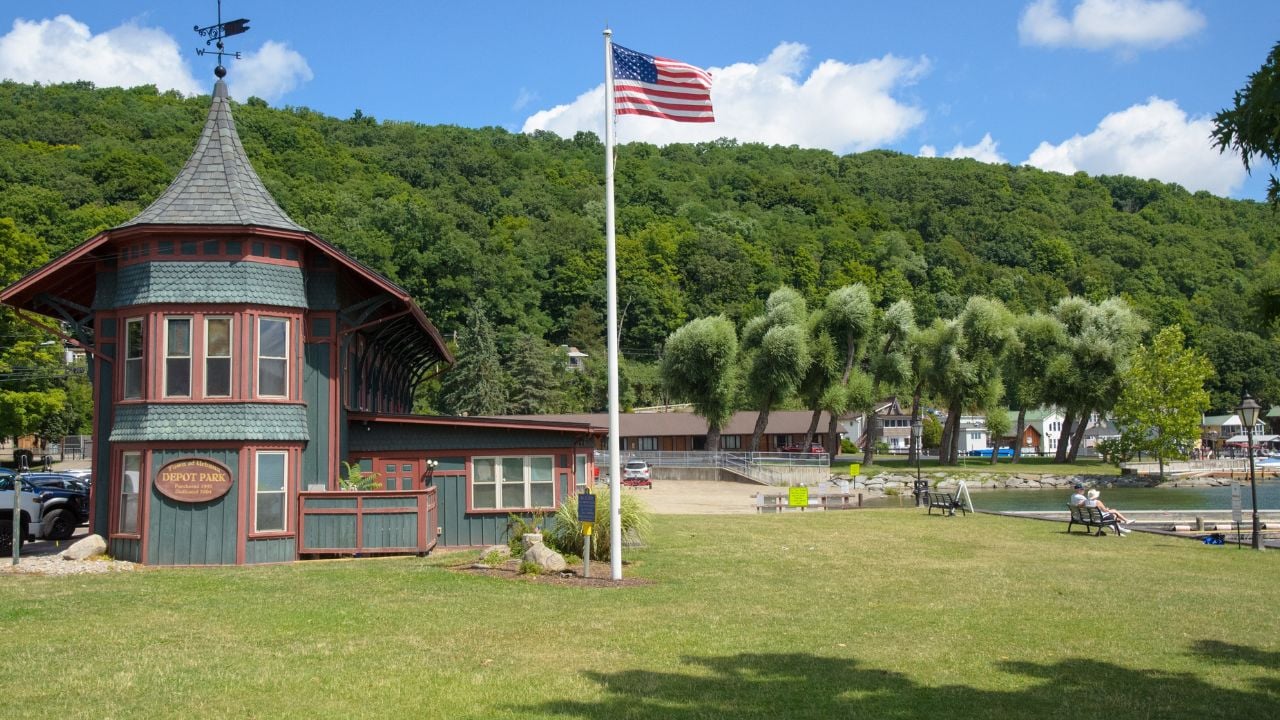
Hammondsport
Hammondsport is easy to miss if you don’t already know to look for it, tucked into the southern tip of Keuka Lake in Steuben County wine country.
The village traces back to 1792, when settlers first cleared land at the lake’s edge.
Its year-round population runs to just 583 people.
That’s barely a blip.
Hammondsport also happens to be the birthplace of Glenn Curtiss, the early aviation pioneer the U.S. Navy came to call the father of naval aviation.
Curtiss tested early flying machines over the fields and the lake around Hammondsport, years before many Americans had ever seen a plane leave the ground.
Sharon Springs
Sharon Springs held nearly 10,000 visitors a summer at its Gilded Age peak, a season many people living in New York today have never heard mentioned.
Wealthy travelers came for the sulfur springs, believed back then to cure everything from rheumatism to bad skin.
Grand hotels started going up around Main Street between 1836 and 1860, and by the height of the spa era in the early 1900s, more than 60 hotels and boarding houses lined its streets.
Then the New York State Thruway opened its Utica-to-Newburgh stretch in 1954, and traffic on old Route 20 dried up.
The visitors stopped coming.
A slow revival followed once historians got the old spa district onto the National Register of Historic Places in 1994.
How Big Sharon Springs Used to Be
Sharon Springs shows how far an upstate New York town can fall from its peak crowd.
The village pulled in as many as 10,000 visitors a summer during its Gilded Age heyday, a crowd that once included members of the Vanderbilt family.
Today, Sharon Springs counts fewer than 500 year-round residents, a sliver of the visitors it once hosted every summer.
Piseco
Piseco sits inside Hamilton County, the least populated county in New York.
The whole county holds about 5,100 people, spread across land close to the size of Delaware.
Piseco itself is smaller still, a lakeside hamlet inside the town of Arietta, where the population came to just 292 residents in the last census.
The name comes from an Indigenous man named Pezeeko, who lived along the western shore of the lake when a surveyor mapped the area in the early 1800s.
The name outlived him.
A fire tower once stood watch on nearby T Lake Mountain, scanning the Adirondacks for smoke from 1916 until 1970.
Chittenango
Chittenango is a village of about 4,900 people in Madison County, small enough that many downstate New Yorkers have never had a reason to say its name out loud.
It happens to be the birthplace of L. Frank Baum, the author who wrote The Wonderful Wizard of Oz after growing up nearby.
Baum was born there on May 15, 1856.
Village leaders lean into it.
A yellow brick sidewalk has run down both sides of Genesee Street since 1982, a nod to Baum’s story.
The original bricks didn’t last.
Workers pulled them out during a 2007 downtown revitalization and repaved the walk in stamped, colored concrete instead, so today’s yellow brick road isn’t brick.
An annual festival called Oz-Stravaganza celebrates Baum’s legacy every June, drawing visitors from across the country.
Many of them never notice the switch.
Boonville
Boonville sits where the Tug Hill Plateau meets the edge of the Adirondacks, a village many New Yorkers south of Utica have never had a reason to pass through.
About 2,000 people live in the village today.
Boonville’s winters explain part of why it stays off many people’s radar.
The village recorded 346 inches of snow in 1976 alone, more than many parts of the country see in a decade.
Boonville just deals with it.
Snowmobile racing on Boonville’s frozen oval turned it into a regional draw during the 1960s and ’70s, pulling in crowds as large as 40,000 people.
The races stopped by the late 1970s.
A new group revived the racing in 2007 as the Boonville Snow Festival II, and it still runs every winter today.
It’s just smaller now.
Andes
Andes is a Catskills hamlet in Delaware County that many New Yorkers, even Catskills regulars, drive past without noticing the turnoff.
Its population peaked around 3,000 in 1860 and has since fallen to just over 1,100 residents.
A tenant uprising known as the Anti-Rent War turned deadly just outside Andes in August 1845, when a crowd surrounded an undersheriff sent to seize a farmer’s livestock over unpaid rent and opened fire.
He’d bragged at the local tavern that morning that “lead cannot penetrate Steele,” his own last name.
He was wrong.
The undersheriff died later that day, and the fallout helped push New York to abolish its old rent system within a few years.
Deposit
Deposit straddles the Delaware and Broome county line, a village whose own name many New Yorkers assume is a typo rather than an actual place.
It isn’t.
Loggers gave Deposit its name in the late 1700s.
They stacked cut timber on the riverbank each fall, waiting for spring floods to lash it into rafts up to 200 feet long and float it down to Philadelphia.
The first settler, John Hulce, arrived in 1789.
By 1811, the village had just 12 houses when it incorporated.
Today, Deposit holds under 1,500 people, still small enough that many people in the state have never driven through it on purpose.
Trumansburg
Trumansburg lies close enough to Ithaca that many New Yorkers lump it in as a neighborhood of the college town rather than its own village.
Around 1,750 people call it home.
The village takes its name from Abner Treman, a Revolutionary War veteran who settled the land in 1793 after receiving it for his service.
A postmaster later misspelled the family name on an official filing.
Nobody ever fixed it, so Trumansburg is what stuck.
Nobody minded.
Just outside the village limits, Taughannock Falls drops 215 feet, more than 30 feet taller than Niagara Falls.
Many visitors who make the drive couldn’t say which village sits next to it.
Taughannock Creek once powered a gristmill and a small gun factory in the early 1800s, long before anyone built a trail along the gorge for sightseers.
Steamboats and Victorian-era hotels later carried tourists up Cayuga Lake to see the falls, decades before New York state ever took over the land as a park.
Psst! How much do you know about upstate New York’s history? Take our quiz and see how many you can get right.
Quiz
Upstate New York History IQ
Answer these questions on forts, founders, and firsts across upstate New York. We bet you can’t get them all right. Prove us wrong?
The Battles of Saratoga, widely considered the turning point of the Revolutionary War, were fought in what year?
9 Things Downstate New Yorkers Say About Upstate That Locals Are Sick Of
A family from Long Island checks into a bed-and-breakfast near Cornell University and asks how far away the nearest college town sits.
Cornell has anchored Ithaca since 1865, and comments like that one drive upstate locals up the wall.
9 Things Downstate New Yorkers Say About Upstate That Locals Are Sick Of
8 Unwritten New York City Bagel Shop Rules Tourists Break Every Day

A visitor walks into a Manhattan bagel counter and stands in line behind six people, four of them holding little paper tickets she never grabbed.
The next three customers through the door order ahead of her, and nobody explains why.
8 Unwritten New York City Bagel Shop Rules Tourists Break Every Day
