
8 Water Restriction Rules California Homeowners Break Without Realizing It

California requires a homeowner’s greywater system to soak fully into their yard.
There’s no grace period. Letting water from your sink or washing machine pool on the surface or run toward the street counts as illegal runoff immediately.
These are the California water restriction rules homeowners break without realizing it.
Note: This is general information, not legal advice. Water-use rules, watering schedules, and penalties vary by city and water agency and are subject to change. Several of the rules below (driveway hosing, fountains, irrigation runoff, and watering after rain) trace back to a statewide emergency regulation that expired in December 2023; they remain in effect today only where individual water agencies and districts, like Contra Costa Water District, have adopted them as local rules.
1. Hosing off a Driveway
A driveway, sidewalk, or patio hosed clean with drinking water breaks California’s rules in nearly every city and water district in the state.
Contra Costa Water District spells out the rule on hardscape washing: Hosing down a driveway, sidewalk, parking area, or patio is banned unless skipping it would create a health or safety hazard.
Grass clippings, dirt, and cut leaves don’t clear that bar.
None of that matters.
A homeowner blasting cut grass off the driveway after mowing, or rinsing mud off a patio before company arrives, breaks this rule every time and rarely knows it.
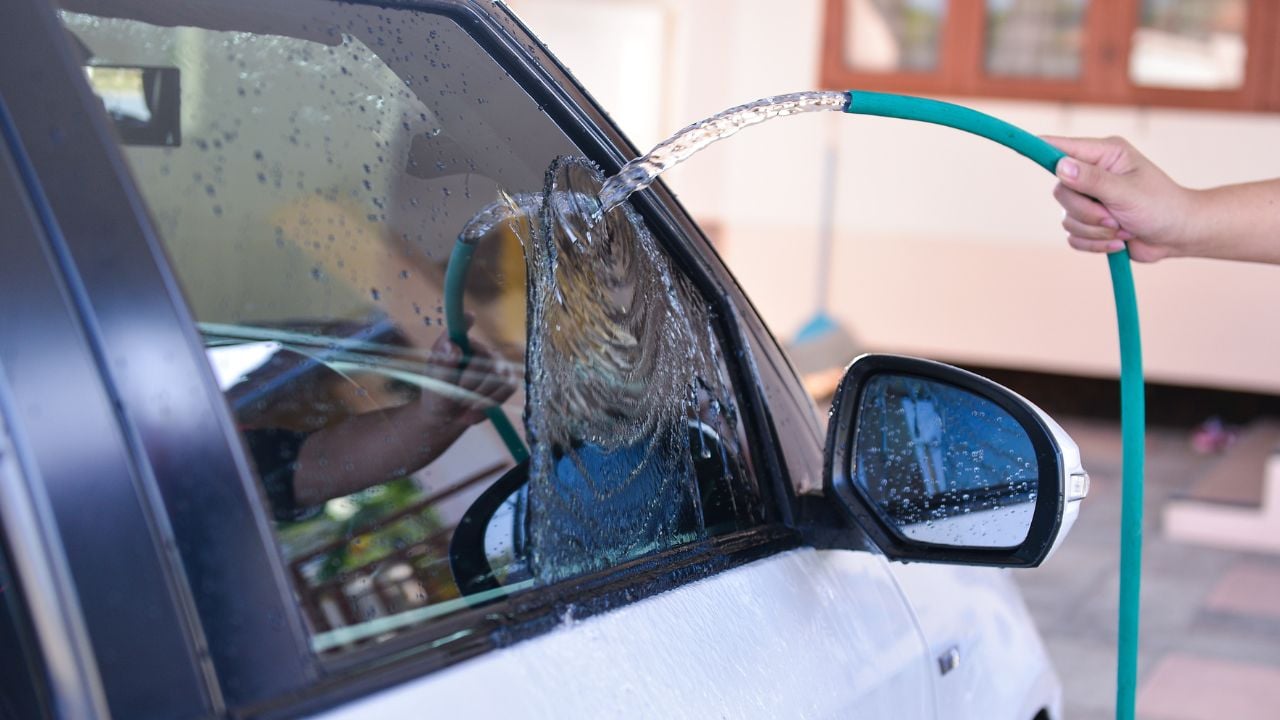
2. Washing the Car With the Wrong Hose
California’s rule for washing a car at home is simple: Any hose used has to carry a shut-off nozzle, the kind that stops water the instant you let go of the handle.
A hose without a shut-off nozzle is illegal to use on a vehicle, even for two minutes, in a homeowner’s own driveway, and the rule carries no exceptions for a quick rinse.
Many hoses sold today already come with a shut-off nozzle attached.
A hose that’s been hanging in the garage for a decade usually doesn’t.
Swap the nozzle, and the same Saturday car wash goes from a violation to a routine chore.
3. Running a Fountain on Tap Water
A backyard fountain running fresh tap water instead of recirculating it counts as wasted water under California’s rules, no different from water flowing straight down a drain.
An ornamental fountain plumbed straight to a garden hose or a home’s water line, with no pump cycling the same water around, breaks the rule every time someone tops it off.
A recirculating pump fixes it.
A pretty fountain running fresh tap water through it and out into the yard doesn’t.
Many older courtyard fountains and garden features were installed years before this rule took hold, and their owners have never heard that the water running through them counts as a violation.
4. Letting Sprinklers Run off the Yard
Irrigation water that spills past the yard it’s supposed to soak, onto a sidewalk, a street, or a neighbor’s lawn, breaks California’s runoff ban.
A sprinkler head aimed a few degrees wide, a cracked drip line, or a zone that runs longer than the soil can absorb all count as runoff.
The rule allows a small, unintentional trickle without penalty.
Anything beyond that doesn’t.
A puddle collecting at the curb every time the sprinklers kick on is the kind of everyday sight that’s a cited violation waiting to happen.
5. Watering Right After It Rains
Irrigating a lawn during a rainstorm and for 48 hours after it, once at least a quarter inch of rain falls, breaks the water-waste rule set out in California’s 2022 statewide water-waste regulation — a rule that has technically expired at the state level, but that many local water agencies still enforce on their own.
Many sprinkler timers don’t know it rained.
They run on a schedule set weeks earlier and switch on right through a storm unless someone pauses them by hand.
Under the state regulation this rule came from, enforcement could mean warning letters, conservation orders, and fines as high as $500 a day; today, the penalty for breaking it depends on whichever local water agency is enforcing it.
The lawn is soaked.
The sprinklers run anyway.
That’s the violation, and a timer left on autopilot is one of the easiest ways California homeowners land in it without touching a single dial.
6. Watering on the Wrong Day
Local water agencies across California set their own watering schedules instead of following one statewide calendar.
Los Angeles, served by the Los Angeles Department of Water and Power (LADWP), currently limits outdoor sprinklers under its own watering ordinance to three set days a week based on whether a street address ends in an odd or even number, with all outdoor watering banned between 9 a.m. and 4 p.m.
Miss your assigned day, and the first violation is only a written warning.
It isn’t a fine yet.
Miss it again, and LADWP starts fining, $100 for a second violation on a standard meter, climbing as high as $600 by the fourth violation on a larger meter.
A homeowner who just moved, or who assumes the whole neighborhood follows one universal schedule, is among the most likely to run sprinklers on the wrong afternoon.
There’s No Single Statewide Watering Schedule
California’s permanent bans on driveway-washing, fountain-topping, and runoff apply everywhere, but the actual watering days and hours are a local call, not a state one.
Some agencies allow two watering days a week instead of three, and the daytime cutoff hour ranges from around 4 p.m. to as late as 8 p.m., depending on the provider.
So, a schedule from a previous address or a friend’s neighborhood doesn’t necessarily carry over.
7. Letting a Leak Sit Too Long
A leaking hose bib, faucet, or pipe left unfixed counts as banned water waste under many California water agencies’ rules, the same category many of them use for hosing a driveway or running a fountain on tap water.
Contra Costa Water District’s own list of permanent water-use prohibitions names failing to repair a leak right alongside driveway-hosing and fountain-topping.
California Water Service, which supplies water to customers in dozens of California communities, enforces that ban by giving customers five business days to repair any leak, break, or water-related malfunction once they’re notified.
Five days.
A slow drip under the kitchen sink, a running toilet, or a hose bib that never fully shuts off can sit ignored for months in many households, counting as banned water waste the entire time even though no one’s watering a lawn or hosing a driveway.
8. Running Greywater Into the Street
Washing-machine water, known as greywater, can run out to a California yard without a permit, but only under strict conditions many people never read.
Under the state’s plumbing code, a laundry-to-landscape system has to deliver that water below at least two inches of soil or mulch, through a labeled three-way valve.
No separate pump.
No connection to the drinking-water line, either.
Spraying it through a sprinkler head breaks the rule, and so does letting it pool on the surface at all, there’s no grace period once it stops soaking in.
So does sending it downhill toward a storm drain, the street, or a neighbor’s yard, which is exactly where a sloped lot tends to carry it.
The Los Angeles Department of Water and Power (LADWP), which enforces the state’s graywater standards within its service area, treats that kind of runoff as a violation under its own graywater FAQ, whether or not the homeowner ever intended it to leave the property.
Homeowners association rules in California add another layer some greywater users never check, since a few HOAs still restrict visible piping or barrels even when the underlying system is perfectly legal under state code.
Psst! How water-wise is your California home? Run through this quick self-check and see where you stand.
10 Things California Residents Can’t Legally Toss in a Household Garbage Bin
Water isn’t the only household habit California regulates without much warning.
Scraping dinner into the kitchen trash can break a state law many homeowners have never heard of, the same way an unmarked hose nozzle can.
10 Things California Residents Can’t Legally Toss in a Household Garbage Bin
8 Things California Retirees Regret Not Doing Before Their Final Paycheck

Water rules aren’t the only California deadlines that sneak up on homeowners.
Retirees leaving a paycheck behind face their own set of dates and decisions, and missing a deadline can cost far more than a watering-schedule fine.
8 Things California Retirees Regret Not Doing Before Their Final Paycheck
