
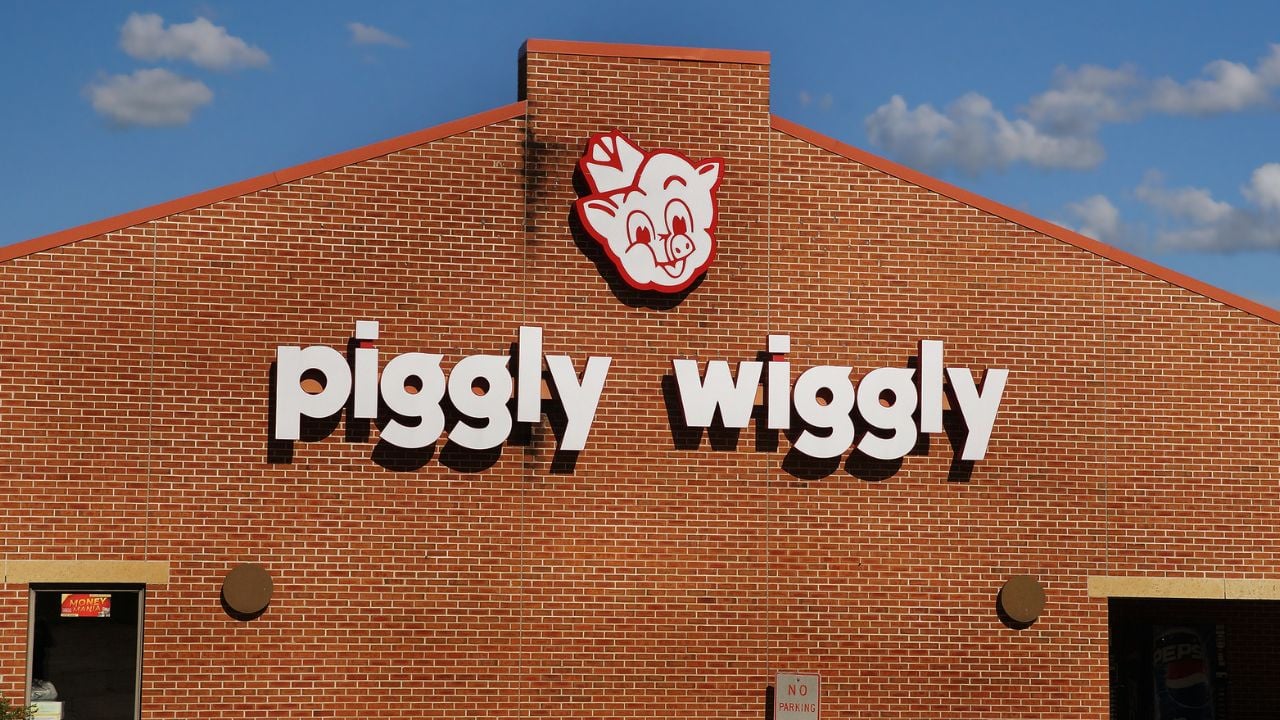
8 Ways One Piggly Wiggly Isn’t the Same as the Next in Alabama

A shuttered Montgomery supermarket reopened in January as Piggly Wiggly Food For Less, running every price off a set rule instead of a weekly sale.
That rule doesn’t travel.
These are the ways one Piggly Wiggly isn’t the same as the next in Alabama.
1. Store Ownership
Piggly Wiggly’s stores don’t answer to one company.
A cooperative called the Piggly Wiggly Alabama Distributing Company supplies many of them, founded by independent grocers in 1959.
More than 250 independently owned stores across six Southeastern states buy through that co-op today.
Some owners run one store.
Kamal Constantine runs fifteen Piggly Wiggly stores out of Mobile.
The family that reopened the Montgomery store runs Piggly Wiggly Food For Less locations spreading into Georgia and Florida too.
So the buggy you push down a Birmingham aisle and the buggy three counties over might share a supplier and nothing else.
Piggly Wiggly’s Three Layers of Ownership
Piggly Wiggly the brand and the Piggly Wiggly on Main Street are two different things.
C&S Wholesale Grocers, a company based in New Hampshire, owns the trademark and licenses it to co-ops like the one supplying Alabama.
It doesn’t run a single Piggly Wiggly store.
The person behind the register in Alabama owns the building, the inventory, and the risk.
2. Pricing Model
Piggly Wiggly Food For Less on Vaughn Road in Montgomery tags every shelf at the store’s wholesale cost, then adds a flat 10 percent at checkout.
There’s no loyalty card to sign up for.
Nobody clips anything.
A few miles away, a different owner still runs the classic model, a weekly flyer, sale prices, and a rewards card that tracks every scan.
Brothers Kevin and Cody McDaniel run that cost-plus store.
They’re opening six more Food For Less locations across Alabama, Georgia, and Florida.
Both stores fly the same sign.
Neither owner had to ask the other for permission.
3. Beer and Wine Availability
Piggly Wiggly can’t sell beer or wine everywhere in the state.
The reason has nothing to do with company policy.
Alabama splits its 67 counties into wet and dry territory, and about 40 counties allow alcohol sales countywide.
The rest stay dry outside a handful of cities that voted themselves wet.
Cullman County is dry.
The city of Cullman inside it isn’t.
So an owner inside the city limits stocks a beer cooler.
An owner running a store in the unincorporated county just outside it legally can’t.
Every owner checks local law before the shelf gets built, not a memo from headquarters.
4. Rewards Program
Piggly Wiggly doesn’t run one loyalty program across Alabama.
Piggly Wiggly West Alabama built a rewards app for digital coupons and weekly deals around Tuscaloosa.
That operation is run by B&W Foods, co-owned by Jay Welborn, with seven stores in Tuscaloosa, Northport, Haleyville, and Phil Campbell.
The Alabama Grocers Association named Welborn its 2026 Retailer of the Year.
Piggly Wiggly Birmingham runs a separate discount newsletter instead, with its coupons and sign-up page.
Drive from one operator’s territory into the other’s.
The points don’t follow.
The two programs don’t talk to each other.
5. Local Vendor Deals
Piggly Wiggly Birmingham struck a deal to carry Conecuh Sausage through the state’s Buy Alabama’s Best program.
The sausage comes from a plant in Evergreen, Alabama.
The partnership ties its sales to fundraising for Children’s of Alabama.
The same Birmingham stores also stock cinnamon rolls from Rolls Bakery, a small local baker sold almost nowhere else.
C&S wasn’t involved.
A Piggly Wiggly owner two towns over never made that same call.
Their meat case runs a different lineup of locally made brands, or none at all.
6. Seafood Counter
Alabama Gulf seafood fills the case at Piggly Wiggly Birmingham, stocked through a direct partnership with the state’s seafood promotion office.
That partner is the Alabama Seafood Marketing Commission, a state agency created in 2011.
The stores post a fresh seafood guide through the year, naming whatever species is running well off the Gulf that season.
That’s one owner’s call.
It isn’t a chain-wide rule.
A Piggly Wiggly further from the coast can run a basic seafood case with none of that sourcing behind it.
Both stores are still Piggly Wiggly.
7. Store Size and Layout
Kamal Constantine’s newest Piggly Wiggly store, opened at University Boulevard and Airport Road in Mobile as of a mid-2024 report, runs 54,000 square feet.
A typical grocery store that size runs 30,000 to 40,000 square feet.
The aisles measure 8 feet across, wide enough for two buggies to pass side by side.
That’s room to breathe.
Constantine leased space inside the store to a candy shop, a florist, and a coffee and smoothie counter, all ringing up through the same registers.
That arrangement is Constantine’s call, not something Piggly Wiggly’s co-op requires of anyone else in Alabama.
Psst! How much do you know about Piggly Wiggly and Alabama grocery history? Take our quiz and see how many you can get right.
Quiz
The Great Piggly Wiggly Quiz
See if you know the wild history behind that pig on the sign.
Where did Clarence Saunders open the very first Piggly Wiggly store, and in what year?
8. Pharmacy Counters
That same Piggly Wiggly in Mobile also opened with a pharmacy counter.
It's the first one Constantine has added across his fifteen stores.
A local pharmacist leases the counter and runs it independently, the same arrangement Constantine used for the candy shop and florist.
Fourteen still don't have one.
One owner, fifteen stores, and they aren't identical to each other.
Constantine says the new pharmacy is already one of the store's stronger tenants.
Which store gets the next pharmacy counter depends on what that neighborhood is asking for, the same read he uses for the candy shop and the florist.
6 Things Alabama Hardware Stores Do That Big Chains Gave Up On
Anders Hardware in Northport is still run by the same family, five generations in, 117 years after it opened as a general store in 1909.
Alabama's independent hardware stores kept doing the small, fiddly jobs long after Lowe's and Home Depot gave up on them.
6 Things Alabama Hardware Stores Do That Big Chains Gave Up On
8 Alabama Town Names With Origins That Surprise Even the People Who Live There
A lot of people hear the name Nauvoo, Alabama, and assume Mormon pioneers built it the way they built the original Nauvoo in Illinois.
That's the wrong guess. The reason traces back to one resident's travels, and it has nothing to do with the Latter-day Saints at all.
8 Alabama Town Names With Origins That Surprise Even the People Who Live There
