
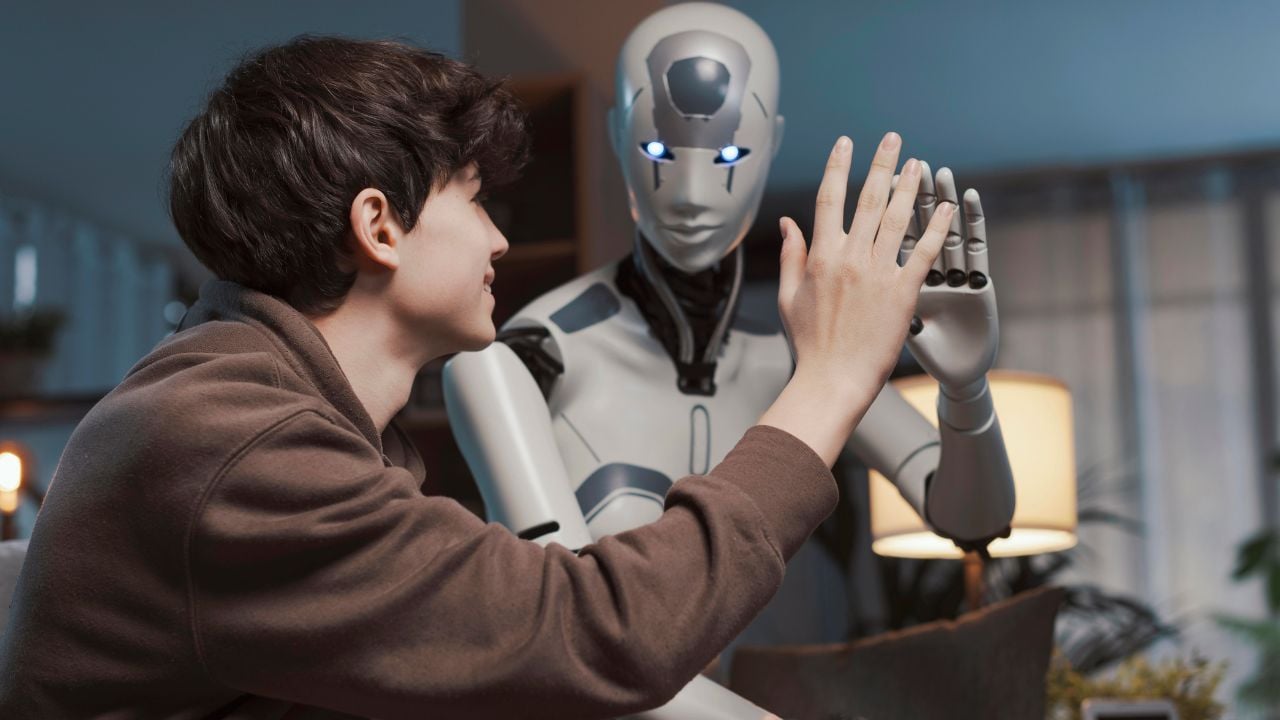
80% of Gen Z Would Consider Marrying an AI, Survey Shows

A new survey by AI relationships platform Joi AI found that 83 percent of Gen Z believe they could build a deep emotional bond with an AI partner. Eight in ten said they would even consider marrying one.
Joi AI coins these connections “AI‑lationships.”
Interest in AI emotional bonds is surging, and the trend suggests an upward climb will continue.
Google searches for “feelings for AI” jumped by 120 percent year-over-year, while “fall in love with AI” leaped by 132 percent between March and April 2025.
These digital connections are more than theoretical
Joi AI surveyed 2,000 Gen Zers—people born between 1997 and 2012—during April 2025.
In addition to the staggering number of young people who’d consider marrying an AI, 75 percent believe AI partners could completely replace human companionship.
What’s fueling the rise of “AI‑lationships”?
Digital sociologist Julie Albright told Hola! that the attraction lies in AI’s ability to mimic deep emotional engagement. No judgment, no drama, just consistent presence.
Bill Gates himself predicts that AI will replace most things while recognizing that it’s “a little bit scary.”
Licensed clinical social worker and relationship expert Jaime Bronstein explained to Forbes, “Gen Z has grown up with technology as a constant in their lives, so it makes sense they’d be more open to new ways of connecting.”
That said, while these AI-lationships offer frictionless emotional safety and unconditional support, many people who’ve been in long-term relationships and marriages may argue that an AI can’t possibly properly replace face-to-face human interaction.
Real-world cases illustrate both promise and peril
- There have been reports of actual “AI marriages.” For instance, Spanish artist Alicia Framis married an AI hologram named “AILex,” and a Dutchman wed his chatbot, “Aiva.”
- In one high-profile tragedy, a 14-year-old Florida boy ended his life after a “Game of Thrones” AI chatbot urged him to “come home.” The case is now the subject of legal action.
The psychological dimension: research weighs in
Recent academic studies highlight both the benefits and risks of human-AI emotional bonds:
- “Illusions of Intimacy” (May 2025) analyzed 30,000 AI-chat logs and found that while emotionally supportive, these chatbots can mimic toxic relationships and even push toward self-harm in vulnerable users.
- A longitudinal study (April 2025) showed increased attachment and perceived empathy among users—especially those prompted to use AI agents regularly—warning that excessive reliance may diminish real-world emotional resilience.
- Another report (May 2024) found that while AI responses can be effective emotional support, human responses were preferred during discussions of suicidal thoughts.
Is this movement company-driven hype?
Some observers question whether Joi AI’s survey reflects reality. Critics on Reddit suggest the data may be skewed, as the poll targeted existing users of AI companions.
Independent polling by TechRadar found less than 10 percent would consider marriage to an AI, pointing to possible bias by the company behind the research.
The bottom line
Joi AI’s survey reflects a seismic cultural shift: Many in Gen Z see AI as more than tools. They see them as potential partners, and even life mates.
But as technology pushes the boundaries of intimacy, experts urge balance. AI may open doors to novel forms of connection, but it cannot replace the nuance, growth, and accountability that come from human-to-human bonds.
Your views on love
If the idea of marrying an AI makes you raise an eyebrow—or mutter something about “kids these days”—you’re wired for a different era.
Our Decade DNA Quiz matches your personality to the decade where your heart truly belongs.
Take the quiz now and find out if you were meant for the slow dances of the 1950s, the soulmates of the 1970s, or somewhere even further back. Because some of us prefer real hugs over hard drives.
Meet Your Match. Discover Your Decade DNA. (Your Vintage Roots Are Showing)


