

9 Harmless Rivalries Ohioans Take Very Seriously

Columbus now outweighs Cleveland by more than two to one in population, according to the Census Bureau’s newest count.
Residents refuse to call that settled.
These are the harmless rivalries Ohioans take very seriously.
1. Skyline Chili vs. Gold Star Chili
Skyline Chili and Gold Star Chili turned one bowl of Cincinnati chili into a decades-long rivalry.
Nicholas Lambrinides, a Greek immigrant, opened the first Skyline in 1949 after learning the trade at Cincinnati’s original Empress Chili.
Sixteen years later, four brothers named Daoud, immigrants from Jordan, bought a burger stand in the Mount Washington neighborhood and turned it into Gold Star.
Nobody switches sides.
Order a three-way anywhere in the city, spaghetti topped with chili and shredded cheese, and the cashier already knows which chain you’d never touch.
Skyline now runs more than 130 restaurants across four states.
Gold Star keeps its map tighter, sticking mostly to Greater Cincinnati and northern Kentucky.
2. Battle of Ohio
The Battle of Ohio is the National Football League’s nickname for Browns versus Bengals, an intrastate rivalry that’s run hot since the two teams first met in 1970.
Cleveland and Cincinnati sit on opposite corners of the state.
Every game turns Columbus into a kind of neutral ground where fans of both teams pack the same sports bars.
Fans take it seriously.
The two teams have played more than 100 times, and the series has stayed close for decades, tight enough that a single game still swings the yearly bragging rights.
3. Cedar Point vs. Kings Island
The rivalry between Cedar Point and Kings Island splits amusement park loyalty right down the middle of the state.
Cedar Point opened on Lake Erie back in 1870 and now markets itself as “America’s Roller Coast,” home to Steel Vengeance and the record-chasing Top Thrill 2.
Kings Island opened near Cincinnati in 1972 and answers with The Beast, which still holds the world record for longest wooden roller coaster on Earth.
Sandusky families drive right past Kings Island’s exit on I-71.
Cincinnati families do the same thing to Cedar Point, four hours in the opposite direction.
Neither side budges.
A 2024 merger folded both parks into the same parent company, Six Flags, but shared ownership hasn’t stopped either park’s fans from arguing over which park is better.
4. Crosstown Shootout
The Crosstown Shootout pits the University of Cincinnati against Xavier University, two basketball programs sharing one city and little patience for each other.
The schools have met on the court since 1928, and the game has carried weight since it became an annual date in the early 1940s.
It got out of hand once.
Both benches cleared in the final seconds of the 2011 game after a round of trash talk, and both schools opened investigations into what happened.
The Hamilton County prosecutor reviewed the brawl and filed no criminal charges.
Old rivalries do that.
The Shootout survived the embarrassment, and Cincinnati families still split their loyalty by which campus a cousin attended.
5. Battle of the Bricks
The Battle of the Bricks has pitted Ohio University against Miami University since 1908, making it the oldest college rivalry in the state.
Athens and Oxford sit less than an hour apart on back roads through farm country, close enough that families end up splitting allegiances at the same Thanksgiving table.
A marketing team reportedly gave the rivalry its “Battle of the Bricks” name sometime in the early 2000s, decades after the games themselves started.
The label now covers every sport the two schools play against each other in a given year.
The nickname stuck.
Old nickname or not, the football teams have met more than 100 times.
Fans in Athens or Oxford still talk about a win all winter.
6. Ohio Cup
The Ohio Cup belongs to whichever Major League Baseball team, the Cincinnati Reds or the Cleveland Guardians, wins more of their meetings in a given season.
The trophy dates back to 1989, when the two teams played an exhibition series in Columbus, close to halfway between their home ballparks.
Interleague play folded the rivalry into the regular season in 1997.
Nobody treats it lightly.
Reds and Guardians families have even turned Ohio Cup weekend into a joint charity fundraiser, proof the rivalry runs friendly even when the games get chippy.
What Happens When the Ohio Cup Ties
A tied Ohio Cup season doesn’t reset anything.
The team already holding the cup simply keeps it until somebody wins it outright.
7. Wagon Wheel
The Wagon Wheel has been the rivalry prize between Kent State and Akron since 1946, and the actual wheel came with a tall tale attached.
A Kent State dean donated the wheel, claiming it once belonged to a horse-drawn carriage that got stuck in the mud near campus in 1870.
Nobody can prove the story.
Kent State and Akron have kept the trophy competition running every year since joining the same conference in 1992.
The competition now stretches across more than a dozen sports beyond football.
A losing season still stings less than losing the wheel.
8. Cleveland vs. Columbus
Cleveland and Columbus residents carry on a rivalry over which city deserves to be called the state’s true center of gravity.
Columbus now sits at 938,396 residents, more than double Cleveland’s 363,608, according to the Census Bureau.
Cleveland used to be the bigger of the two, by a wide margin.
Not anymore.
Columbus grew mostly by annexing land around it, stretching from 89 square miles in 1960 to 220 square miles by 2020.
Cleveland’s borders barely moved at all in that same stretch.
Cleveland natives still point to the skyline, the lake, and a football stadium that fills up every fall.
Columbus residents just point to the map, where their city keeps growing anyway.
Psst! How much do you know about Ohio’s history? Take our quiz and see if you can ace it.
Quiz
Ohio Trivia IQ
Answer these questions on Ohio history, geography, and firsts. We bet you can’t get them all right. Prove us wrong?
How many U.S. presidents were born in Ohio?
9. Cincinnati's West Side vs. East Side
Cincinnati splits into a West Side and an East Side long before anyone gets to the chili rivalry.
Mill Creek and an old canal blocked easy growth to the west back in the 1800s, so streetcar and rail lines pushed development east instead, according to local historians.
The stereotypes stuck.
West Siders get cast as blue-collar and Catholic, East Siders as wealthier and more buttoned-up, even though decades of new residents have blurred both labels.
Parochial high schools keep the divide alive for life, not just childhood.
Someone who graduated from Elder or Seton on the West Side will bring it up decades later, the same way an East Sider mentions Moeller without being asked.
9 Ohio County Fair Rules Visitors Find Out About at the Gate
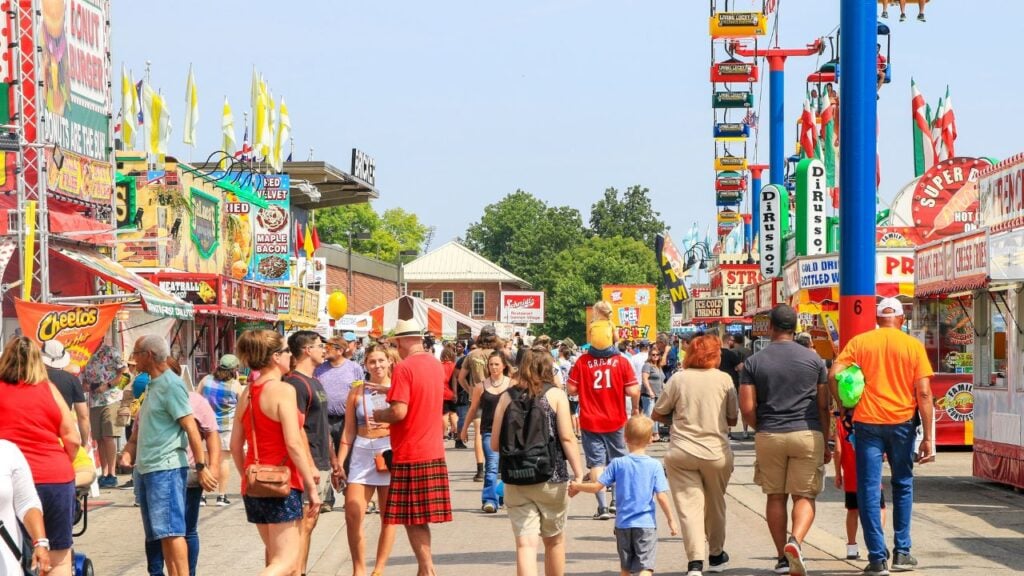
Ohio's county fairs post their rules right at the gate, and many visitors walk past them without reading a word.
Staff can turn away a packed cooler at the first checkpoint, long before anyone reaches the midway.
9 Ohio County Fair Rules Visitors Find Out About at the Gate
8 Things Ohioans Believe About Their Own State That Aren't True

Ohio became a state in 1803, or so every history class claims.
Congress left a piece of that paperwork unfinished for generations, and it's just one of the widely repeated claims about Ohio that turns out to be false.
8 Things Ohioans Believe About Their Own State That Aren't True
