
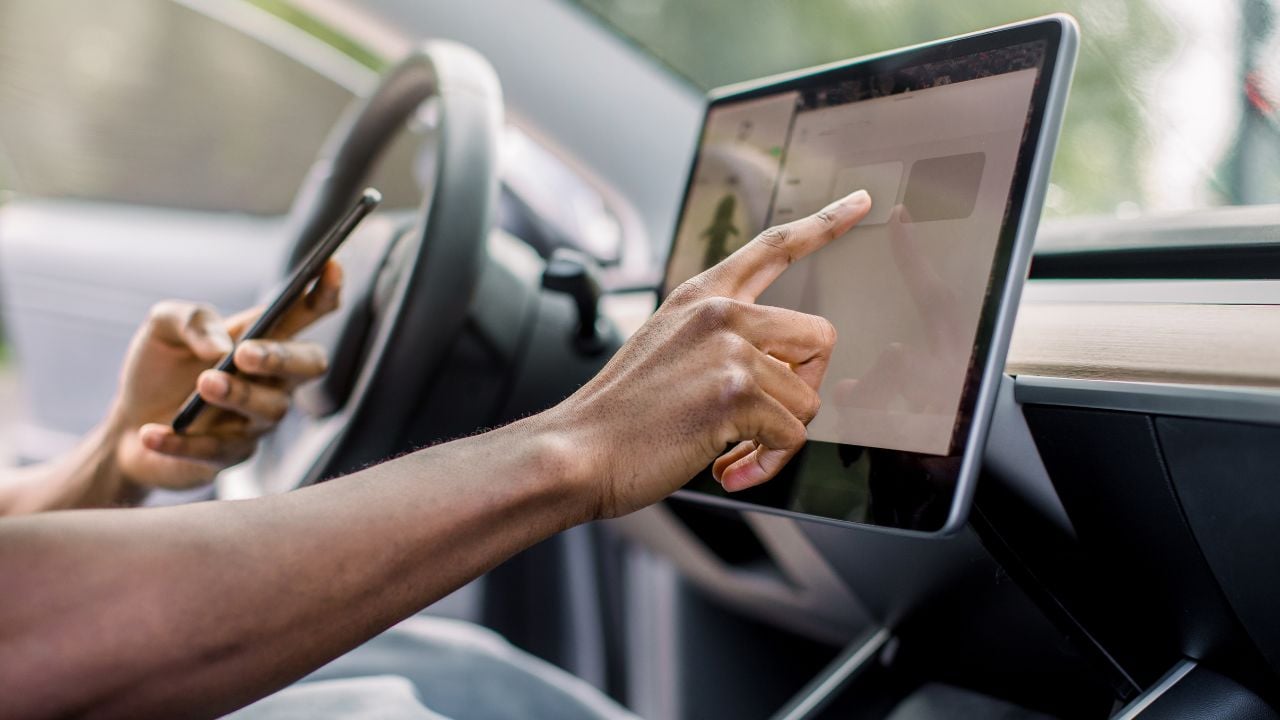
9 New Car Technology Features That Leave Hoosiers Asking Why

A recent AutoPacific survey found that half of car shoppers say today’s vehicles pack in so much screen content that it feels unsafe.
These are the new car technology features that leave Hoosiers, and Americans everywhere, asking “Why?”
1. Front-Passenger Screens
Front-passenger screens have shown up on trucks and SUVs that never used to have them, a feature built solely for whoever’s riding shotgun.
Cadillac’s current Escalade lineup stretches a 55-inch display across the dash, with a dedicated panel just for the passenger seat.
It streams Hulu or YouTube while the driver keeps a separate screen for navigation.
J.D. Power’s research shows how little that screen gets used: 35% of owners with a passenger screen say they’ve never used it, and just 6% use it every drive.
Nobody’s watching.
J.D. Power’s same study puts the screens’ problem rate at 21.3 problems per 100 vehicles, among the highest of any technology it measured and well above the driver-assistance systems built to make driving easier.
2. Hands-Free Highway Systems
GM’s Super Cruise and Ford’s BlueCruise both promise hands-free driving on mapped highways.
Hands-free doesn’t mean eyes-free.
Both systems track the driver’s eyes through a camera on the steering column, ready to intervene the moment attention drifts.
J.D. Power’s 2026 survey found owners rate these more advanced, hands-off systems lower than the plainer, hands-on adaptive cruise control many cars already had.
That holds even though the newer systems draw fewer complaints.
Drivers seem more comfortable with the system that clearly assists them than the one asking them to hand over control.
J.D. Power’s research points to that comfort gap as the reason.
More automation doesn’t guarantee more comfort.
3. Full Self-Driving’s Name
Tesla markets its top driver-assist package as Full Self-Driving (Supervised).
The name tells buyers the car can drive itself, even though a person still has to watch the road the entire time.
California disagreed.
A California administrative law judge ruled in December 2025 that the Full Self-Driving name is unambiguously false, since the software can’t drive autonomously.
The judge gave Tesla 60 days to fix its marketing or risk a suspended dealer license.
Tesla is suing to overturn that finding, so the fight over the name isn’t settled.
The car still needs you.
The Technology Category Behind Every Hands-Free Feature
Every one of these hands-free car technology features, including Super Cruise, BlueCruise, and Tesla’s Full Self-Driving (Supervised), falls under a classification the auto industry calls SAE Level 2.
That’s the classification for driver assistance that still requires a human to supervise the car at all times.
The scale runs to Level 5, full automation with no driver at all.
Nothing sold to individual drivers in the United States reaches that level yet.
Mercedes-Benz sells the closest thing to a step up, a Level 3 system called Drive Pilot.
It’s certified only in California and Nevada, and only for low-speed traffic jams on approved highways.
4. Automatic Emergency Braking
Automatic emergency braking technology is supposed to stop a car before it hits something, and federal regulators credit it with cutting rear-end crashes nationwide.
Honda’s version had the opposite problem for some owners.
Federal safety regulators opened a formal investigation into automatic emergency braking on close to 295,000 Honda Insight and Passport models.
More than 100 drivers reported the brakes slamming on for no obstacle at all.
Sometimes the false alarm hit hard enough to cause a rear-end crash.
Nothing was there.
Drivers are left guessing whether their emergency brakes will protect them or trigger the crash they’re trying to avoid.
5. Regenerative Braking’s Silent Stop
The regenerative braking feature lets an EV slow down by reversing its electric motor instead of leaning on the brake pads.
That’s why many EV drivers barely touch the brake pedal in stop-and-go traffic.
No pedal required.
Consumer Reports found in 2023 that several Hyundai, Kia, and Genesis EVs don’t turn on their brake lights during that kind of slowdown.
That’s true even while the car decelerates as fast as a normal stop.
The car behind never gets a signal.
Automakers said the vehicles still met federal lighting standards, since current rules don’t require a brake light for every kind of slowing.
They said they were working on a fix.
A driver coasting to a stop in one of these EVs can look normal to the car behind, right up until it’s too close.
Psst! How much do you know about the technology already in your car? Take our myth-vs-fact challenge and see how many you get right.
6. Touchscreen-Only Controls
Touchscreen-only dashboard technology took over the industry over the last decade, burying the volume knob and the temperature dial inside a menu a driver has to find while moving.
A recent AutoPacific survey found half of car shoppers say today’s vehicles pack in so much screen content that it feels unsafe.
Even automakers agree.
Mercedes-Benz, Volkswagen, and Audi have all said publicly they’re putting physical buttons and dials back into upcoming models after years of pushing screens for nearly everything.
A Mercedes-Benz software executive has said the data show physical buttons simply work better, which is why the company put them back.
Regulators are drawing the same conclusion.
New European Union safety rules taking effect in 2026 ban routing certain safety-critical functions through a touchscreen alone.
Regulators reason that a driver hunting through a menu while driving isn’t as safe as reaching for a control by feel.
A knob a driver can find by feel, without looking down, is suddenly a selling point again.
7. Blind-Spot Alerts’ Many Names
Blind-spot alerts warn a driver about a car hiding next to their bumper, and nearly every new vehicle has some version of the feature.
The name changes by brand.
Audi calls it side assist, Toyota calls the identical function blind spot monitor, and GM calls its version side blind zone alert.
AAA has found a single feature like this can carry up to 20 different names across the industry.
Only the name changes.
Consumer Reports has pushed automakers, alongside AAA and J.D. Power, to standardize these terms since 2020.
Automakers still aren’t required to use them.
So the same blind-spot system can greet a driver with a brand-new name every time they rent or buy a different car.
8. Automatic Engine Start-Stop
Automatic engine start-stop shuts a car’s engine off at every red light and restarts it the instant a driver’s foot leaves the brake, all to save fuel while idling.
It felt like a stall to many drivers who’d never seen it before.
The technology went from a novelty to standard equipment fast.
It showed up on 35.7% of new light-duty trucks by model year 2018 alone, per the U.S. Department of Energy.
It’s not broken.
Owner complaints about the vibration, the restart delay, and worries over starter wear have been consistent enough to draw regulators’ attention.
The EPA recently pulled the fuel-economy credit that pushed automakers to install start-stop in the first place.
9. EV Range on the Sticker
EV range on the window sticker comes from a lab test, and the number on a driver’s dash rarely matches it exactly.
Edmunds has run a real-world range test on roughly 150 EVs and found gaps running more than 20% in both directions.
A 2025 Cadillac Escalade IQ rated for 465 miles went 558 in Edmunds’ testing.
Does every EV overshoot its window sticker that way?
Not always.
Cold weather, tires, and driving habits all swing the number.
Two drivers in the identical model can see two different range readouts in the same week.
10 Things Hoosiers Do That Confuse Everyone Who Moves to Indiana

A new neighbor in Kokomo shows up to a pitch-in carrying nothing but a bottle of wine.
Nobody at the table says a word about the empty casserole dish. There’s a reason for that silence many transplants never guess.
10 Things Hoosiers Do That Confuse Everyone Who Moves to Indiana
14 Gas Station Myths Hoosiers Need to Stop Believing
Filling up in Indiana ought to be a straightforward errand, and yet it comes loaded with ill-informed myths Hoosiers have never bothered to question.
You’ve probably been lied to about the pump more than once.
