
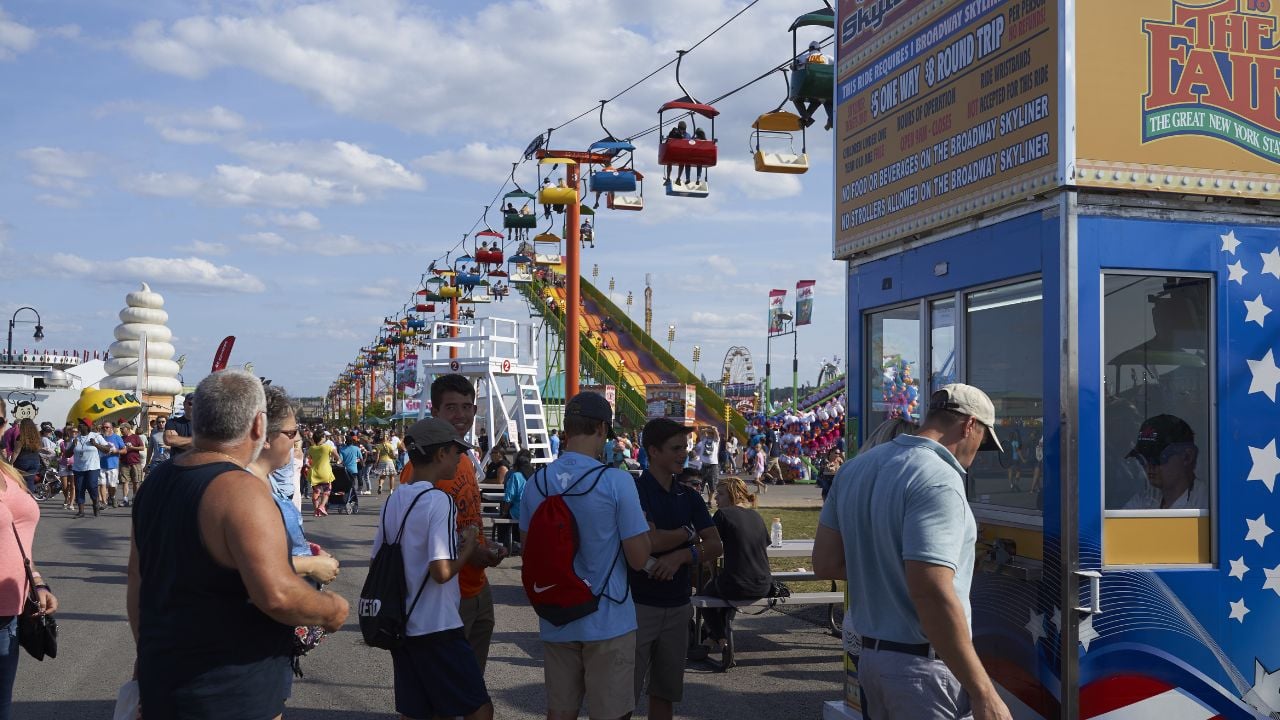
9 New York State Fair Habits That Give Away a First-Timer

The Great New York State Fair is underway in Syracuse, and the newcomers already stand out.
Close to a million people pass through the Onondaga County fairgrounds every year.
Regulars move through that crowd like they’ve done it dozens of times, because many of them have.
These are the New York State Fair habits that give away a first-timer.
1. Parking Like a Tourist
Early risers separate themselves from first-timers at the Great New York State Fair before anyone even reaches a gate.
Three of the fairgrounds’ main lots, Brown, Pink, and Gray, open at 6 a.m., hours before the Fair itself does. So, regulars can grab a close spot and beat the worst of the traffic.
Few first-timers know that.
The Orange lot doesn’t open until 9 a.m.
On the busiest Friday, Saturday, and Sunday crowds, the overflow lot on Willis Avenue doesn’t open until 10.
First-timers who stroll up at 10:30 expecting an easy pull-in land in the farthest overflow row instead.
The ticket window is still ahead of them.
2. Bringing Cash to the Gate
Getting into the Great New York State Fair starts with a card, not cash.
Regulars buy admission and parking online or by phone days ahead, through the Fair’s own ticketing site, and walk straight to the gate with everything already paid for.
A first-timer who shows up planning to hand a twenty to the ticket window meets a reverse cash machine instead, one the Fair keeps at every gate to turn a bill into a usable card.
No cash changes hands there.
Once you’re inside, many vendors still take cash, so the surprise is only at the gate.
3. Skipping the Cooler
Packed coolers are welcome at the Great New York State Fair, under its own visitor rules.
Its own visitor guidelines tell fairgoers they’re welcome to bring in a cooler of food and drinks, as long as it isn’t alcohol.
Regulars know this and roll in with a cooler on wheels.
Bring your own, save money.
A first-timer leaves the cooler in the trunk, assumes every bite has to come from a food stand, and spends the whole day buying what they could have packed for free.
Bag and cooler checks still apply at the gate.
4. Walking the Whole Fairgrounds
A full 375 acres make up the Great New York State Fair’s Syracuse grounds, and regulars never plan to walk every one of them.
A free tram runs a nine-stop horseshoe route across the grounds from 8:30 in the morning until 11:30 at night.
Regulars hop on between the animal barns and the Midway without a second thought.
It saves your knees.
A first-timer treats the whole visit like a hike, logging miles between the Dairy Products Building and Chevy Court that a five-minute tram ride would have covered.
Sore feet by 3 p.m. are the giveaway.
5. Standing for Chevy Court
Free concerts happen twice a day at Chevy Court, near Gate 1, courtesy of the Great New York State Fair, at 1 p.m. and 6 p.m.
No ticket, no extra charge beyond the admission you already paid.
Seating is first-come, first-seated, with no reserved section for anybody.
Nobody’s exempt.
Regulars show up early with a blanket or a folding chair and claim a spot long before the opening act.
Every seat is already claimed by the time a first-timer wanders over right at showtime, and the view from the back is a squint at a stage they could have watched from the third row.
Psst! How much do you know about the New York State Fair’s history? Take our quiz and see how many you can get right.
Quiz
New York State Fair IQ
Answer nine questions on the Fair’s history, records, and traditions. We bet you can’t get them all right. Prove us wrong?
How much butter goes into the Great New York State Fair’s famous butter sculpture every year?
6. Missing the Milk Bar
Inside the Dairy Products Building, the Great New York State Fair sells one of the cheapest treats on the grounds at a counter many first-timers never notice.
A glass of white or chocolate milk at the Milk Bar costs 25 cents, poured every day of the 13-day run.
Strawberry milk shows up too, but only on a handful of days, since the counter has never had enough spigots to pour all three flavors at once.
Nobody hands over a quarter anymore.
Fairgoers feed bills into a token machine first, then hand the tokens to the staff behind the counter.
Same quarter, new middleman.
Regulars build a stop there into every visit, tokens already in hand.
A first-timer scans the Dairy Products Building for a menu board or a register, finds neither, and keeps walking toward the butter sculpture instead.
Even a fistful of quarters still needs to go through the token machine first.
7. Paying for Admission That's Already Free
Two whole groups of people never pay admission at the Great New York State Fair, any day of the run.
Anyone 65 or older enters free, and so does every kid 12 and under.
No exceptions.
Free admission for both groups isn't a one-day special.
Free admission covers the entire 13-day run.
Buy a full ticket for a grandparent or a nine-year-old anyway, and that's $8.32 spent on something that was free the whole time.
8. Ignoring the Discount Calendar
An entire calendar of special days at the Great New York State Fair is built around who you are, not just when you show up.
Student Youth Day waives the gate fee for anyone 18 and under.
That's money saved.
Law Enforcement Day, Fire, Rescue & Emergency Medical Services (EMS) Day, and Armed Forces Day each cover their own group.
Regulars check that calendar before they ever buy a ticket.
A first-timer who works a fire department shift or wears a uniform every day of the week pays full admission on a day the Fair would have let them in for nothing.
What You Need to Prove on a Discount Day
The New York State Fair's free-admission days don't all ask for the same proof at the gate.
Native Americans Day, set for September 4, waives the fee for tribal members with no ID required.
Law Enforcement Day and Fire, Rescue & EMS Day both ask for a valid ID or department credential before the gate lets anyone through free.
State Parks Day works differently again, taking an Empire Pass, Access Pass, Lifetime Liberty Pass, or Golden Park Program pass instead of a badge or a birthday.
9. Asking for the Old Village
One of the Great New York State Fair's longest-running attractions got a new name this summer, and regulars picked it up fast.
The Six Nations, also called the Haudenosaunee, asked the Fair to rename the grounds long known as Indian Village to Haudenosaunee Village, a change that took effect in June.
Fair staff and longtime visitors already use it without thinking twice.
Old habits fade fast.
A first-timer working off an old blog post or last year's map still asks a gate worker for directions to a name that, officially, doesn't exist anymore.
The buildings and the longhouse tours didn't move.
America's First State Fair
Syracuse hosted the country's first state fair in 1841, the original run of what's now the Great New York State Fair.
For the next several decades, the Fair moved between cities across the state, including Albany, Buffalo, and Rochester, before Syracuse became its permanent home in 1889.
Those early fairgrounds covered just 100 acres, a small fraction of the grounds fairgoers cross today.
World War II shut the whole operation down for five straight years, from 1942 to 1947, while the grounds served as a military training base.
Five years, gone.
The only other cancellation came in 2020, when the pandemic closed the gates for the year.
The Fair topped 925,989 visitors in 2025.
10 Words New Yorkers Use That Confuse Everyone Else

New York keeps at least four distinct accents going at once, and the words change right along with the county line.
These are the words that split New Yorkers from the rest of the country, and sometimes from each other.
10 Words New Yorkers Use That Confuse Everyone Else
9 Things Downstate New Yorkers Say About Upstate That Locals Are Sick Of
A family from Long Island once asked a bed-and-breakfast owner near Cornell University how far away the nearest college town was.
Cornell has stood in Ithaca since 1865, and half the block exists because of it.
9 Things Downstate New Yorkers Say About Upstate That Locals Are Sick Of
