
9 Plants North Carolina Gardeners Swear They’ll Never Grow Again

Some of the most stubborn plants in a North Carolina yard arrived in a nursery pot, with a tag and a price on them.
Regardless of their origin, N.C. Cooperative Extension publishes control instructions for several plant species. Homeowners with yards need to be aware of them.
These are the plants North Carolinians regret ever putting in the ground.
1. Japanese Blood Grass
Japanese blood grass sells under the name Red Baron, bought for the red blades that light up a border in October.
North Carolina prohibits selling it.
The ornamental is a variety of cogongrass, a state and federal noxious weed that the N.C. Department of Agriculture and Consumer Services calls one of the top 10 invasive weeds in the world.
The color isn’t the problem.
Inspectors have tracked cogongrass down 10 times in the state since 2012, in Pender, Sampson, Scotland, and Martin counties down east and in Wake and Stanly in the Piedmont.
Cogongrass burns hot enough to turn a routine controlled burn dangerous, and the goal in every case is wiping out the patch before it spreads.
If a clump you bought years ago is still sitting in your border, call your county Extension center about it.
2. Leyland Cypress
Leyland cypress went into North Carolina yards by the thousands as the fast answer to a neighbor’s new deck.
N.C. Cooperative Extension puts its full size at 100 feet tall and 50 feet wide, and recommends spacing the trees at least 12 to 15 feet apart.
Almost nobody does that.
Crowded rows in Sanford and Cary pick up Seiridium canker, Passalora needle blight, and Botryosphaeria dieback, plus Phytophthora root rot in the wet clay of a graded lot.
One tree browns out, then the tree beside it, and a solid green wall turns into a row of gaps you can see the neighbor’s deck through.
Extension’s advice after you pull a dead tree is blunt: Don’t put another Leyland cypress in that hole.
Green Giant arborvitae, Japanese cedar, and Arizona cypress all screen a property line, and planting them in small clusters of three or five keeps one fungus from taking out the whole row.
3. Chinese Wisteria
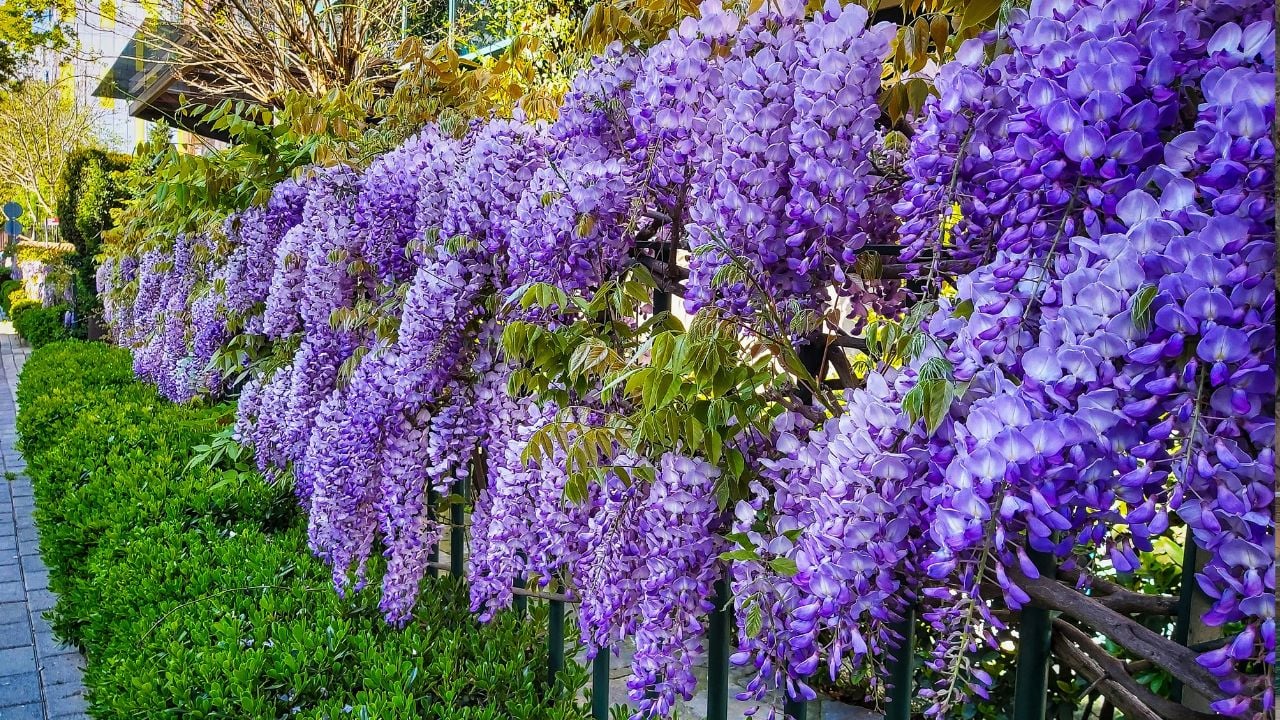
Chinese wisteria is the purple curtain hanging off pines along Piedmont back roads, and much of it started in somebody’s yard.
A single vine runs up to 70 feet long and thickens to 10 inches across, which is fence-post territory.
It winds counterclockwise and tightens as the trunk under it grows, until the vine girdles the tree.
There’s no saw involved.
Here’s the part that surprises people: Chinese wisteria barely spreads by seed because the seeds run too big for birds to carry, so it travels on runners that root as they crawl across the ground.
Hand-pulling works in the first season and stops working after that, which is why the Extension agents in Madison County walk homeowners through a cut-stump herbicide treatment instead.
American wisteria, the native, hangs the same lavender clusters after its leaves come out, and it stays where you put it.
4. Chameleon Plant
Gardeners buy chameleon plant for its leaves, splashed with red, cream, and green, and for the damp shade where nothing else will grow.
Damp shade is where it escapes.
The plant spreads by rhizome, and any segment left in the ground starts a fresh plant, so digging it out moves it and tilling it multiplies it.
Each fragment starts over.
NC State Extension’s own advice is to grow it inside a container sunk in the ground, or in a strip fenced in by a driveway and a sidewalk.
Henderson County Extension lists it alongside English ivy and creeping liriope on its invasive groundcover page.
Crush a leaf and you get a smell somewhere between orange peel and old fish, which is a strange thing to be weeding out of a hosta bed for years afterward.
5. Bradford Pear
Bradford pear lined new subdivisions across the state for thirty years, and the fields behind those subdivisions are full of its offspring.
The first Bradford couldn’t pollinate its own flowers.
Then nurseries sold Cleveland Select, Chanticleer, Aristocrat, and Autumn Blaze down the same streets, those varieties crossed with each other, and the seed came out viable.
Birds did the delivering.
Wild pear grows thorns up to 4 inches long, stiff enough to puncture a tractor tire, and it forms thickets with nothing growing underneath.
South Carolina, Pennsylvania, and Ohio have already banned the sale of Callery pear, and a Kansas ban takes effect on January 1, 2027.
North Carolina hasn’t.
What the state runs instead is the Bradford Pear Bounty, which trades a free native tree for photographic proof that you cut yours down, up to five trees per household.
The exchanges ran this past spring in Hayesville, Asheville, Hendersonville, and Burlington, and the before-and-after photos are the part people forget to bring.
Psst! How much of what you’ve heard about gardening in North Carolina holds up? Flip these cards and see how many you call right.
6. Golden Bamboo
Golden bamboo makes a fast screen along a property line, and it doesn’t stay on your side of that line.
The canes reach 30 feet and form thickets where little else grows, from moist coastal woods to open lots outside Greensboro.
Some varieties run 20 feet of rhizome in a single season, and those rhizomes travel underground and surface in the neighbor’s flower bed, which is how a screen turns into a conversation nobody wanted.
Cooperative Extension in Caldwell County puts full control at two to three years of steady work, and quitting before then lets the stand come back.
Hardly anyone gets every rhizome.
The plan is cutting every new shoot as it comes up, mowing the whole area weekly through the growing season, and treating the survivors with glyphosate, then doing it again next year, and the year after.
Bamboo can’t survive weekly mowing.
That’s every Saturday from April to October, for two growing seasons.
7. Nandina
Nandina anchors foundation beds at brick ranch houses all over the Piedmont, and the berries hanging off it in clusters are the problem.
The leaves and the fruit make cyanide.
The herbarium curator at the University of North Carolina at Chapel Hill found dead cedar waxwings on campus within sight of a large nandina planting, which led to a year of monthly testing on 11 shrubs around Chapel Hill and Hillsborough.
The green berries hanging on the shrub in August turned out to be the most cyanogenic fruit on the plant, and the ripe red fruit releases its cyanide slowly instead.
Slow poisoning still kills.
A waxwing flock lands in winter and strips a shrub bare in minutes, and the cyanide comes out of all that fruit in amounts a bird that size can’t clear.
Nandina is listed as an invasive species in North Carolina, and the botanical garden’s own advice is to pull the shrub and plant an eastern red cedar, or grow a non-fruiting cultivar, or strip the fruit before it ripens.
8. Jerusalem Artichoke
Jerusalem artichoke, the sunchoke, goes into a vegetable garden as the no-work perennial, which is accurate and is also the problem.
The stalks run head-high and taller by August, and by then they’re shading whatever you planted behind them.
You dig the tubers in fall, you eat well, and you miss a few.
Hardly anyone digs them all.
NC State Extension says any tiny piece left in the soil sprouts a new plant, and that an established patch is difficult to remove.
In coastal plain sand the tubers lift out whole, and in Piedmont clay they snap off and stay put.
A few seasons later, the sunchokes cover the row where the bush beans used to go.
Give them a stock tank, a bed with a solid bottom, or a corner of the yard you’ve already written off.
9. Garlic Chives
Garlic chives earn a spot in an herb bed for about two summers.
They’re good chopped into eggs, and the cream flowers that open above the clumps in early summer keep the bees busy.
Then the seed drops.
NC State Extension, which runs its plant database out of Raleigh, tags the plant weedy and notes that it spreads both by self-seeding and by underground rootstocks, which is two ways to lose a bed at once.
The same page suggests growing it in a pot.
Seedlings come up in the gravel, in the lawn, and between the flagstones, and every seedling makes a small bulb that snaps off below the leaves when you pull it.
Cut the flower heads the week they fade, before the black seed sets, and you keep the herb you wanted.
Miss that week two summers running, and the seedlings turn up in the driveway cracks.
9 Things North Carolinians Do That Transplants Just Can’t Figure Out

Newcomers pick up the accent and the barbecue rules eventually.
The habits are harder, and a few of them make no sense at all until you’ve lived through one Carolina summer.
9 Things North Carolinians Do That Transplants Just Can’t Figure Out
9 North Carolina HOA Rules That Cost Homeowners Who Ignore Them

Your yard belongs to you, right up until the letter shows up in the mailbox.
A few of these rules carry fines that keep running while you argue about them.
9 North Carolina HOA Rules That Cost Homeowners Who Ignore Them
