
9 Popular Home Trends That Make No Sense in Minnesota’s Climate

Minnesota’s weather records list an all-time high of 115 degrees and an all-time low of 60 below.
The Twin Cities average 54 inches of snow a year on top of that.
Builders everywhere are selling the same handful of trends right now, and a Minnesota homeowner wants them as much as anybody in Arizona does.
These are the popular home trends that make no sense in Minnesota’s climate.
1. Flat and Low-Slope Roofs
The Twin Cities area alone averages 54 inches of snow a year, according to the Minnesota Department of Natural Resources.
A flat or low-slope roof has almost no pitch to help shed that weight.
A flat roof gives gravity nothing to work with.
Heat leaking out of the attic melts the snow sitting on the roof deck.
That meltwater runs toward the eaves, where the edge of the roof stays colder than the middle.
The water refreezes right there and backs up under the shingles, a pattern the University of Minnesota Extension calls an ice dam.
Ceilings pay for it.
A steep roof lets gravity beat the meltwater to the gutter.
A roof built flat for a warmer market gives that same water time to sit, freeze, and creep back under the shingles.
2. Wall-to-Wall Glass
Minnesota winters push the mercury low enough that the state’s climate records list average winter temperatures of 18 degrees in the south and 8 degrees up north.
A wall of glass loses heat far faster than an insulated wall ever will.
That gap only grows as the window gets bigger.
Builders keep selling the look nationwide as floor-to-ceiling glass, and Minnesota’s new construction is no exception.
Two well-known window makers, Andersen and Marvin, build their products a few hours apart in Bayport and Warroad.
Both companies engineer high-performance glass to cut down on that heat loss.
Even their best glass still loses more heat than an insulated wall.
More glass means more surface for warm air to escape, and a great room wrapped mostly in windows costs more to heat all winter.
3. Statement Skylights
An oversized skylight is a popular way to chase more natural light, and the University of Minnesota Extension names skylights as one factor that raises ice-dam risk.
Heat finds the gap.
A skylight interrupts the attic’s insulation and punches a heat source through the roof deck, exactly where the shingles need to stay cold to keep snow from melting unevenly.
Recessed lighting causes the same problem, and the extension service lists both alongside heating ducts run through an unconditioned attic.
That’s one more hole for heat to use.
A single skylight can look dramatic in a listing photo.
It also means one more warm spot on a roof that needs to stay evenly cold to shed snow the way it’s designed.
4. Eaveless Rooflines
Why do some of Minnesota’s newest builds skip the roof overhang that’s supposed to protect the walls below?
They’re chasing the clean, boxy silhouette popular in warmer design markets, where an overhang isn’t doing much work anyway.
That overhang protects the walls below it.
Cold-climate builders discussing the problem on the building-science site GreenBuildingAdvisor.com note that a home built with no overhangs lets roof runoff run straight down the exterior walls instead of clearing them.
Skip the overhang, and that water finds the wall instead of the ground.
In Minnesota, that runoff is often melting snow, and it refreezes against the siding the moment the sun drops, turning one design choice into a slow, repeating soak.
Siding built to shed a quick rain wasn’t built to hold a slow freeze against its face all winter.
Psst! How climate-smart is your Minnesota home already? Run through this checklist and see where you stand.
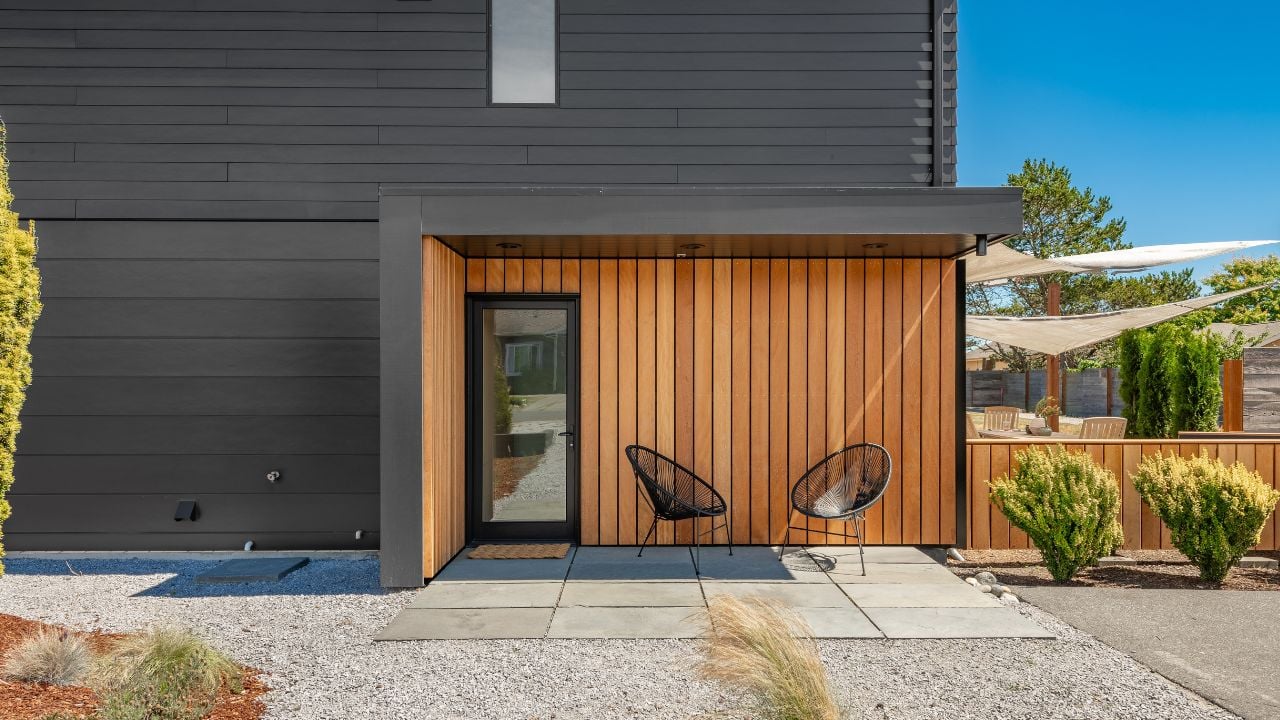
5. Black Exterior Siding
Minnesota exteriors are trending darker right now, following the charcoal-and-black wave sweeping new construction nationwide.
Dark looks sharp in a listing photo.
A dark exterior also runs hotter in direct sun than a light one.
That extra heat stresses the material with more expansion and contraction than a paler finish ever sees.
Minnesota adds the opposite extreme every winter.
The state’s weather records list an all-time high of 115 degrees and an all-time low of 60 below zero.
Vinyl siding is a thermoplastic, and cold-climate roofing contractors document panels contracting by as much as half an inch at temperatures of 20 to 40 degrees.
That same material also turns more brittle under rough handling any time a hard freeze sets in.
That’s true whether it’s an installer working in cold weather or a snow shovel catching the wall.
One color takes on both extremes.
A black or near-black exterior spends summer soaking up extra heat and winter contracting under the cold.
That’s a wider swing than the trend’s warm-climate origin ever had to handle.
6. Desert-Style Gravel Yards
Minnesota yards are picking up on the nationwide gravel-garden trend, trading grass for mineral mulch and drought-tolerant perennials.
Lavender, a gravel-garden staple, needs a cold-hardy variety bred for it to have any shot at coming back after a Minnesota winter.
Salt is the bigger risk to these plants, not the cold.
The gravel bed usually sits right where Minnesota spreads the most de-icing salt, along the driveway and the front walk.
Minnesota’s extension service documents dried, browned foliage on plants that sit too close to a salted driveway, plus outright death for evergreens planted within a few feet.
The gravel bed sits just as close as ever.
7. Open-Concept Great Rooms
Minnesota new-construction buyers want open-concept layouts as much as anyone, with 61 percent of recent buyers calling it their most important feature nationwide.
Warm air doesn’t stay put.
An open floor plan usually pairs with a tall, vaulted ceiling over the great room, and that height gives heat more room to rise and pool near the top.
Building-science writers call the result a stack effect.
Warm air escapes through gaps up high, and that escape pulls cold air in through every crack near the floor.
Feet feel it first.
That stack effect runs hardest exactly when Minnesota’s furnace is working hardest, during the long stretch of days that never climb out of the teens.
An open, vaulted great room built for a mild climate turns into the room where Minnesota’s heating bill does the most work every winter.
8. Outdoor Kitchens
Minnesota backyards are getting outdoor kitchens at about the same clip as the rest of the country.
Al Bruce, founder of the design firm Olive & Barr, discussed the trend with Homes and Gardens.
He said outdoor kitchens have become one of the top items on homeowners’ wish lists heading into 2026.
It’s coveted for about five months.
An outdoor kitchen built with running water, a sink, and gas or propane lines needs each line drained before the first hard freeze.
Water left inside expands as it freezes and cracks the pipe, the valve, or the fixture around it.
That risk applies to every plumbed outdoor kitchen in the state, no matter how well it’s built.
Trade guidance on winterizing these spaces is blunt about it: No setup is fully winter-proof.
That’s a lot of seasonal upkeep for a feature that only earns its keep for a few months a year.
What Winterizing an Outdoor Kitchen Takes
Turning off the water to a Minnesota outdoor kitchen isn’t the same as winterizing it.
The lines still need to be drained and blown clear with compressed air.
A few ounces of trapped water is enough to crack a fitting once it freezes and expands.
Pull any built-in refrigerator, ice maker, or drink cooler not rated for freezing temperatures, or have a technician service it, before the cold sets in.
Propane tanks should come off the unit too, stored separately for winter instead of staying hooked up outside.
9. Rooftop Decks
Minnesota’s home builders are watching the same rooftop-deck boom reshaping backyards elsewhere, a feature one national home-warranty company calls a leading trend in new construction right now.
Minnesota barely makes the list.
That same overview names its hottest markets as the Southwest, Texas, the Pacific Northwest, Southern California, and the East Coast.
Not one cold-winter state made that list.
There’s a reason for that.
A roof built to hold a deck, furniture, and a crowd of people still has to carry the same snow load as any other roof in the state.
Waterproofing membranes underneath a roof deck take on that same freeze-thaw cycling, expanding and contracting every time a sunny afternoon gives way to a subzero night.
Any water that finds a seam in that membrane freezes solid, expands, and works the seam open wider the next time it thaws.
8 Hy-Vee Fuel Saver Mistakes That Cost Minnesota Shoppers at the Pump
Fuel Saver points feel like free money until the fine print catches up with a driver at the pump.
A few small missteps at checkout can knock cents off the discount before the pump even starts, and many Hy-Vee shoppers never notice.
8 Hy-Vee Fuel Saver Mistakes That Cost Minnesota Shoppers at the Pump
9 Reasons People Are Leaving Minnesota in 2026
A brutal winter and a rising cost of living have many Minnesotans running the numbers on somewhere warmer.
Some of the reasons behind the exodus have nothing to do with the cold at all.
