

9 Reasons Florida Retirees Are Moving to Georgia in 2026

Can a lifelong Floridian be happier one state north?
Thousands are betting on it.
They’re following I-75 out of Florida into Georgia, chasing lower monthly bills, cooler mountain air, and a shorter drive to a top hospital than they ever had.
These are the reasons many Florida retirees are choosing to move to Georgia.
Note: This is general information, not financial, tax, or insurance advice. Tax rules, dollar amounts, and coverage terms are subject to change.
1. Home Insurance Costs Far Less
Florida retirees now brace for their home insurance bill.
The average Florida homeowner pays about $7,136 a year to insure a $300,000 house, roughly three times the national average.
A Georgia homeowner pays around $2,323 for that same coverage, a hair under what a typical American pays.
That gap is around $4,700 a year.
Every year.
Rising insurance and property costs help explain why almost as many people 65 and older left Florida in 2025 as moved in, close to 44,900 heading out.
For many of them, the first quote from a Georgia agent is a welcome shock.
2. Social Security Stays Yours
Retirees fret that crossing into Georgia means the state will dip into their Social Security.
It doesn’t.
Georgia doesn’t tax Social Security benefits at all, so your check will arrive whole, exactly as it did in The Villages.
Florida charges no state income tax, a perk that Georgia can’t match.
For most retirees, though, the difference is smaller than the rumor makes it sound.
Social Security often makes up the biggest slice of a retiree’s monthly income, and Georgia leaves every dollar of it alone.
3. Retirement Income Gets a Pass
Georgia’s real gift to older residents is what it does with the rest of your income.
The state’s flat income tax dropped to 4.99% in 2026, lower than it was a year ago.
But anyone 65 and older can shield up to $65,000 of retirement income each, so a married couple can protect up to $130,000 together.
Pensions, individual retirement account withdrawals, interest, dividends, and capital gains all count toward that shield.
Retirees aged 62 to 64 still get to exclude up to $35,000 apiece.
Do the math.
Between the Social Security break and that exclusion, a typical retired couple owes Georgia little, and sometimes nothing at all.
4. Counties That Waive School Tax
Georgia’s property taxes start out reasonable, and the senior breaks only grow once you turn 62.
The state values your home at just 40% of its fair market value, so the taxable number starts well below the sticker price.
The exemptions build from there.
In Cobb County, residents 62 and older are exempt from 100% of the school portion of their tax bill, with no income limit attached.
School taxes are usually the biggest line on that bill.
Gone.
Cherokee, Forsyth, and Fulton counties run their own senior exemptions, so the exact deal shifts from one county to the next.
A Floridian used to Save Our Homes caps finds a different, often friendlier, set of rules up north.
5. Your Housing Dollar Stretches
Georgia hands a retiree more house for the money than most of Florida does.
The typical Georgia home runs about $374,000, while a Florida home sits closer to $417,000.
That buys a new roof.
Step away from the Atlanta metro and the discount grows, with towns like Macon, Augusta, and Rome listing solid brick ranches for far less than a comparable place in Sarasota.
Everyday costs follow the same pattern, and Georgia’s overall cost of living sits below average on the national index while Florida’s runs above it.
In Florida, condo and homeowners association fees have jumped since the state tightened its building-inspection laws, adding another line that Georgia buyers rarely face.
Groceries, gas, and services all cost a touch less across the line.
6. Hurricane Math Changes Inland
Florida gets hit by more hurricanes than any other state, with roughly 500 storms logged since 1851.
Georgia isn’t storm-free, and its coast around Savannah and the Golden Isles takes the occasional hit.
But most retirees settle well away from the coast.
A house in Blue Ridge, Athens, or greater Atlanta sits hours from the water, where storms arrive weaker and far less often.
Inland, the risk drops.
That distance shows up on the insurance quote and in the number of nights nobody spends boarding up windows.
7. Georgia Gives You Four Seasons
Florida offers two seasons, hot and slightly less hot.
Georgia hands retirees four.
Spring dogwoods, real autumn color across the north Georgia mountains, and a light dusting of snow some winters up around Blairsville and Ellijay.
The Blue Ridge foothills and the Chattahoochee National Forest put hiking, waterfalls, and cool mornings within a day trip.
Summers still bring heat and humidity, so nobody escapes July entirely.
Leaves that turn.
For a snowbird who spent 40 years in flip-flops, that first cool October morning is a small luxury.
8. Hospitals Worth the Drive
Good medical care matters more with every birthday, and Georgia keeps it close to home.
Emory University Hospital in Atlanta has ranked as the best hospital in Georgia for 14 years running, with national marks in geriatrics, neurology, and urology.
Augusta University Medical Center anchors the eastern side of the state, a teaching hospital with a Level 1 trauma center.
Savannah, Macon, and Columbus each keep large regional systems, so serious care isn’t only an Atlanta thing.
That reach matters.
Even a mountain-town retiree usually sits within a manageable drive of a nationally ranked hospital.
Psst! How much do you know about Georgia’s taxes, towns, and quirks? Take our quiz and see how many you can get right.
Quiz
Georgia Move IQ
Test yourself on Georgia’s taxes, towns, and quirks that surprise new arrivals. We bet you can’t get them all right. Prove us wrong?
When you move to Georgia and title your car, the state charges a one-time Title Ad Valorem Tax (TAVT). What does that one-time tax replace?
9. Estate Tax Still Skips You
Anyone leaving Florida wonders one thing: Will the new state grab a cut of whatever you leave behind?
In Georgia, the answer is no.
Georgia charges no estate tax and no inheritance tax, so your heirs collect the whole amount.
Florida works the same way, which means a retiree gives up nothing on this front by moving.
You keep it.
The savings you built under the Florida sun pass to your kids intact, whether you settle in Savannah or up in the Cohutta mountains.
No state estate return, no inheritance form.
Heirs just get what you left them.
The Cheapest Places to Retire in Georgia in 2026
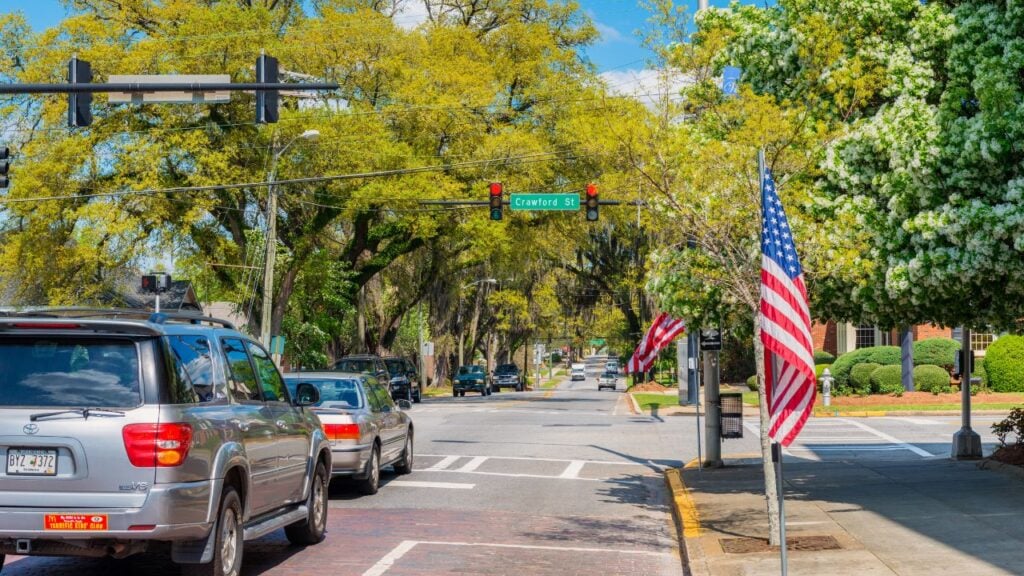
Not every Georgia town costs what metro Atlanta does.
Down in the state's southern and middle stretches, a comfortable home still lists for less than a snowbird might expect, and the Social Security break comes standard.
The Cheapest Places to Retire in Georgia in 2026
7 Georgia State Parks Locals Say Beat the Famous Ones

Georgia has more than 60 state parks, and the crowds pile into maybe five.
The best paddling, hiking, and stargazing tend to sit at the parks most visitors blow past.
