
9 Tennessee Road Signs That Mean Something Different Than Visitors Assume

Thirty-four separate signs guide drivers down just one stretch of Interstate 24, more warnings than many visitors will encounter anywhere else in Tennessee.
Tennessee’s traffic engineers pick every spot for a reason: An ice-prone bridge, a steep mountain grade, or a slope known for loose rock.
These are the road signs that mean something different than out-of-state drivers assume.
Note: This is general information, not legal advice. Traffic laws and sign placement are subject to change, so confirm current details with the Tennessee Department of Transportation.
1. Deer Crossing
Tennessee’s yellow deer crossing signs aren’t random decorations scattered along pretty stretches of highway as a guess of where deer could be.
State engineers place them where deer already cause the worst wrecks.
Tennessee logged more than 8,000 deer-related crashes in 2024, including 465 injury crashes and five deaths, according to the Tennessee Highway Patrol.
Those crashes cluster hardest from October through December, when mating season sends deer wandering across roads they normally avoid.
November is historically the worst month of the year for it.
So the diamond with the leaping deer marks a documented crash zone, not a guess.
2. Slower Traffic Keep Right
Tennessee’s Slow Poke Law makes it illegal to sit in the left lane of a multi-lane road or interstate unless a driver is passing someone.
The black-and-white “Slower Traffic Keep Right” signs are how the state posts that rule on the highway.
Many drivers read them as a polite suggestion.
It isn’t one.
The rule expanded on July 1, 2020, to cover every Tennessee highway and interstate with two or more lanes running the same direction, not just the busiest ones.
A first offense is a Class C misdemeanor with a $50 fine plus court costs.
There are exceptions.
Bad weather, a stalled car in the right lane, merging traffic, or an upcoming exit can all put a driver in the left lane legally.
But cruising there out of habit, at the speed limit or not, is exactly what the sign warns against.
3. Roadside Move Over Signs
Tennessee’s roadside “Move Over” signs sound like friendly advice.
They aren’t.
Tennessee’s Move Over Law has required drivers to change lanes or slow down for stopped emergency and highway crews since 2006.
A first violation carries a fine between $250 and $500, and a judge can add up to 30 days in jail.
That’s not a warning.
It’s a court date.
What Else Falls Under Tennessee’s Move Over Law
Tennessee’s Move Over Law covers more than flashing police lights.
Tow trucks, recovery vehicles, and utility crews all count.
Lawmakers added Tennessee Department of Transportation (TDOT) highway workers to that list in 2017.
A first offense brings a fine between $250 and $500.
That rises to $1,000 for a second offense and $2,500 for a third.
A crash that causes injury or death under this law can turn into a felony charge, up to vehicular homicide.
4. Bridge Ices Before Road
Visitors crossing Tennessee’s mountain bridges often read a “Bridge Ices Before Road” sign as boilerplate caution posted on every overpass in cold country.
It’s not boilerplate.
A bridge freezes before the pavement around it because cold air reaches the deck from every side, not just the top.
A regular road stays warmer longer because the ground underneath keeps releasing heat it soaked up earlier in the day.
A bridge has no ground underneath to do that.
That’s the difference.
On elevated stretches like Interstate 40’s climb through the Pigeon River Gorge, a bridge deck can look perfectly dry at 34 degrees and turn to black ice a mile later, right where the pavement changes.
Tennessee’s winters tend to run mild.
That’s exactly why so many drivers ignore the sign until the one week it matters.
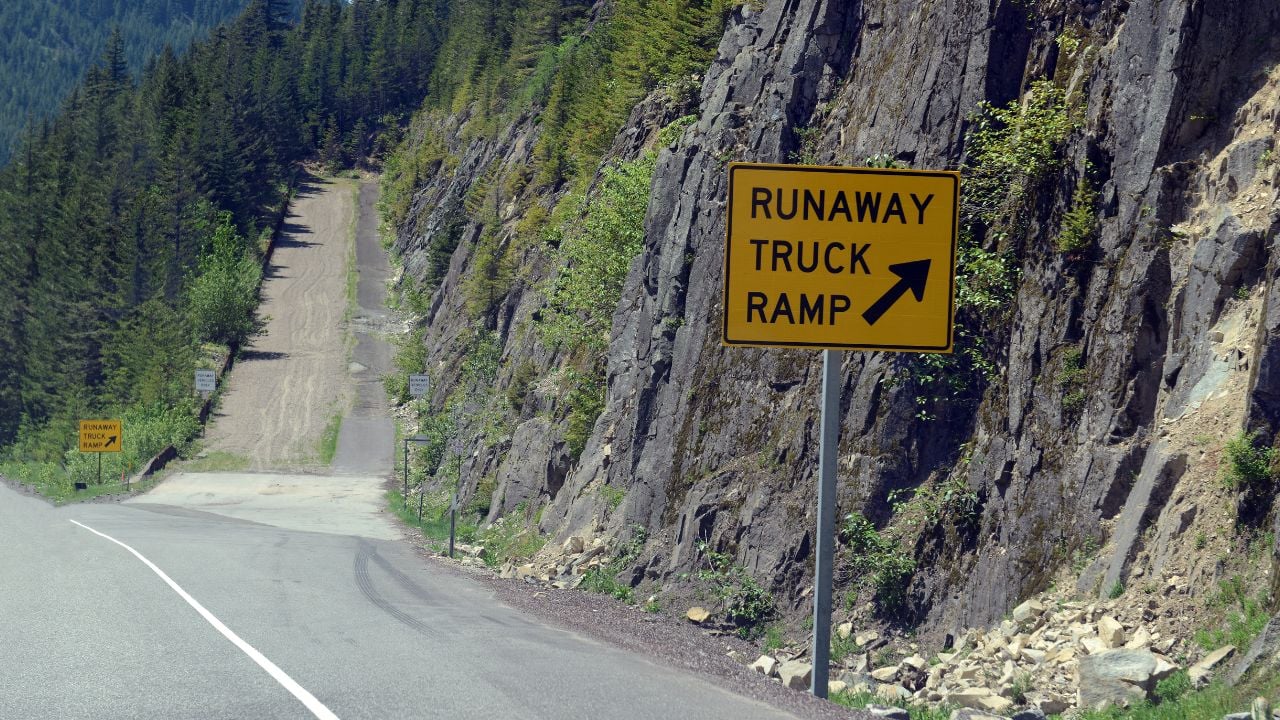
5. Runaway Truck Ramp
Monteagle Mountain gave Tennessee good reason to post “Runaway Truck Ramp” signs on Interstate 24.
Many visitors assume it’s just a gravel turnout for tired truckers.
It’s not that.
The interstate drops 1,933 feet over about five miles of 6% grade coming down the mountain toward Chattanooga.
Two ramps, both on the left shoulder, sit filled with pea gravel to catch a truck whose brakes give out.
They’re built for that exact moment, not for a photo op.
The speed limit on that stretch drops to 55 miles per hour for cars and 45 for trucks heading downhill.
Thirty-four separate signs guide drivers through that single stretch of mountain.
Not a casual warning.
Tennessee doesn’t post that many for nothing.
6. Bear Crossing
Vehicles killed more than 70 bears in one year alone along Interstate 40’s Pigeon River Gorge corridor in Tennessee.
That’s why Tennessee posted bear crossing signs on one six-mile stretch there, not as a blanket Smokies souvenir for the whole route.
Crews installed them in both directions back in 2020, between the Foothills Parkway and the North Carolina line.
Wildlife experts call that stretch of the gorge a “death trap.”
The toll is heavy.
That’s not a stray animal wandering across the road at dusk.
It’s a documented pattern TDOT is still trying to break.
7. No Engine Brake
Tennessee Code section 55-7-117 turns a “No Engine Brake” sign into more than a mountain-town noise request.
Many out-of-state truckers and recreational-vehicle (RV) drivers read it as a courtesy ask and keep using the compression brake anyway.
That’s a mistake.
Running an engine compression brake without an approved, muffled exhaust system is a Class C misdemeanor under Tennessee law.
That’s the same charge class as Tennessee’s Slow Poke Law, with a fine that can run up to $50.
Local governments can ask TDOT to post the sign, then back it with a noise ordinance of their own.
8. Watch for Fallen Rock
Out-of-state drivers often read Tennessee’s “Watch for Fallen Rock” signs as leftover caution from some old rockslide, long since cleared.
Tennessee means something more active than that.
Corridors such as the Ocoee River Gorge cut Highway 64 through steep bluffs in the Cherokee National Forest.
Loose rock still works its way down those slopes after hard rain and winter freeze-thaw cycles.
There’s no warning first.
That’s why crews inspect the road after every big storm.
No season is safe from it.
It comes down during summer whitewater season on the Ocoee River just as easily as it does in a January freeze.
So the sign is less a warning about the past and more a forecast for whatever week a driver happens to be passing through.
9. Adopt-A-Highway
Tennessee prints a volunteer group’s name on that small green sign along the highway for a reason.
It’s not there by accident.
Each sign marks a group that agreed to keep that stretch of road clean.
Volunteers under TDOT’s Adopt-A-Highway program commit to quarterly roadside cleanups along the route they choose.
TDOT supplies the safety gear and trash bags.
The program started in 1989.
Volunteers have hauled more than 12 million pounds of litter off Tennessee roadsides since then.
That adds up fast.
Tennessee posts one more road sign that trips up visitors just as often as anything on this list.
It has nothing to do with deer, bears, or grades.
It’s the yellow, oddly shaped sign warning drivers not to pass.
6 Kroger Bakery and Deli Finds Tennessee Shoppers Swear By
Many Tennessee Kroger shoppers know exactly where the bakery and the deli sit, but getting the most out of either counter is another story.
These finds make parties easier, orders faster, and a regular Tennessee grocery run a little more rewarding.
6 Kroger Bakery and Deli Finds Tennessee Shoppers Swear By
10 Sounds of a Tennessee Summer Locals Can Name in Seconds

A truck idling outside a Franklin gas station with the windows down and the radio off says a lot about how a Tennessee summer sounds.
This roundup catalogs the katydids, cicadas, and porch-swing creaks Tennesseans can name before the first note even finishes.
