
9 Things North Dakotans Keep in Their Car From October On

Starting October 15, North Dakota law lets drivers bolt metal studs onto their tires for the winter.
The state picked that date on purpose.
Everything else in a car trunk follows the same logic.
These are the things North Dakotans keep in their car from October on.
Note: This is general information, not legal advice. Winter driving laws and requirements are subject to change, so confirm current details with the North Dakota Department of Transportation.
1. Full Tank of Gas
North Dakota’s transportation department has one blunt instruction for winter driving season: Never leave home with less than a full tank of gas.
Simple as that.
The reason shows up on the worst days.
An October 2019 storm dropped up to 30 inches of snow near Harvey.
The storm buried North Dakota roads under drifts topping 10 feet, the National Weather Service’s Bismarck office reported.
North Dakota’s interstates and highways shut down for four days, from October 9 through October 13, the same National Weather Service office found.
Nobody controls when a closure like that reopens.
A driver stuck for hours burns through a quarter tank just running the engine for heat.
A full tank of gas buys the hours nobody wants to need.
2. Studded Snow Tires
October 15 marks the legal start of one piece of winter gear: Studded snow tires, permitted under North Dakota Century Code 39-21-40 through April 15.
The law sets it.
Drivers who mount studs outside that stretch risk breaking state law, since metal studs aren’t allowed on North Dakota highways the rest of the year.
School buses are exempt and may run studded tires all year, the same code section says.
North Dakota’s Studded-Tire Fine Print
North Dakota’s studded-tire law doesn’t stop at the calendar.
The same code section caps how far each metal stud can stick out, no more than 1/16 of an inch past the tread.
A shop mounting studs for a customer has to stay inside that limit too.
3. Jumper Cables
Vision Zero North Dakota, the state’s traffic-safety program, puts battery checks on its cold-weather driving checklist.
A car battery is weakest right at the first hard freeze.
North Dakota’s climate normals put that arrival in early-to-mid October, October 9 in both Fargo and Cavalier, the National Weather Service’s Grand Forks office found.
Cold saps a battery’s power.
A hard freeze makes an engine work harder just to turn over.
That’s the backup plan.
A driver with cables in the trunk can usually get a jump from the next car that stops.
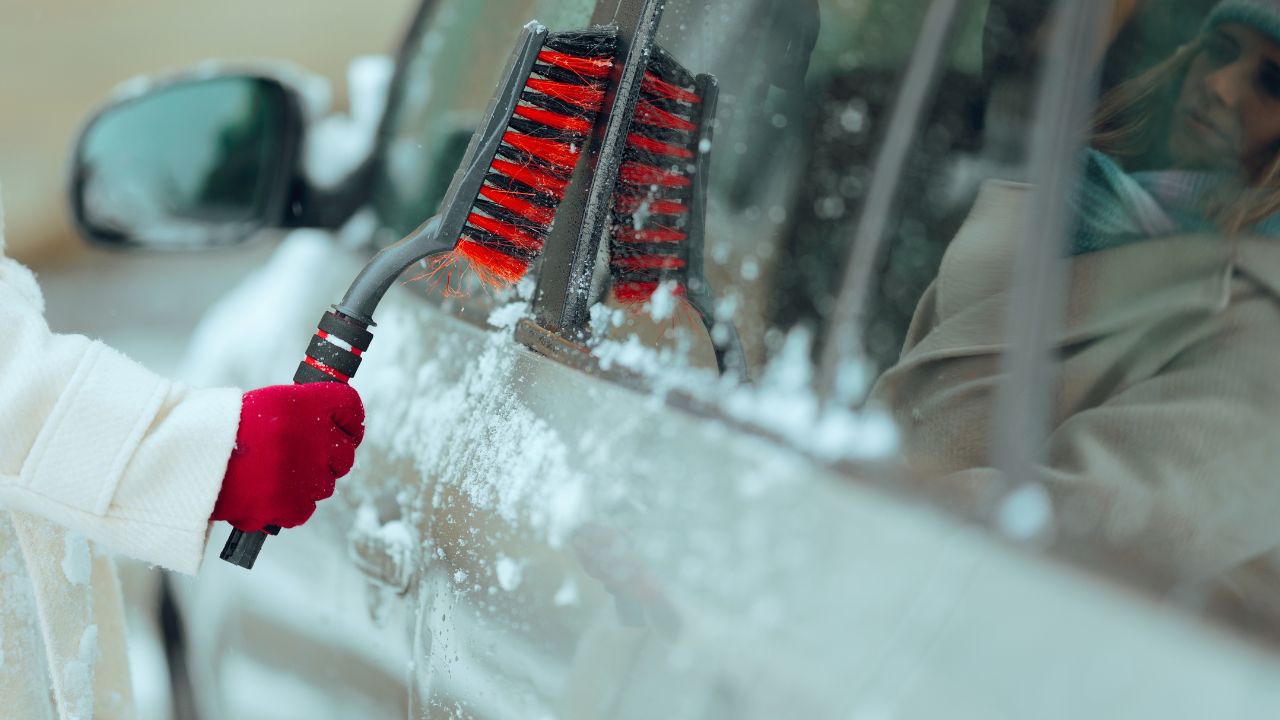
4. Ice Scraper and Brush
The studded-tire window and its first hard frosts tend to land close together on the calendar.
Nobody wakes up to a clear windshield once frost starts glazing the glass overnight.
Vision Zero North Dakota’s pre-drive checklist calls for winter-grade washer fluid and working wipers.
Washer fluid and wipers alone don’t do much against a half-inch of hard frost.
That’s the scraper’s job.
A scraper and a brush handle what the wipers can’t.
5. Folding Shovel and Grit
North Dakota Living, the magazine published by the state’s rural electric cooperatives, lists a small shovel among its winter car-kit basics, along with sand or cat litter for traction.
The state’s climate normals put the ground’s first hard freeze in early-to-mid October, which is when overnight frost starts turning wet roads and driveways into ice without warning.
A shovel matters most after the snow stops, not during it.
Getting stuck usually means digging out the drive wheels, not the whole car.
Traction beats brute force.
Sand or cat litter under a spinning tire gives it something to grip besides ice.
A folding shovel takes up less trunk space than a full-size shovel.
That compact style still satisfies North Dakota Living’s basic call for a small shovel in every kit.
6. Flashlight and Batteries
The National Weather Service’s Bismarck office puts a flashlight and extra batteries on its winter car kit list for drivers.
North Dakota’s Game and Fish Department marks October through early December as the peak stretch for deer-vehicle collisions.
Many of the crashes happen at dawn or dusk, when young deer are dispersing to new territory.
Darkness comes early now.
Daylight runs short fast once fall turns toward winter.
A breakdown after dark on a rural stretch means working by whatever light is in the trunk.
Extra batteries matter every bit as much as the flashlight.
7. Blanket and Warm Layers
A blanket earns its place in a trunk once overnight lows cross the freezing mark.
Climate normals put that first crossing as early as the first week of October in Fargo.
The National Weather Service’s winter car-kit list includes a blanket and extra clothes for exactly that reason.
Body heat only goes so far in a stalled car with the engine off.
It happens fast.
A blanket and a dry change of clothes cover the gap until help arrives.
8. Shelf-Stable Snacks
The same National Weather Service list names high-energy, shelf-stable food as a winter car-kit basic for drivers: Nuts, candy bars and raisins.
None of it needs a fridge or a microwave.
North Dakota’s October 2019 storm shut down interstates and highways for four days, October 9 through October 13, long enough to miss more than a few meals.
Meals can wait.
Food that doesn’t need heating or refrigeration outlasts the wait.
9. Phone Charger
North Dakota’s transportation department tells drivers to carry a cell phone every time they drive in winter.
A dead phone helps nobody.
Deer-vehicle collision season runs October through early December, and a driver who hits one on a rural stretch needs a working phone to call for help.
Rural highways can run for miles between towns.
Dialing 511 for road conditions does no good once the battery dies.
A charger in the glove box keeps that call possible.
North Dakota’s October Blizzard
The state has already lived through a blizzard in October, not just a heavy snow.
A Colorado Low stalled over northwest Minnesota in October 2019, the National Weather Service’s Bismarck office found.
A ridge of high pressure blocked the storm from moving for days.
Wind gusts reached 64 miles per hour during the worst of it.
Many trees across the eastern half of the state still held their leaves that early in the season.
Wet, heavy snow piled onto full branches instead of bare branches.
That extra weight made many of them give way.
North Dakota’s Behind-Schedule Harvest
The state’s harvest was already running late when that October storm hit.
North Dakota had its wettest September on record that year, the National Centers for Environmental Information found, leaving crops standing in the field.
Farmers still needed dry weather to bring the crops in.
Farmers needed a break.
An October blizzard was the opposite of what anyone racing a harvest wanted to see.
Psst! How much do you know about North Dakota winter driving? Take our quiz and see how many you can get right.
Quiz
North Dakota Winter IQ
Answer these questions on North Dakota winter weather and road rules. We bet you can’t get them all right. Prove us wrong?
What’s the coldest temperature North Dakota has ever officially recorded?
Deer Season's Extra Risk
Drivers face a different kind of deer season every fall, weeks before hunters do.
Timing is everything.
October through early December is the peak stretch for deer-vehicle crashes in North Dakota, the state Game and Fish Department says.
Dawn and dusk bring the worst odds.
The agency's advice cuts against instinct: Brake hard and stay in the lane instead of swerving.
Swerving to avoid one deer risks a rollover or a head-on crash with something worse than an animal.
A seatbelt does the rest of the work if a collision happens anyway.
15 Clever Ways To Save Big Money at the Gas Pump

Gas prices move constantly, and the habits that offset them rarely go out of style.
These are the moves that stretch a tank of gas further, no matter which pump a driver uses.
