
9 Things Wyoming Landowners Need to Finish Before the First Blizzard

A blizzard tore into northeastern Wyoming in the first days of October 2013.
Upton, in the state’s northeast corner, woke up under 20 inches of snow as the storm brought gusts topping 70 mph to the wider region before it let go.
Many people hadn’t finished all their fall work yet.
These are the things Wyoming landowners need to finish before the first blizzard.
1. Windbreaks for the Herd
Landowners running cattle or sheep in Wyoming still bring up the October 2013 storm that buried Upton under 20 inches of snow.
Many outfits hadn’t finished moving animals off summer range yet.
A solid, V-shaped windbreak is the fix ranchers reach for first.
University of Wyoming Extension guidance, reported by the Wyoming Livestock Roundup, calls for two 10-foot-tall arms set at a right angle into the wind.
Each arm runs roughly 70 to 106 feet long, spaced 100 to 150 feet apart, and the whole structure needs to stay at least 50% solid.
It also has to sit 150 feet clear of the feedbunks and barns it’s protecting, since drifting snow just piles up somewhere else otherwise.
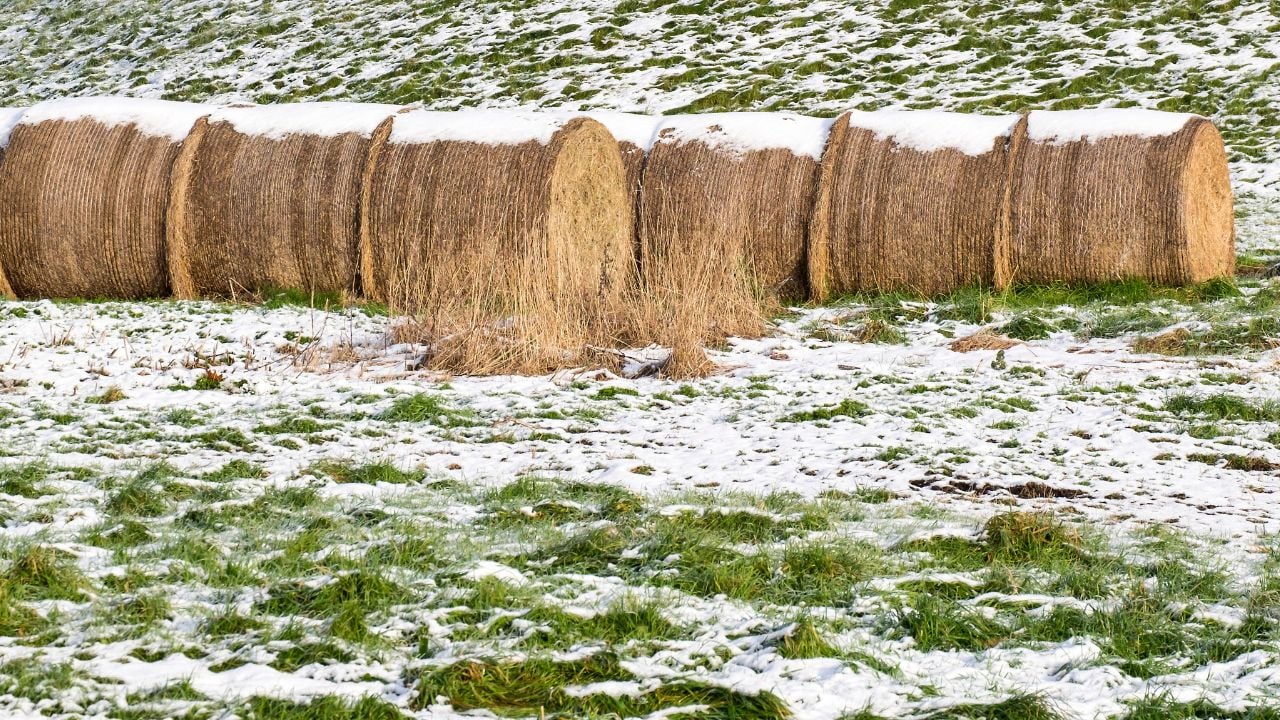
Ranchers without trees or lumber on hand can stack round hay bales two high instead, the bottom bale standing on end and the top one on its side.
Winter Storm Warning vs. Blizzard Warning
Wyoming’s National Weather Service offices use two different alerts for a reason, and mixing them up costs a landowner prep time.
A Winter Storm Warning means significant snow, ice, or a mix is coming, with no wind requirement attached to it.
A Blizzard Warning is stricter, requiring sustained winds or frequent gusts of 35 mph or higher plus snow that cuts visibility below a quarter mile, for at least three hours straight.
Only that second alert meets the government’s actual definition of a blizzard, and it’s the one where finishing early stops being optional.
2. Counting the Winter’s Hay
Landowners also count out exactly how much hay a herd needs before the first bale ever gets fed.
A 1,300-pound cow eats about 2% of her body weight in hay a day, or roughly 26 pounds, according to University of Maryland Extension‘s cow-calf forage guidance.
Multiply that by every cow on the place, then by however many months hay season runs.
Once fall grass plays out, a herd can stay on hay clear into spring.
Short hay means trouble.
Buying more halfway through January usually means paying whatever price is left in the county.
3. Ice-Free Stock Tanks
A stock tank that freezes solid overnight is a battle many livestock owners fight every blizzard season.
Ice means no water.
Rancher Randall Otwell got tired of chopping ice with an ax and a pitchfork.
He and his wife built a floating device instead, one that keeps a tank ice-free without a traditional heater.
A standard electric stock tank heater runs about $3.39 a day through Powder River Energy, a Wyoming electric cooperative.
Getting the heater tested and running before ice sets in beats discovering it’s dead on the coldest morning of the year.
4. Fence Lines and Gates
Landowners walk their fence lines every fall for a reason that has nothing to do with property lines.
The Wyoming Stock Growers Association says a hard storm drifts sheep and cattle into fence corners, where deep snow can bury them before anyone notices.
A downed wire or a gate left unlatched turns that same storm into a much bigger search.
That search gets expensive fast.
Landowners tighten wire, replace rotted posts, and make sure every gate latches before the ground freezes too hard to set a new one.
5. Generator and Fuel Supply
A landowner’s rural well depends on electricity for more than lights.
The well pump, the stock tank heater, and the furnace all run on the same grid, and a blizzard is exactly when that grid tends to fail.
The timing is never good.
The Wyoming Office of Homeland Security’s winter handbook tells rural residents to stockpile heating fuel before a storm arrives, not during one.
A generator that hasn’t run since spring is a gamble no landowner wants mid-storm.
Testing it under load, topping off the oil, and setting aside enough gasoline or diesel for several days closes that gap.
6. Topping off the Propane
Families who heat with propane learn to fill the tank early, before the first blizzard, and one December proved exactly why.
In December 2022, Wyoming’s governor declared a state of emergency over low propane supplies statewide.
Delivery trucks were driving farther and waiting longer at terminals just to keep up.
A rural tank that’s already low when the roads close can’t wait for a delivery truck that can’t get through.
Fill it early instead.
7. Barn Doors and Roofs
Barn, shed, and run-in shelter owners check the doors first since a door that won’t latch is where wind gets inside.
Wind finds every gap.
Once wind pressurizes the inside of a building, the roof ends up fighting to lift off from underneath.
Extension guidance on wind-damaged pole barns calls for closing and latching every door and window before a storm.
Any roof sheathing still held on with nails is worth reattaching with screws instead.
Hurricane clips at the truss-to-column connections add another layer of holding power.
Reinforcing an outside wall with lumber fastened straight to the posts helps too.
8. Winterizing Trucks and Equipment
Many landowners keep a truck and at least one piece of equipment running all winter, whether that’s a tractor, a skid steer, or a stock trailer.
Nobody plans a breakdown.
The state’s winter handbook lays out the basics: charged battery, working lights and brakes, fresh antifreeze, and winter-grade oil.
An emergency kit rides along too, with blankets, extra clothing, food, water, and basic tools packed in before the first storm, not after.
A dead battery on a county road in a whiteout turns a five-minute check into an emergency nobody wants.
Psst! How much do you know about Wyoming’s wildest winter weather? Take our quiz and see how many you can get right.
Quiz
Wyoming Winter Survival IQ
Answer these questions on Wyoming’s toughest winters and wildest wind. We bet you can’t get them all right. Prove us wrong?
In December 2025, a wind gust hit 105 mph somewhere in Wyoming. Where was it recorded?
9. A Plan on Paper
A simple record of how many head, what kind, and where they were before the snow started is what Wyoming landowners who've been through a bad storm keep on hand.
That habit pays off through USDA's Livestock Indemnity Program, which covers losses from blizzards and winter storms that last three or more days with high wind or extreme cold.
The program pays out only when a rancher can back up the numbers.
Guesswork doesn't pay.
Photos, tallies, and a clear head count from before the storm make that case.
Notice of loss and the actual application are both due by March 1 of the following year, a deadline that doesn't bend for a bad memory.
A written plan also means everyone on the place knows where the animals belong when the wind picks up, not just whoever answers the phone first.
A rancher with the head count already written down spends storm season checking water lines, not hunting for paperwork in March.
9 Cracker Barrel Traditions That Have Disappeared
Cracker Barrel's stock dropped by $94 million in a single trading day in August 2025, right after the company swapped its old logo for a slimmer one.
The company put the old logo back within days, but that wasn't the only tradition phased out over the years.
