
9 Utah Foods and Drinks That Confuse Out-of-Staters

Mormon pioneers reached the Salt Lake Valley in 1847 with wagon rations and little else.
Utah’s kitchens never fully shook that make-do streak.
These are the Utah foods and drinks that catch out-of-staters off guard, their appetite included.
1. Fry Sauce
Utah’s fry sauce turns a basket of fries into a small local ritual, a blend of ketchup, mayonnaise, garlic, and pickle brine that shows up on tables from drive-ins to sit-down diners.
Don Carlos Edwards, a Logan native who moved to Salt Lake City in 1941, mixed the first batch there in the 1940s, discovering it by dipping a fry into the pink sauce he had made for his burgers.
He called it pink sauce at first.
Pink, not red.
Many Utahns don’t go back to plain ketchup once they’ve tried it.
Grocery stores across the state stock bottled versions of it right next to the mustard.
Hand a newcomer a fry dipped in a pink blend of two condiments that don’t usually share a bottle, and the first reaction is rarely enthusiasm.
2. Funeral Potatoes
In Utah, funeral potatoes carry a name that stops out-of-staters before the fork even gets there.
The dish is a casserole of hash browns, cheese, sour cream, and cream of chicken soup, baked under a crust of crushed cornflakes and butter.
The Relief Society, the Church of Jesus Christ of Latter-day Saints’ women’s organization, gets much of the credit for spreading the recipe through ward luncheons and funeral receptions.
The name stuck.
Funeral potatoes now turn up well beyond actual funerals, served at Utah barbecues, potlucks, and even on a commemorative pin during the 2002 Olympics in Salt Lake City.
Utahns still argue over whether the crunchy topping should be cornflakes or crushed potato chips, and neither side plans on backing down.
3. Green Jell-O Salad
Green Jell-O salad in Utah means suspending shredded carrots, crushed pineapple, or cottage cheese curds inside a bowl of lime Jell-O and serving the wobbling block as a side dish, not a dessert.
The gelatin holds its shape only until a fork goes in, and the vegetables suspended inside stay visible through the sides of the bowl the whole meal.
Utahns took it personally.
When Des Moines briefly out-consumed Salt Lake City in Jell-O sales in 1999, Utahns launched a “Take Back the Title” campaign, and more than 14,000 residents signed petitions urging lawmakers to make it official two years later.
The resolution lawmakers passed in 2001 recognizes Jell-O as a favorite snack of Utah.
Utahns had petitioned for the fuller title of official state snack, and that framing has stuck in popular reporting ever since, even though the bill’s own text stops at “favorite.”
Nobody signs a petition for a snack they don’t love.
The gelatin-salad trend faded elsewhere decades ago, but it never left Utah’s potlucks and church dinners.
4. Utah Scones
A Utah scone shares a name with the British teatime biscuit and almost nothing else.
Not baked. Fried.
Order one here, and a cook hands over a pillow of deep-fried bread, thick and full of air bubbles, closer to a funnel cake than anything baked.
The dough soaks up oil on the way out of the fryer, and a plate comes back glistening under a pour of honey butter or powdered sugar.
The same fried dough turns savory when it’s piled with beans, chili, and lettuce for a Navajo taco, a dish with its own separate origin story a few counties away.
A full basket rarely survives long once it lands on the table.
5. Dirty Soda
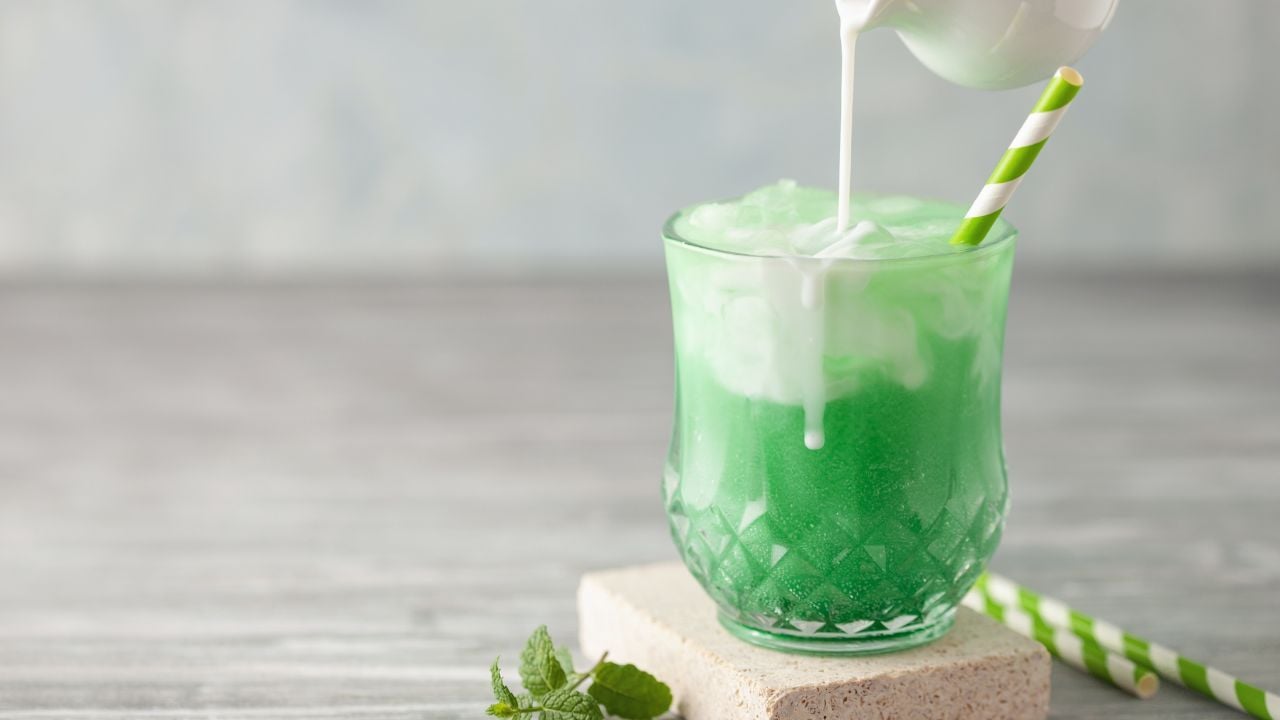
Utah’s dirty soda mixes a can of ordinary cola or citrus soda with cream, flavored syrup, and fruit puree until the drink barely resembles anything that came out of a fountain.
Swig, the St. George shop widely credited with turning the combination into a business, opened its first walk-up window on April 2, 2010, charging a dollar a cup.
A dollar a cup.
That didn’t sound alarming.
One cup of dirty soda can carry 250 to 400 calories and 55 to 70 grams of sugar, according to a registered dietitian who tracks the trend nationally.
That’s more added sugar than the American Heart Association recommends for a whole day.
The same report cited a 186-gram-sugar dirty soda sold by one national chain as a “metabolic disaster,” more sugar than 19 doughnuts in a single cup.
Why Dirty Soda Took Off in Utah
Utah’s dirty soda habit traces back to a religious guideline more than a marketing push.
The Church of Jesus Christ of Latter-day Saints asks its members to abstain from coffee, tea, and alcohol entirely, under a health code known as the Word of Wisdom.
Soda never made that list.
A blended, syrup-topped cup of it became Utah’s stand-in ritual drink, the way a coffee order works everywhere else.
6. Pastrami Burgers
Utah’s pastrami burger stacks a hamburger patty with a mound of sliced pastrami thick enough to double the sandwich’s height.
Not an afterthought.
Crown Burgers, the Salt Lake City shop best known for the pastrami burger, opened in 1978, when John and Rula Katzourakis teamed up with Rula’s brother Nick Katsanevas to open a burger stand of their own.
The pastrami itself came from somewhere else first.
John had worked at Minos Burgers in Anaheim, a stand owned by Rula’s other brother, Jim Katsanevas, where the pastrami-topped burger sold only two to four orders a day.
It never caught on there.
Utah felt differently.
Astro Burger, Apollo Burger, and Olympus Burgers each sell their own version today.
Beef and cured deli meat, stacked together, isn’t a combination many outsiders expect on a burger.
The sandwich takes both hands and a full stack of napkins to finish.
7. Bear Lake Raspberry Shakes
Every summer, Bear Lake in Utah turns into a raspberry destination, thanks to a German immigrant named Theodore Hildt who started planting berries near the shoreline in the 1920s.
His small patch eventually grew to 80 acres.
Lakeside drive-ins blend those raspberries into a shake so thick it barely moves through a straw.
Many Utahns will drive an hour out of their way for a shake.
That’s dedication.
The shake stays thick enough to eat with a spoon before it thins out enough to sip.
Psst! How much do you know about Utah’s food history and state symbols? Take our quiz and see how many you can get right.
Quiz
Utah Food IQ
Answer these questions on Utah’s food history and state symbols. We bet you can’t get them all right. Prove us wrong?
Utah’s nickname, the Beehive State, comes from the word “Deseret.” What does that word mean?
8. Pickle Pie
Pickle pie turns a jar of dill pickles into dessert in Utah, and that sentence alone tends to end conversations with newcomers.
A cook named Cula Ekker created the recipe at the Sunglow Cafe in Bicknell, a town of about 300 people, and it's been on the menu since 1965.
The filling blends ground sweet pickles with eggs, sugar, cinnamon, nutmeg, and lemon extract, baked inside a regular pie crust and topped with whipped cream.
The first forkful reads like a mince pie.
Then the vinegar tang creeps in once the chewing starts.
Pickles, for dessert.
Only the whipped cream on top tastes like an ordinary dessert.
9. Aggie Blue Mint Ice Cream
Aggie Blue Mint is Utah State University's bright blue mint ice cream, studded with chocolate cookie pieces and white chocolate flakes, added to the campus creamery's lineup in 2004.
The campus creamery traces back to 1922, when a small storefront started scooping four original flavors, and it now turns out roughly 52,000 gallons a year.
That color doesn't occur naturally in mint.
Dye did that.
Many Utahns grew up on the shade and barely notice it anymore.
A first-time transplant usually asks what's in the scoop before taking a bite.
Aggie Blue Mint alone makes up about a fifth of everything the creamery scoops each year, according to the university's own numbers.
