
17 Words Floridians Say That Make Northerners Do a Double Take

A Floridian can order lunch, gripe about the bugs, and give you directions without saying one word a Northerner recognizes.
It sounds like English.
Kind of.
These are the everyday words Floridians say that leave Northerners doing a double take.
No-See-Ums
Floridians warn you about the no-see-ums before they ever mention the sharks.
They’re biting midges, barely a millimeter long, and only the females draw blood.
You feel the bite before you spot the bug.
Standard mesh won’t stop them either, so they drift straight through ordinary window screens at dusk.
Sunset on a Gulf pier near Sanibel Island is arguably their favorite shift.
Snowbird
Snowbirds aren’t a kind of Florida seabird, though the word throws off every newcomer.
They’re winter residents who drive down from colder states around November and head home by April.
Restaurants fill up by 5 p.m., and traffic on US-1 doubles.
Every winter.
Locals clock the season by the out-of-state plates filling every Publix parking lot.
Lovebug Season
Twice a year, Florida drivers grit their teeth for lovebug season.
The insects fly locked together, front to back, in clouds thick enough to smear a windshield in minutes.
May brings the first wave, and September brings the second.
Ask around long enough, and someone swears University of Florida scientists built them in a lab.
Not true.
That story is a myth, and the flies spread into the state from the Gulf Coast on their own.
Sugar Sand
Floridians call the powder-white stuff on the Gulf beaches sugar sand, and they mean it as a compliment.
The grains are close to pure quartz, so they stay cool underfoot and squeak with every step.
Around Destin and the Emerald Coast, the sand glows almost white under a noon sun.
Bring sunglasses.
Northerners raised on brown Atlantic sand do a double take the first time they see it.
The 305
Say “the 305” anywhere in Florida, and everyone knows you mean Miami, not a phone setting.
It’s an area code turned into a badge, worn on hats, tattoos, and rapper nicknames.
The number covered the whole state back in 1947, one of the first area codes in the country.
Now it means Miami-Dade and the Keys.
Broward answers to the 954, and Tampa goes by the 813.
Wear it proudly.
Pub Sub
A Pub Sub is the deli sandwich from Publix, and Floridians treat it like a food group.
The Chicken Tender Sub draws the biggest crowd.
Order it on fresh Publix bread with the works, and a first-timer finally gets the fuss.
Northerners hear “grocery store sandwich” and expect nothing, then take a bite and go silent as they savor the taste.
Swale
The swale in Florida is the strip of grass between your yard and the road.
It’s a shallow drainage channel, so heavy rain runs into it instead of your living room.
You mow it, but the county owns it.
Park there for a cookout and nobody minds.
Cities like Cape Coral will fine you for paving it over.
Florida Room
A Florida room is the glassed-in porch built onto the back of the house.
It’s part sunroom, part den, ringed with windows and often left off the central air.
Older homes have jalousie windows that crank open for a cross breeze.
Families played cards and watched storms roll in from that room for decades.
Lanai
A lanai is the screened porch or patio off the back of a Florida home, and the word comes from Hawaiian.
It usually wraps around the pool behind a cage of screen.
That screen keeps the bugs and seagulls out while you sit outside.
No mosquitoes.
Real estate listings across the state brag about the lanai like it’s a second living room.
King Tide
A king tide is the highest tide of the year, and it floods Florida streets on a cloudless day.
The sun and moon line up in fall, so the water climbs higher than usual.
In Miami Beach, saltwater rises through the storm drains and pools on the road without any rain.
Tourists panic, but locals just reroute around the flooded blocks.
The Panhandle
The Panhandle is the long, skinny stretch of Florida reaching west toward Alabama.
Pensacola and Tallahassee sit up here, closer to the Deep South than to South Beach.
Part of it runs on Central time, an hour behind Miami.
Northerners picturing palm trees and Cuban food find pine woods and grits instead.
Zephyrhills
Most of the country sees Zephyrhills on a water bottle and stops there.
In Florida, it’s a town in Pasco County, north of Tampa.
The bottled spring water started there in the 1960s and drew from nearby Crystal Springs.
Same name.
Order a Zephyrhills at a Tampa deli, and you’ll get a cold bottle of water, not a bus ticket.
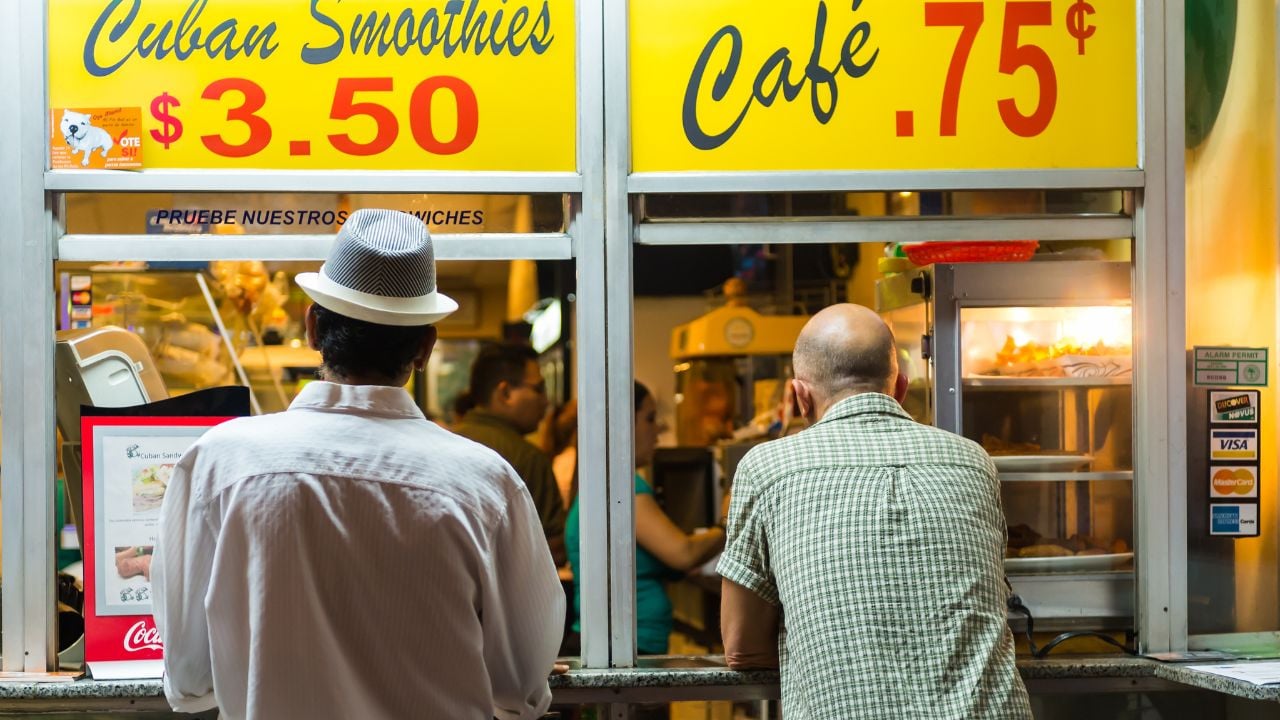
Cafecito
Cafecito in Miami is a thimble of sweet Cuban espresso, and the whole city runs on it.
You order it at a ventanita, the walk-up window on the side of a Cuban cafe.
Ask for a colada, and you get a bigger cup meant to share, poured into little plastic shots for the whole office around 3:00 p.m.
Northerners expecting a grande latte get a jolt the size of a shot glass.
Dale
Dale runs through Miami conversation as go, hurry up, okay, and let’s do it, all at once.
It’s Spanish and literally means “give it,” and it’s stretched to fit almost any moment.
Pitbull turned it into a catchphrase heard worldwide.
Dale.
Northerners hear it fifteen times a day and never crack the code.
The I-4 Corridor
The I-4 corridor is the band of Florida that Interstate 4 cuts from Tampa through Orlando to Daytona Beach.
Political reporters obsess over it because the region swings between parties.
Win the I-4 corridor, and you often win the state.
Northerners think it’s just the road to Disney World.
Jit
A jit is a kid or a young person in Florida slang.
The word grew out of Florida’s Black communities long before it hit the internet.
Rappers from the state carried it into their songs, and now you hear it from Jacksonville to Miami.
Watch the jits.
Northerners catch it in passing and reach for a dictionary.
Cracker
In Florida, “Cracker” is a heritage term many native Floridians wear with pride.
It reaches back to the 1800s cattle drivers who pushed herds across the palmetto scrub.
They snapped long rawhide whips to move the cattle, and the crack of the whip named the men.
Generations deep.
You’ll still find Cracker houses with wide porches, a Cracker Trail marked across the state, and festivals honoring the families who ranched here before window units and bug screens.
Call a fifth-generation rancher near Okeechobee a Florida Cracker, and it lands as respect.
12 Signs You’ve Lived in Florida Too Long, According to Locals
A tourist and a twenty-year Floridian can share the same parking lot and live in two different worlds.
The tourist still notices the heat. The local stopped noticing years ago.
12 Signs You’ve Lived in Florida Too Long, According to Locals
11 Unwritten Florida Rules Tourists Learn the Hard Way
Florida runs on a rulebook nobody hands you at the airport.
Some of these rules cost you a fine, and a few can cost you a night in jail.

#1 should be buggy. I never, in my life, heard someone call a shopping cart a buggy until I moved here.