
11 Unwritten Florida Rules Tourists Learn the Hard Way

A Florida vacation comes with a rulebook nobody hands out at the airport.
Some of the rules carry fines, and a few carry jail time.
These are the unwritten Florida rules tourists learn the hard way.
Clear the Left Lane
Florida statute says a driver may not stay in the furthest left lane while being overtaken by faster traffic.
That’s a moving violation, with a fine and three points on your license.
On I-95 and I-4, locals enforce it with headlights and horns long before a trooper does.
Cruising the left lane at the speed limit marks a rental car faster than the license plate frame.
Pass, then move over.
Psst! How much do you know about Florida beyond the beach? Take our quiz and see if you can ace it.
Quiz
Only-in-Florida Quiz
Answer these questions on Florida oddities. We bet you can’t get them all right. Prove us wrong?
Learn the Flag Colors
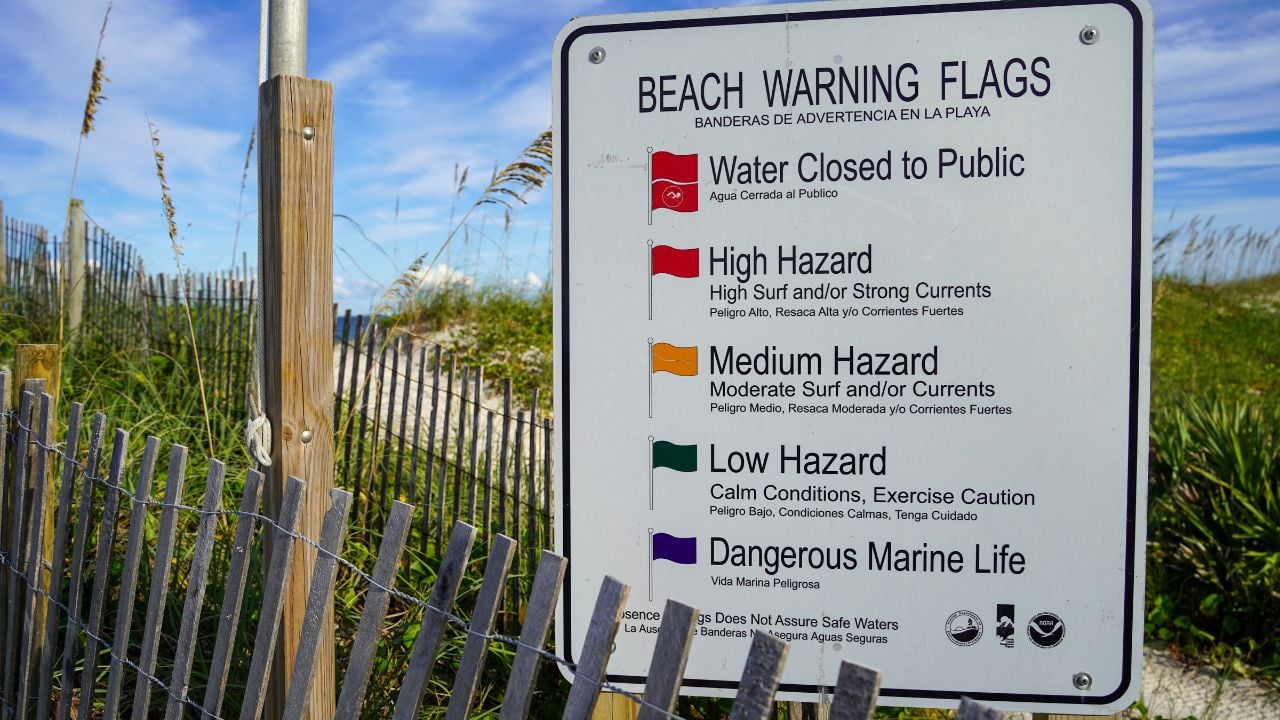
Florida beaches fly a color-coded warning system, and lifeguards expect you to read it.
Green means calm, and yellow means use caution.
Purple means dangerous marine life.
Single red means high hazard.
Double red means the water is closed, full stop.
Conditions change by the hour, so locals check the flag pole on every walk down.
In Panama City Beach, swimming under double red flags brings a $500 citation, and code enforcement stopped giving warnings first.
The Gulf looks calm from the sand even when rip currents run underneath.
Turtle Season Is Law
Sea turtle nesting season runs March through October on Florida beaches.
Wildlife officials ask beachgoers to fill in holes, knock down sandcastles, and clear chairs off the sand each night.
A nesting turtle can fall into the hole your kids dug at noon.
So can a hatchling making its first crawl to the water.
Many beach towns also require lights off or shielded after dark, flashlights and phone screens included.
Disturbing a nest is a crime, and the penalties escalate to felony territory.
Never Feed a Gator
Feeding an alligator in Florida is illegal, with penalties that start at a $100 fine and turn criminal on repeat offenses.
The law protects people, but it protects the gator, too.
An alligator that connects humans with food loses its natural wariness.
Wildlife officers end up euthanizing gators that people feed.
Floridians photograph them from a distance and keep the sandwich in the cooler.
The same restraint applies at the golf course pond, the boat ramp, and the retention pond behind the vacation rental.
Assume every body of fresh water in Florida has a resident.
Hands Off the Manatees
Florida's Manatee Sanctuary Act makes it unlawful to annoy, molest, harass, or disturb a manatee.
A conviction carries up to a $500 fine and 60 days in jail under state law.
Touching counts.
So does splashing to make one move, or offering it water from a hose.
Watch from the dock, and let the sea cow drift.
Leave the Sea Oats
That pretty golden grass on the dunes is off-limits.
Cutting or picking sea oats is against the law in Florida because the roots hold the dunes together.
Dunes are hurricane armor for the whole beachfront.
The same logic covers walking on them.
Use the boardwalk crossovers, even when the shortcut looks tempting.
Live Shells Stay Put
Sanibel and all of Lee County ban live shelling, and the rule is enforced.
A live shell is any shell with a creature still inside, whether or not it looks alive.
Fines can reach $500.
The sniff test settles it: A strong fishy smell means the shell is occupied.
Do the Sanibel Stoop all you want, but check each shell before it goes in your bucket.
Respect No-See-Um Hours
Nobody warns tourists about the bugs you can't see.
No-see-ums, the tiny biting midges of coastal Florida, swarm at dawn and dusk, especially near mangroves and still air.
A steady breeze keeps them away, and a windless evening delivers them by the hundreds.
Screened porches exist in Florida for exactly this reason.
Locals move happy hour inside around sunset and reclaim the patio after dark.
Tourists who host a 7 p.m. cookout on the canal learn the schedule in one evening.
Wildlife Gets the Right of Way
When a sandhill crane family strolls across the road, Floridians stop and wait.
No honking.
Same for the gopher tortoise inching across a two-lane road at its own pace.
Both species are protected in Florida, and locals treat the pause as part of the commute.
Drivers who can safely pull over sometimes shepherd a tortoise across in the direction it was already heading.
Tourists who lean on the horn out themselves instantly.
Shorebird Zones Are Serious
Those roped-off patches of sand with the small signs aren't suggestions.
Florida wildlife officials post them so beachgoers give nesting shorebirds room through summer.
A parent bird scared off its nest leaves eggs and chicks exposed to the sun, and Florida sun finishes the job in minutes.
Keep the beach walk, the kids, and especially the dog outside the ropes.
The birds were nesting on that sandbar before the condos had names.
Skip the Twilight Swim
Lifeguards and locals both pass on swimming at dawn and dusk, when bait fish school close to shore in the murky light.
Whatever eats the bait fish clocks in at the same hours.
Floridians also keep their distance from anyone casting a line.
Swimming beside a fishing pier full of cut bait defeats the entire point of caution.
Swim at 10 a.m. with the crowd, and save the sunrise for photos.
10 Florida Town Names Out-of-Staters Always Mispronounce
Nothing outs a Florida newcomer faster than reading a road sign out loud.
Florida's map mixes Native American syllables, Spanish words, and developer inventions. Locals hear every wrong pronunciation instantly.
10 Florida Town Names Out-of-Staters Always Mispronounce
9 Summer Secrets Floridians Never Tell Tourists

Floridians survive summer on a playbook nobody publishes.
It covers when to drive, when to swim, and when to stand still in the frozen-food aisle.
