
9 Things You Never Knew Were Invented in Ohio

Two civilian engineers at Dayton’s McCook Field built a parachute a falling man could open by hand.
Somebody had to test it, so on April 28, 1919, Leslie Irvin jumped out of a plane over the field and pulled the ripcord.
He broke his ankle and started a parachute company anyway.
These are the things many Americans never knew were invented in Ohio.
1. Your Vacuum Cleaner
A janitor sweeping carpets at a Canton department store in 1907 kept going home wheezing.
James Murray Spangler blamed the dust his push sweeper threw into the air.
So he built a better machine from a fan motor, a soap box, a broom handle and his wife’s pillowcase.
His was the first portable electric vacuum cleaner with both a cloth filter bag and cleaning attachments, and he earned the 1908 patent for it.
Money was the problem.
William Hoover, a harness maker married to Spangler’s cousin, invested in the business and the patents and took over as president.
Spangler stayed on as superintendent while the company took Hoover’s name.
Their town was still called New Berlin, and it wouldn’t take the name North Canton until 1918.
2. Ritty’s Cash Register
The till came up short.
James Ritty ran a busy Dayton saloon in the 1870s, and the cash never matched the crowd at his bar.
On a steamboat trip through Europe in 1878, he watched a counter tick off the ship’s propeller revolutions.
That gave him his answer.
Back home, he and his brother John worked through three designs before one held up, and patent 221,360 covered it.
They called it Ritty’s Incorruptible Cashier.
There was no cash drawer yet, so its only job was putting every sale in front of the owner and the customer.
Ritty sold his interest within a few years.
The buyers grew it into National Cash Register, where a young engineer named Charles Kettering got his start.
3. Your Car’s Starter
Starting a car in 1910 meant grabbing a hand crank and hoping, until a Dayton laboratory took the problem apart.
A backfire broke wrists.
Henry Leland, who ran Cadillac, lost a friend who died from an injury he got from a hand crank.
Leland took the problem to Charles Kettering, who had left the cash register business to open Delco, the Dayton Engineering Laboratories Company.
Kettering’s team worked out a starter that fed the flywheel one short, hard burst of battery current.
Leland put it in every 1912 Cadillac.
Within a decade, a starter came standard on new cars.
4. Pull-Tab Cans
Ermal Fraze forgot the can opener at a family picnic outside Dayton in 1959, pried the lids off on his car bumper, and spent the rest of the afternoon thinking about a better way.
Back at his shop, Reliable Tool and Manufacturing, he worked out a lid a finger could open, using the can’s own metal as both rivet and lever.
Pittsburgh Brewing put the new top on Iron City beer.
By 1965, nearly 75% of American breweries had switched.
Fraze’s tab came off in your hand, though, and beaches and ballparks filled with sharp little rings.
The litter got ugly.
Stay-on tabs arrived in the mid-1970s, and Fraze had nothing to do with them.
Psst! How much do you know about Ohio history? Take our quiz and see how many you can get right.
Quiz
Ohio History Pop Quiz
Test yourself on Ohio’s firsts, its oddities, and the famous names it produced. We bet you can’t get them all right. Prove us wrong?
Congress skipped a step back in 1803, so Ohio wasn’t formally admitted to the Union until which year?
5. Heimlich's Fight Over Back Slaps
Henry Heimlich, a Cincinnati surgeon, spent decades telling people never to slap a choking person on the back.
He called them death blows.
Heimlich ran surgery at Jewish Hospital and argued that a back slap drives food further down the windpipe.
His answer was to squeeze up under the ribs and force trapped air out of the lungs.
He published the technique in 1974.
Seven days after the paper ran, the method saved its first choking victim.
Then the American Heart Association's 2025 guidelines put back blows right back in, telling rescuers to alternate five of them with five abdominal thrusts.
Abdominal thrusts is the official name now, and most people still ask for the Heimlich anyway.
6. Paint in a Can
Before a chemist in Newburg took it on, painting a house meant grinding your own pigment and stirring it into oil by hand.
D.R. Averill wrote his answer into a patent dated July 16, 1867, from that Cuyahoga County township Cleveland later annexed.
What he wanted, in his patent papers' own words, was paint supplied in convenient packages, ready for use, and in any color or shade.
That saved a morning.
Sherwin-Williams, founded a few miles up the road in Cleveland, put its own ready-mixed paint on the market in 1873.
Four years later the company patented the resealable paint can, so you could shut the lid and come back to the job tomorrow.
7. Modern Golf Ball
The first rubber-wound golf ball core came out of the B.F. Goodrich plant in Akron in 1898.
Coburn Haskell had traveled down from Cleveland to meet his golf partner Bertram Work, who ran the plant.
Then he sat there waiting.
Bored, he wound rubber thread tight into a ball and bounced it off the floor, and it came back up near the ceiling.
Work saw it too.
The two of them turned that accident into a rubber-wound core under a gutta-percha shell.
Their patent, granted April 11, 1899, names Work of Akron and Haskell of Cleveland.
Golfers dropped the solid gutta-percha ball inside a decade.
The ball in your bag has a solid core now.
But the idea of putting rubber inside it started on that Akron floor.
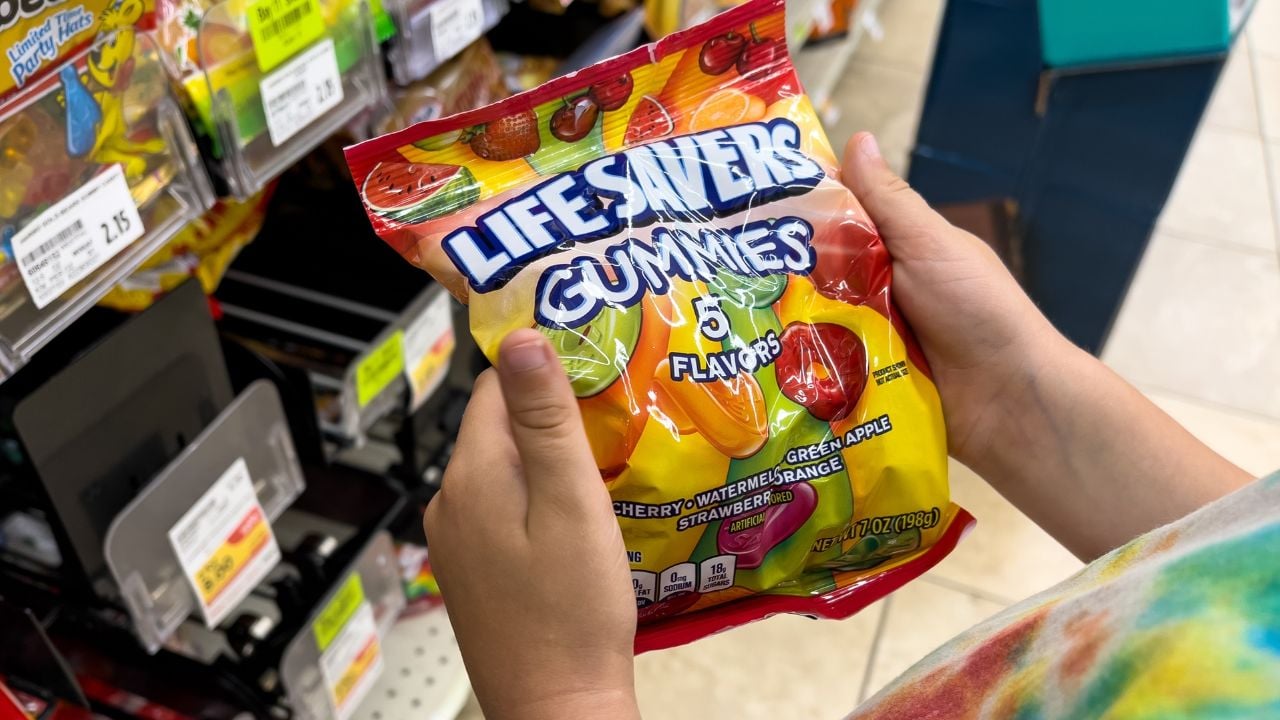
8. Life Savers Candy
Clarence Crane made chocolates in Cleveland, and every summer the heat ruined his stock.
He needed something that could sit in a shop through August.
So he bought a pharmacist's pill machine and pressed peppermints with it.
The machine punched a hole through the middle of every mint.
They looked like life preservers, which is where the name came from.
Then Crane walked away.
He handed the trademark and the business to two New York businessmen in 1913 for $2,900.
Edward J. Noble and J. Roy Allen bought the candy from Crane at first, and sales stayed bad.
The cardboard tubes he shipped the mints in soaked up the peppermint flavor.
Noble designed a foil package instead.
By 1915 the pair were making Life Savers themselves, without Crane.
9. Cozy Coupe
Jim Mariol got the idea scooting across his Cincinnati office floor on a desk chair.
The industrial designer had spent a college co-op term at Chrysler drawing hubcaps, steering wheels and hood ornaments.
Little Tikes, founded in Hudson, put his red and yellow Cozy Coupe on sale in 1979.
There's no engine in it.
You get a door that swings, a wheel that turns, a roof and no floor, since the driver's sneakers do the work.
By 1991, with half a million rolling out a year, it was outselling every gasoline-powered car in America, according to Smithsonian magazine.
The same magazine puts total sales at 22 million worldwide as of 2012.
Twelve Lamps Over Public Square
Charles Brush didn't wait for the rest of the country to sort out electricity.
On the evening of April 29, 1879, he switched on twelve arc lamps over Cleveland's Public Square, then known as Monumental Park.
Thousands turned out wearing smoked glasses, since nobody knew how bright it would be.
The National Inventors Hall of Fame credits him with the first electric light system installed in the United States.
Brush wasn't finished.
Nine years later he raised a wind-driven dynamo behind his Euclid Avenue mansion and wired it to a basement full of batteries.
That machine was the first automatically operated wind turbine generator built to make electricity.
It also made his the first home in Cleveland running on electric light.
Psst! People pin some famous inventions on the wrong state entirely. Tap through these cards and see which claims hold up.
Who Gets Traffic Light Credit
The argument over who invented the traffic light started in Cleveland, and it still hasn't settled.
A signal went up at Euclid Avenue and East 105th Street on August 5, 1914.
History.com describes it as widely regarded as the first electric traffic signal.
Competing claims exist, though.
A Salt Lake City officer named Lester Wire had mounted a wooden box of red and green lights on a pole two years earlier.
James Hoge designed the Cleveland version: Four pairs of red and green lights on corner posts, wired to a switch an officer threw in a control booth.
Hoge received patent 1,251,666 for it in 1918.
Garrett Morgan gets the credit in most retellings.
That isn't quite right.
Morgan's 1923 patent added a third position, the warning interval that holds every direction for a beat before the change.
He sold the rights to General Electric for $40,000.
So Cleveland can claim both, just not in the order most people tell it.
Signing Away Superman
The check that bought Superman came with a release form.
Jerry Siegel and Joe Shuster signed it in 1938 and handed over every right to the character.
Siegel grew up in Cleveland, Shuster was a Toronto native, and the two built Superman at Glenville High School five years earlier.
Publisher Harry Donnenfeld paid $135 for the strips that ran in the first issue of Action Comics.
That was the whole deal.
The same release bound them to Donnenfeld alone for ten years, at $35 a page and half the net profit.
They sued for the copyright in 1948 and took a $100,000 settlement.
Then they lost the court case, their jobs and any further involvement with Superman comics.
It took until December 1975, and public pressure from two cartoonists' groups, before Warner Communications agreed to pay each man $20,000 a year for life and restore their bylines.
7 Store Closings Hitting Ohio Shoppers

A full parking lot doesn't mean your store is staying open.
Shops that anchored their shopping centers for years taped closing signs to the doors across Ohio this summer.
7 Store Closings Hitting Ohio Shoppers This Summer
24 Tech Annoyances That Drive Ohioans Over 50

Apps, passwords, and smart gadgets run modern life, and Ohioans have opinions about all three.
Nobody wants to go back in time, but a few old-fashioned versions worked better.
