
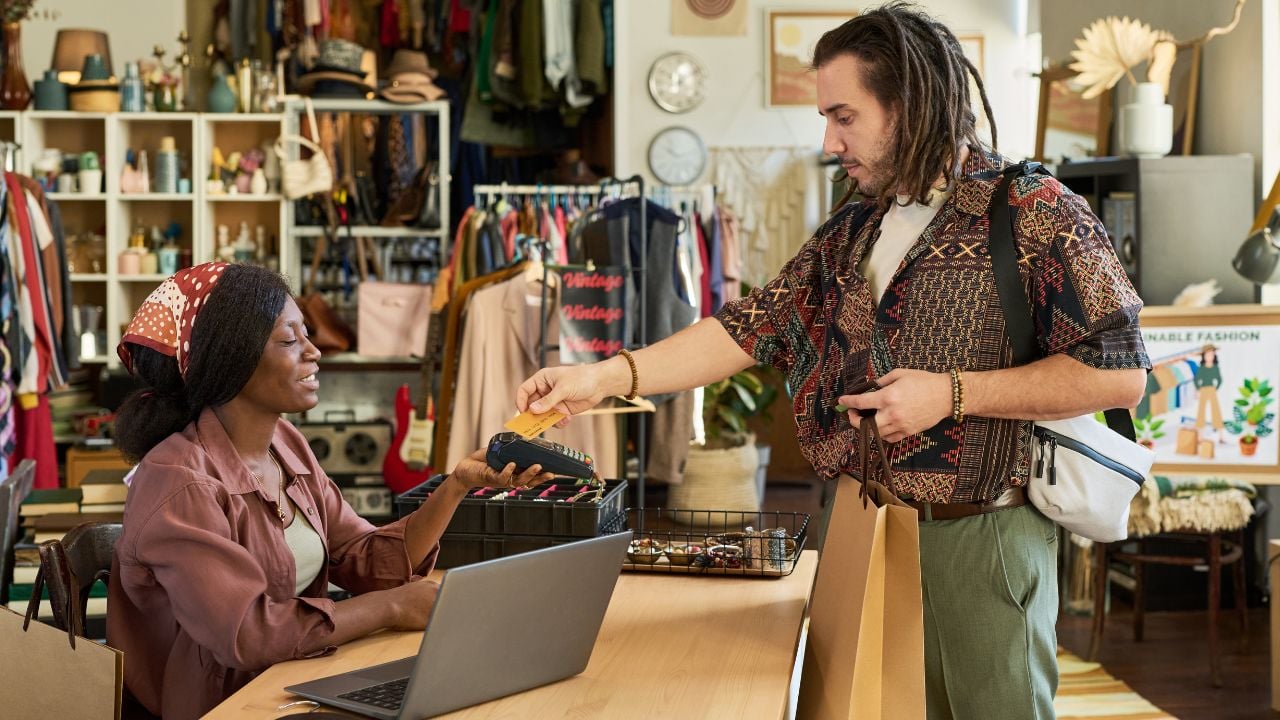
8 Overlooked Thrift Store Sections Where Pennsylvanians Can Score the Best Finds

A shopper walks all 30,000 square feet of the Re-Uzit Shop in New Holland and leaves with two shirts.
She unknowingly passed the good shelves four times.
Thrift stores sometimes put their best inventory where fewer people pass because the volunteers pricing those shelves have no way to know what they’re holding.
These are the overlooked thrift store sections where Pennsylvanians can often score the best finds.
1. Linens Aisle
Nobody fights you for the linens aisle at a thrift store.
That’s the reason it stays worth digging through.
Start with the folded napkins and tablecloths, and check the corners for a script Vera signature, sometimes with a small ladybug printed beside it.
Vera Neumann’s designs ran through American department stores for decades, and a thrift store prices her napkins like napkins.
Then work the blanket stack, where the label matters more than the pattern does.
Wool outlives fleece.
Woolrich wove in Clinton County from 1830 until the mill closed in 2018, so a blanket with that label in a central Pennsylvania store may have been made twenty minutes up the road.
2. Pots and Pans
Most shoppers give a thrift store’s cookware shelf about four seconds.
From three feet away, it reads as a pile of scratched nonstick.
But try lifting the heavy pieces.
Matthew Griswold and Samuel Seldon started their company in Erie in 1865, and the Smithsonian credits it with pioneering finished cast iron cookware.
The underside of the museum’s own Griswold pan reads GRISWOLD ERIE PA., U.S.A.
That’s Pennsylvania iron.
Old cast iron often feels different in your hand, too, since it weighs less than a new pan the same size and the cooking surface is smooth rather than pebbled.
McGraw Edison bought Griswold in 1955 and sold it to a Cincinnati company two years later, so the Erie name on a pan puts it in the years before that sale.
3. Framed Art Rack
The framed art leaning against the back wall gets the fastest walk-by in the store, and almost nobody looks past the picture to the frame around it.
Buy the frame anyway.
A wide wooden frame with tight corners and unbroken glass earns its sticker on its own, and what goes inside it is a decision you make later at home.
You can feel the difference between the two kinds of frame, since gilded wood has heft and a modern lookalike is molded plastic you can lift with two fingers.
Then turn it around.
Gallery labels, framers’ stamps, a pencil notation like 24/250 in the margin and a signature tucked under the mat all sit on the back, where the person who donated it never looked.
The Pennsylvania Academy of the Fine Arts opened in Philadelphia in 1805 as the country’s first art museum and art school, and it ran annual exhibitions from 1811 until 1969.
So a Philadelphia gallery label on the back of a $9 frame is worth reading before you decide what you’re carrying.
Psst! How much of a Pennsylvania thrift store are you working? Run through this checklist and see how you score.
4. Glassware Shelf
Almost nobody turns a piece of glass over at a thrift store.
That shelf holds a century of Pennsylvania glassmaking.
Westmoreland Glass opened in Grapeville in 1889 making goblets, pitchers and novelty items.
Its milk glass came much later, largely through the 1950s, and that white pressed glass is what collectors chase today.
They read the base for an intertwined WG monogram molded into the glass, per the national collectors’ club.
A missing mark proves nothing.
The company left many of its earlier pieces unmarked and sent others out the door with nothing but a paper label.
The club also warns that common milk glass stays modestly priced, so the colored, hand-decorated and rare pieces are where the value is.
That corner of the state poured a lot of glass. Jeannette went by Glass City with seven glass factories at its peak, and L.E. Smith worked out of Mount Pleasant for most of a century.
5. Craft Corner
Near the back of the store, past the toys, most thrift stores keep two or three shelves of yarn, thread, buttons and folded fabric that nobody bothers to merchandise.
Head for the fabric.
When somebody clears out a sewing room, quilting cotton and wool suiting often land on that shelf in bags, priced by the bag instead of by the yard.
Yarn works the same way, so read the paper band on the skein: Wool, alpaca and cotton cost several times what acrylic costs new, and the shelf price doesn’t change with the fiber.
Uncut sewing patterns sit in the same bin with their tissue pieces still folded flat inside the envelope, which is the difference between a pattern you can use and a souvenir.
Around Lancaster County, where quilting has been a household craft for generations, that shelf is worth a second look on your next trip.
6. Men’s Department
Thrift stores sort clothing by size and by gender, never by fiber.
The men’s department is where that habit pays you back.
Wool and cashmere sweaters arrive by the closetful when a family clears out a house, and not everybody crosses the aisle to look at them, especially if you’re not in the market for men’s clothes.
Read the collar tag first, since anything sold new as cashmere has to list its fiber content under federal labeling rules.
That tag is also the only answer you’re going to get. Labels get cut out, washed blank or trimmed off, and nobody has to relabel a sweater once it reaches a donation bin.
Experts need a microscope.
Work the jackets on the same rack for a zipper pull stamped TALON, made in Meadville, where the Hookless Fastener Company was turning out a thousand zip fasteners a day by November 1913 and took the Talon name in 1937.
Shopping secondhand isn’t a fringe habit anymore, either: ThredUp’s 2026 Resale Report, prepared by GlobalData, expects Americans to spend $78.8 billion on secondhand clothing by 2030.
7. Book Aisle
Shoppers judge a thrift store’s book aisle by its paperbacks, and that’s the wrong shelf to judge it by.
Go to the cookbooks, then keep going to the spiral-bound church and community collections nobody bothered to alphabetize.
A Scottdale association put the Mennonite Community Cookbook together in 1950, and the John C. Winston Company in Philadelphia printed it.
It has sold close to half a million copies since, and its author tested almost 600 cake recipes before settling on the 79 that made the book.
Those recipes work.
Many church cookbooks got one print run of a few hundred copies and no reprint after it.
So a fire hall collection out of a Schuylkill County coal town could be the only place a recipe still exists, and the handwriting in the margin is somebody’s correction to it.
8. Sporting Goods Corner
Sporting goods in a thrift store usually means a rack of tennis rackets and a barrel of golf clubs, and shoppers skip the fishing tackle sitting beside them.
Otto Henze started Penn Fishing Tackle in a third-floor Philadelphia loft in 1932.
Its first recorded sale came in February 1933, when Miller Auto Supply of Harrisburg bought one of each reel Penn made: A Sea Hawk for $1.21, a Bayside for $1.93 and a Long Beach for $2.48.
The Senator followed in 1936, and Penn kept building black-and-gold reels in Philadelphia for decades, which is why they still turn up in donated tackle boxes.
Spin the handle.
A Penn reel that feels stiff on the shelf usually wants grease and fresh drag washers, and both run a few dollars, so the sticker price is close to the whole cost.
Henze died suddenly in 1948, and his wife Martha took over as president at 39 and kept the Hunting Park Avenue plant running.
Does Pennsylvania Tax Social Security?
Pennsylvania doesn’t tax a single dollar of a Social Security check, whether that check reads $1,100 or $3,900.
The state goes further than that, too, and the part that surprises people is what else comes out untaxed.
Does Pennsylvania Tax Social Security? What Retirees Pay in 2026
12 Things Pennsylvanians Miss After Moving Away
A transplant walks into a grocery store in Nevada asking for scrapple and walks back out with nothing.
The deli clerk has never heard the word, and neither has anybody else in the store.
