
9 Things That Can Get Your North Carolina Driver’s License Suspended (Besides Drunk Driving)

North Carolina doesn’t need a DUI to take a driver’s license.
A judge handling a case with no car anywhere in it can still end with a suspended license.
These are the North Carolina driver’s license suspension triggers that never involve a breathalyzer.
Note: This is general information, not legal advice. North Carolina’s suspension rules and point values are subject to change, so confirm your own driving record and the current requirements with the North Carolina Division of Motor Vehicles (NCDMV).
1. Racking up 12 Points
North Carolina keeps a running tally on every driver, and that tally alone can end a license.
One section of North Carolina law lists eleven separate reasons to suspend a license.
Drunk driving isn’t one of them, since DUI runs on its own statute entirely.
Twelve points in three years is the rule many drivers have at least heard of.
Cross that line, and the first suspension runs 60 days.
A second trip past 12 points stretches it to six months.
A third stretches it to a full year.
Every point clears off the record once a suspension ends.
A clean slate, sort of.
2. Driving Without Insurance
North Carolina can suspend a license over a lack of insurance without a single conviction ever entering the case.
This one runs through a completely different law than the point system, built around actual accidents rather than points on a record.
Get into a reportable crash while uninsured, and North Carolina’s security-following-accident law gives the driver 60 days from the accident report to prove coverage or post a cash bond covering the damages.
Miss that window, and the Division of Motor Vehicles suspends the license outright.
Fault never factors into it.
A driver who did nothing wrong in the crash faces the same deadline if they were uninsured when it happened.
Only accidents involving less than $100 in damage skip the requirement entirely.
A separate system also flags every policy lapse electronically, but that track hits a vehicle’s registration first, not the license.
3. Speeding Twice in a Year
North Carolina doesn’t wait for a driver to hit 12 points if the points come from speeding.
Two convictions for speeding between 55 and 80 miles per hour within 12 months trigger an outright suspension.
The point total on the record doesn’t matter.
One reckless driving charge paired with one qualifying speeding ticket does the same thing.
The suspension for this one runs six months, and it applies even to a driver with an otherwise spotless record.
One ticket won’t do it.
Two will.
4. Getting a No-Driving Court Order
North Carolina lets a judge take a license away in a case that never had a car in it anywhere.
Under the same law that runs the point system, a judge can suspend part of a criminal sentence and set “no driving” as one of the conditions.
Break that condition, and North Carolina’s DMV suspends the license to enforce the order.
The underlying case can be about anything the court decides warrants it.
A driver with a completely clean record can still end up parked, over a case that never touched a steering wheel.
Points Are Only One Way North Carolina Suspends a License
North Carolina doesn’t funnel every suspension through the same point total.
The insurance-accident law above, the two-speeding-ticket rule, and an unrelated case’s no-driving order are just three of the tracks that trigger a suspension on their own, with no points required at all.
A driver with a perfect point total has no shield against any of them.
5. Falling Behind on Child Support
North Carolina ties a driver’s license to more than a driving record, and child support sits right at the top of that list.
Fall 90 days behind on a court-ordered child support payment, and North Carolina’s child support enforcement agency can ask a judge to revoke the license.
A judge weighing the case can grant a limited driving privilege if losing the license would cost the parent their job.
The request still goes through a full court hearing, never an automatic DMV letter that catches a parent off guard.
Catch up on the balance in full, and the agency can certify the debt cleared so the license comes back.
6. Carrying an Open Container
North Carolina can suspend a license over alcohol without ever charging a DWI.
State law makes it illegal to keep an opened container of liquor or fortified wine in the passenger area of a moving vehicle, whether the driver has had a drop or not.
A conviction under that transportation law is its own separate ground for suspension, listed in the same statute that governs points.
Sobriety doesn’t matter.
The bottle just has to be open, in reach, and in the car.
7. Lending Someone Your License
North Carolina doesn’t limit license fraud to the person using a fake card.
Hand a license to a friend so they can pass for 21, or let someone claim a card as their own, and North Carolina can suspend that license over the unlawful use alone, under the same statute covering points and speeding.
The DMV doesn’t need proof anyone got hurt or even got caught driving.
No injury required.
A parent trying to help a teenager into a bar learns that lesson more often than expected.
8. Missing a Court Date
North Carolina doesn’t send a second reminder before pulling a license over a missed court date.
Skip a scheduled traffic court appearance, and the clerk reports the no-show to the DMV once 20 days pass with the case still unresolved.
The suspension that follows stays in place indefinitely.
No exceptions.
It lasts until the driver either resolves the charge or proves to the court they weren’t the one who got the ticket.
A citation from years back can still be sitting there unresolved, blocking a renewal today.
9. Skipping a Court Fine
North Carolina hits an unpaid court fine with the same kind of suspension it uses for a missed court date, just on a slower clock.
A judge orders a fine, a penalty, or court costs, and the clerk reports the debt to the DMV once 40 days pass with nothing paid.
That suspension has no built-in end date.
Getting it lifted takes more than a receipt, though.
A driver can clear it by paying the balance in full, or by convincing the court the missed payment wasn’t willful and that they’re making a genuine effort to pay it off.
A judge can even decide the fine itself should be forgiven.
A small unpaid balance from a single ticket can still freeze a license for years if nobody raises any of those arguments.
Psst! How much do you know about North Carolina’s driving history? Take our quiz and see how many you can get right.
Quiz
North Carolina Driving History IQ
Answer these questions on North Carolina’s roads, plates, and driving firsts. We bet you can’t get them all right. Prove us wrong?
What year did North Carolina first require a driver to pass a test before getting a license?
Checking Your Own License Status
North Carolina gives every driver a free way to see trouble coming before a clerk rejects a renewal at the counter.
NCDMV's MyDMV portal shows a driver's current point total, any pending suspension, and the reason behind it, all from a home computer or phone.
Checking costs nothing.
It takes only a few minutes with a license number and some identifying details on hand.
Many drivers only find out about a problem when a clerk flags their renewal at the counter, long after the 20-day or 40-day reporting window has already closed.
A five-minute look at MyDMV catches a child support flag, an old unpaid ticket, or a stray insurance point before it turns into a wasted trip to a driver license office.
6 Things That Change at the North Carolina DMV in Your 60s
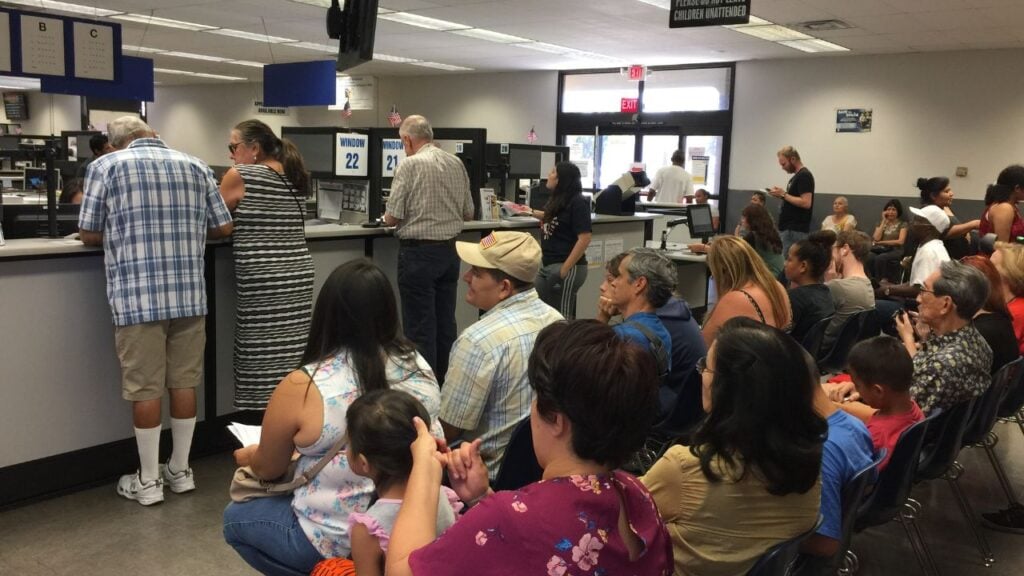
Turning 66 changes more than a birthday cake at the North Carolina DMV.
The renewal cycle shortens, the parallel-parking test disappears, and the price tag shifts, all on the same birthday.
6 Things That Change at the North Carolina DMV in Your 60s
9 North Carolina Squatter Laws That Leave Homeowners Powerless

North Carolina law can turn a truck parked in an empty driveway outside Asheville into a legal claim on the whole property.
A long-term occupant can end up owning a home the owner simply stopped checking on.
9 North Carolina Squatter Laws That Leave Homeowners Powerless
