
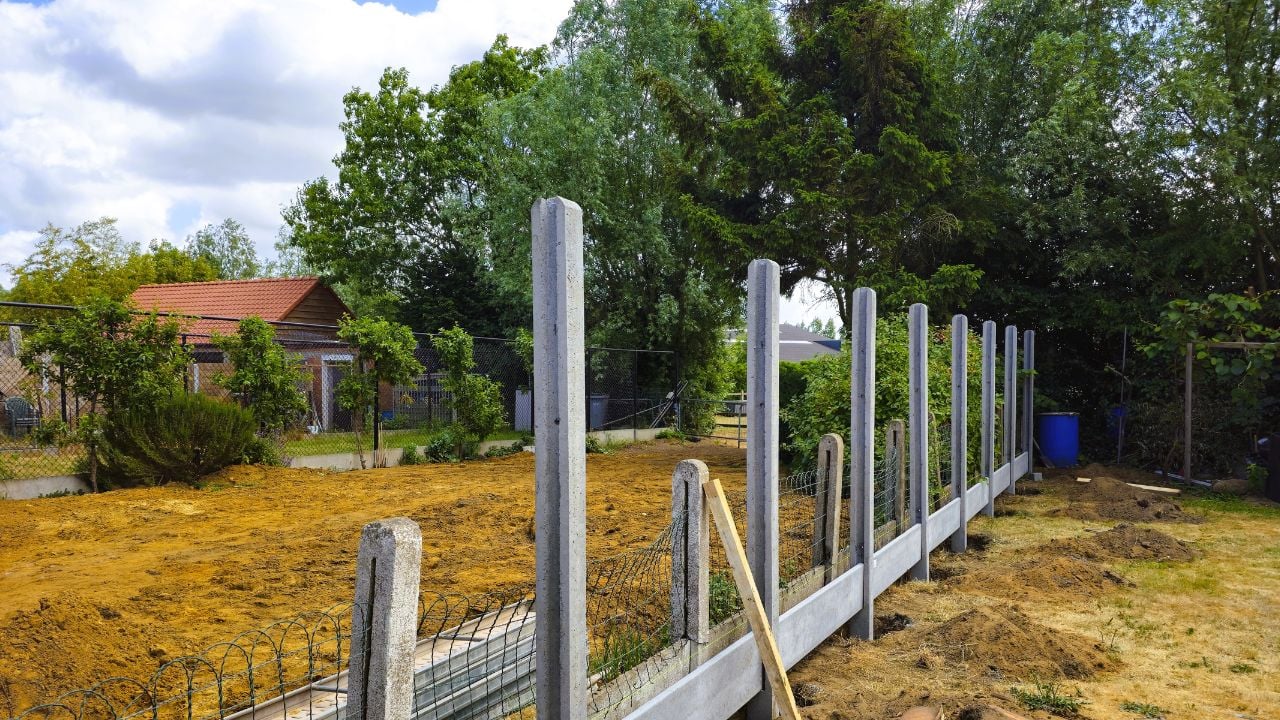
8 Texas Fence and Property-Line Rules Homeowners Learn Mid-Argument

A Texas fence dispute rarely starts with anyone pulling out the actual rule first.
By the time a neighbor calls a city inspector or an HOA board, the argument has usually been going on for weeks.
These are the Texas fence and property-line rules that many homeowners end up learning about after an argument with their neighbor.
Note: This is general information, not legal advice. Fence and property-line rules mix Texas statutes, local ordinances, and HOA rules that change over time, so confirm your address’s own rules with your city’s code compliance office or a licensed Texas surveyor.
1. No Law Splits the Bill
No Texas statute forces you to help pay for a fence, even one that runs straight down your own property line.
A neighbor can hand you a $4,000 estimate for new cedar pickets, and Texas law doesn’t require you to pay a cent of it unless you already agreed to.
The Texas State Law Library’s own guide on neighbor disputes says it plainly: A landowner has no legal obligation to share the cost of a fence a neighbor built, unless the two sides agreed to it beforehand.
Nobody warns you first.
A handshake deal made over the fence line rarely survives the argument that follows, so put any cost-sharing agreement in writing before the first post goes in the ground.
2. Your City Sets the Height
How tall a fence can stand in Texas depends on the city, not the state capitol.
Austin caps a solid fence along a property line at six feet, with narrow exceptions that allow seven or even eight feet where the ground slopes or a pool sits nearby, and only with the neighbor’s written sign-off.
Drive a few hours to a different Texas city and that number changes.
Different council, different code.
A permit isn’t always required either. Austin skips it for a standard fence at six feet or under outside a floodplain, while many other Texas cities require a permit no matter how short the fence runs, so check with your own building department before your neighbor cites a rule that never applied to your address.
3. A Survey Draws the Line
A licensed survey, not a fence, proves where a Texas property line sits.
Many Texas fences went up decades ago by eyeballing a tree line or splitting the difference between two driveways, and the metal T-posts don’t carry any legal weight on their own.
Only a licensed surveyor’s field notes, matched against both deeds, settle where the line falls.
The deed controls.
A title company orders a new survey, the fence turns up a few feet into a neighbor’s Bermuda grass, and both households learn the yard they thought they owned was never theirs to begin with.
4. Tree Trimming Has Hard Limits
Branches and roots that cross onto a Texas homeowner’s land can be trimmed back without asking permission first.
That right covers cedar elm, live oak, or any other species crossing the line, right up to the property boundary.
The boundary still counts.
Cross onto the neighbor’s side, or trim aggressively enough to kill the tree, and the self-help right flips into liability for the damage. Falling branches that crack a roof or invasive roots that buckle a walkway are far more likely to support a nuisance claim than a tree that only drops leaves or blocks the sun.
5. A Fence Can Shift the Line
Stand undisturbed long enough, and a misplaced fence can become the actual property line under Texas law.
The doctrine is called adverse possession, and its most common track usually decides a backyard fence fight, needing ten years of peaceable, open use under Civil Practice and Remedies Code Chapter 16, no deed and no tax bill required.
Mowing counts.
So does gardening a strip, storing a boat on it, or maintaining the fence itself as though the land behind it always belonged to you.
Texas’s Ten-Year Fence Math
Texas law recognizes four separate adverse possession timelines, and the ten-year track is the version that usually surfaces in a backyard fence fight.
That track needs ten straight years of peaceable, open use, mowing, planting, or fencing a strip of land like it’s yours.
The other three tracks split on paperwork.
Texas’s five-year track and one of its two twenty-five-year tracks both require a recorded deed behind the claim.
The three-year track and the other twenty-five-year track don’t, resting on nothing more than “color of title” or on years of continuous use alone, something many neighbor-to-neighbor boundary arguments never have either way.
6. Your HOA Lost Its Veto
Homeowners associations in Texas can no longer refuse a homeowner’s security fence outright.
A 2025 law update to Property Code Section 202.023 bars an association from adopting a covenant that blocks a homeowner from installing a perimeter security fence, camera, or motion detector.
Read the fine print, though.
An HOA can still control the material, color, and style of that fence.
It can also block a fence that obstructs a sidewalk or drainage easement, or require a driveway gate to sit ten feet back from the road.
An HOA can even keep enforcing an old front-yard fence ban, as long as its recorded covenants already had one on the books.
Psst! How much do you know about Texas fence and property-line law? Take our quiz and see how many you can get right.
7. Your Pool Fence Answers to the City
A statewide pool-fence standard does exist in Texas, but it skips the typical backyard entirely.
Health and Safety Code Chapter 757 sets a 48-inch enclosure, a self-latching gate, and a ban on chain link, but the chapter applies only to pools run by a multiunit rental complex or an HOA.
A private backyard pool almost always falls outside that requirement.
This rule’s local.
A homeowner who pours a private pool answers to their own city’s building code instead, which usually borrows the same non-climbable barrier idea but sets its own height and permit rules on top of it.
That gap is exactly where an argument starts: An HOA can fold the state’s own 48-inch, self-latching design into its private pool rules and enforce it on every backyard pool in the subdivision, whether Chapter 757 legally reaches that pool or not.
8. Loose Cattle Can Be Legal
Many rural Texas counties still run on a fence-out default instead of a fence-in rule.
Under Agriculture Code Chapter 143, a county that hasn’t adopted a local stock law puts the fencing duty on the landowner, not the rancher, meaning a neighbor’s cattle wandering onto unfenced land may not be trespassing at all.
The fence is yours.
Cattle still graze wide stretches of Hill Country and Panhandle acreage this way, though the classic Texas Longhorn is a far rarer sight on a working ranch today than it was in the open-range era.
Move to a city or a county that has adopted a stock law, and the responsibility flips onto the livestock owner instead, so the same herd wandering the same fence line answers to a different rule depending on which side of a county line it crosses.
Some Deeds Still Speak in Varas
Older Texas land grants never joined the federal township-and-range grid that many other states survey by.
Stephen F. Austin required his own surveyors to follow Mexican colonial practice before Texas ever became a republic, and that metes and bounds tradition stuck even after statehood.
The grid never arrived.
Those deeds describe land by chains, calls, and the Spanish vara instead, tied back to the original Spanish or Mexican land grant a family received generations ago.
Pull an old abstract on a rural property and a modern surveyor still has to reconcile it against that original grant, not a tidy grid, which is part of why a Texas boundary dispute can take longer to untangle than the neighbor across the fence expects.
A title company handling one of these older tracts usually brings in a surveyor experienced with historic Spanish and Mexican land grants, not just whichever licensed surveyor is closest.
That specialized work is a large part of why closing on a rural property with a vara-based deed commonly takes longer, and costs more, than closing on a subdivision lot that was platted in feet from day one.
8 Texas Small Towns Locals Love (and 3 Tourists Overrun)
About 300 people live in Turkey, Texas, and every spring roughly 7,000 show up just to dance in the streets with them.
Some Texas towns hand tourists a fiddle contest or a bat flight instead of a gift shop, and locals have strong opinions about which ones deserve the crowd.
8 Texas Small Towns Locals Love (and 3 Tourists Overrun)
10 Texas Summer Rules Locals Follow That Newcomers Learn the Hard Way

Think the worst thing a Texas summer can cost is a high electric bill?
Not necessarily. Longtime Texans follow a set of unwritten summer rules about woodpiles, sidewalks, and standing water that newcomers usually learn only after a close call of their own.
10 Texas Summer Rules Locals Follow That Newcomers Learn the Hard Way
