
9 Vermont Foods and Drinks That Make Visitors Regret Asking What’s in Them

Vermont wrote a law in 1999 about what’s supposed to sit beside a slice of apple pie.
It has nothing to do with crust, and it sounds unappetizing to other Americans.
These are the Vermont foods and drinks that leave a visitor sorry they asked what’s in them.
1. Bradford’s Wild Game Supper
Bradford’s Wild Game Supper takes over the United Church of Christ every fall, in an event food writer Calvin Trillin once called the Superbowl of church suppers.
It’s been running for nearly 70 years now.
About 800 people show up for a $25-a-plate supper, seats reserved well in advance.
The menu reads nothing like a potluck.
Venison, moose patties sweetened with blueberries, smoked wild boar, and beaver all turn up on the buffet, tracked by color-coded toothpicks so diners know what they grabbed.
One toothpick color per animal.
Hunters and trappers donate much of what lands on the table.
Organizers have taken the occasional load of roadkill moose when the meat count runs short.
2. Sugar on Snow
Every March, sugarmakers across Vermont turn the season’s first boil into a party.
Sugar on snow is the reason people show up.
The recipe is just hot maple syrup, poured straight onto a pan of packed snow until it hardens into a chewy candy.
Vermonters roll it onto a fork or a popsicle stick and eat it like taffy.
Then comes the part that stops a visitor mid-bite: A dill pickle and a plain doughnut, served on the same plate.
The pickle and the coffee cut the sugar rush, so a second helping goes down easier.
Not a joke.
3. Cabot’s Clothbound Cheddar
Jasper Hill Farm in Vermont’s Greensboro rubs Cabot’s most famous cheddar down in lard for its first days, not plastic wrap.
The creamery presses cloth over that layer of fat before each wheel goes into an underground cellar.
Those wheels age for 9 to 14 months down there, brushed and turned by hand the whole time.
A gray, crumbly rind builds up on the outside.
That rind and the lard beneath it are what give the inside its crumbly, crystalline bite.
Cheese, not candle wax.
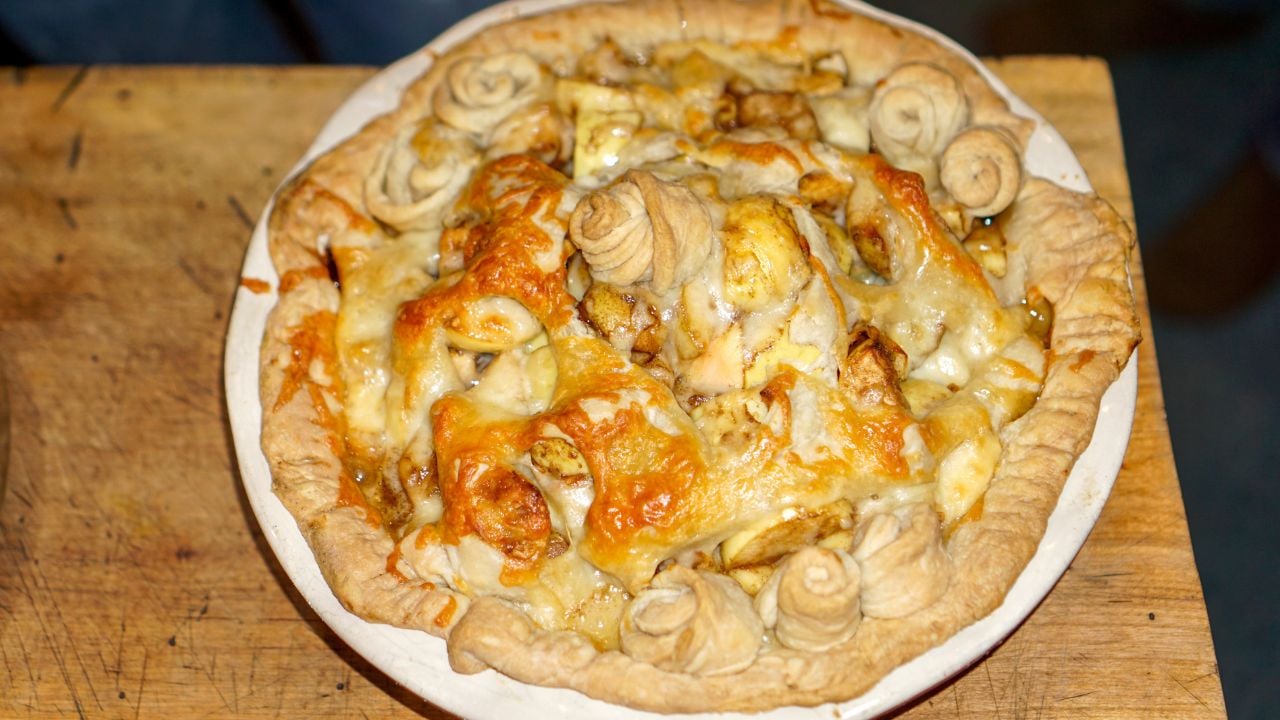
4. Cheddar on Apple Pie
Vermont diners get a wedge of sharp cheddar plated right against a warm slice of apple pie, not a garnish forgotten on the side.
Order it at a diner from Brattleboro to St. Johnsbury and the cheese comes standard, often melting slightly into the crust.
Nobody blinks.
Vermont felt strongly enough about the pairing to write it into law in 1999.
Restaurants are asked to make a good-faith effort to serve a slice with cold milk, vanilla ice cream, or a wedge of cheddar weighing at least half an ounce.
Gov. Howard Dean signed it.
The law carries no penalty, and nobody’s ever been fined over a plain slice.
Many Vermont diners still set that cheese down next to the crust anyway.
Ask why, and a local will just shrug.
5. Vermont’s Gorton
Vermont’s Franco-American families call it gorton.
It’s the pork spread that still greets breakfast tables in Winooski and St. Albans.
French-Canadian immigrants carried the recipe south into Vermont’s mill towns and rail yards.
About 105,000 Vermonters today still claim French or French-Canadian ancestry, the state’s third-largest group after English and Irish.
The spread itself is simmered ground pork and pork fat, seasoned with cloves, cinnamon, and allspice until the liquid cooks away.
It cools into something closer to a coarse pâté than anything labeled “spread” at a regular grocery store.
Fat, mostly.
Vermonters spread it on toast at breakfast, no apology needed.
6. Fiddleheads From the Woods
Fiddleheads push up along Vermont creek banks for about two weeks each spring.
Foragers race the calendar to catch them while they’re still tightly coiled.
They taste something like asparagus crossed with spinach, once they’re cooked all the way through.
No shortcuts allowed.
That last part matters more than many visitors realize.
What Undercooked Fiddleheads Do
Vermont’s foragers pick the same wild fiddleheads that have caused documented outbreaks of food poisoning elsewhere in the Northeast.
The confirmed cases trace to New York and Canada, from people who ate them raw or barely cooked.
Symptoms show up fast, usually within 30 minutes to 12 hours.
They include nausea, vomiting, cramps, and diarrhea.
Researchers still haven’t identified the exact cause.
Boiling them a full 15 minutes, or steaming them 10 to 12, is what makes them safe.
A quick sauté doesn’t get them there, and neither does the microwave.
7. Common Crackers and Milk
By 1885, at least ten steam-powered bakeries were turning out common crackers across Vermont, from Montpelier to St. Johnsbury.
The cracker itself is a flat, roughly two-inch round with almost no flavor on its own.
Old cartoons joked you needed a hammer to break one open.
Old-time Vermonters crumbled it into a bowl of hot milk for Sunday supper, after church, when nobody wanted to cook a full meal.
That’s it.
Families ate it with a spoon, like a cereal that still fights back a little on the way down.
8. Wood’s Boiled Cider
The Wood family has boiled cider down into syrup in Weathersfield, Vermont, since 1882, when they converted a water-powered sawmill into a cider mill.
Willis and Tina Wood took over the mill in 1970 and became the last family still doing it at commercial scale.
Their evaporator presses about 700 gallons of fresh cider a day every fall.
Nearly all of it boils down to roughly 80 gallons of syrup.
No sugar, no additives.
Just heat, until the water cooks off into something dark and far more intense than the maple syrup a first-timer expects.
It puckers before it sweetens.
Slow Food USA now lists it on the Ark of Taste, a catalog of foods at risk of disappearing.
9. Vermont’s Raw Milk
Vermont lets a licensed farm sell milk straight from the tank, no pasteurizer required, as long as a warning sign says so.
The rules split into two tiers.
Tier I caps sales at 350 quarts a week, sold only at the farm, basic cleanliness the only requirement.
Tier II raises the limit to 1,400 quarts a week and opens up farmers markets and home delivery.
No middleman.
Buyers have to be told, in writing, that the product could carry pathogens.
Vermont tests the animals for tuberculosis and brucellosis before they ever join the herd.
A tourist used to shrink-wrapped supermarket milk asks a lot of questions at that farm stand.
A Vermont farm stand posts its raw milk sign right next to the honor-system cash box, no clerk in sight on a slow afternoon.
Vermont requires Tier II sellers to get that milk tested twice a month, on top of the animal checks, before any of it reaches a jug.
Psst! How much do you know about Vermont’s food and farm history? Take our quiz and see how many you can get right.
Quiz
Vermont Food & Farm IQ
Answer these questions on Vermont’s food and farm history. We bet you can’t get them all right. Prove us wrong?
Vermont picked an official state mushroom in 2024 after a group of students pushed lawmakers to do it. Which fungus got the honor?
7 States That Won't Touch a Penny of Your Retirement Income in 2026

Retire to Alaska, and the state does something no other state bothers with: It pays residents a yearly dividend from its oil savings.
Pair that with zero tax on a pension, a 401(k) withdrawal, or a Social Security check, and a handful of states start looking a lot friendlier to a fixed income than the one you're in now.
7 States That Won't Touch a Penny of Your Retirement Income in 2026
