
7 Nevada Ghost Town Finds That Are Illegal to Remove

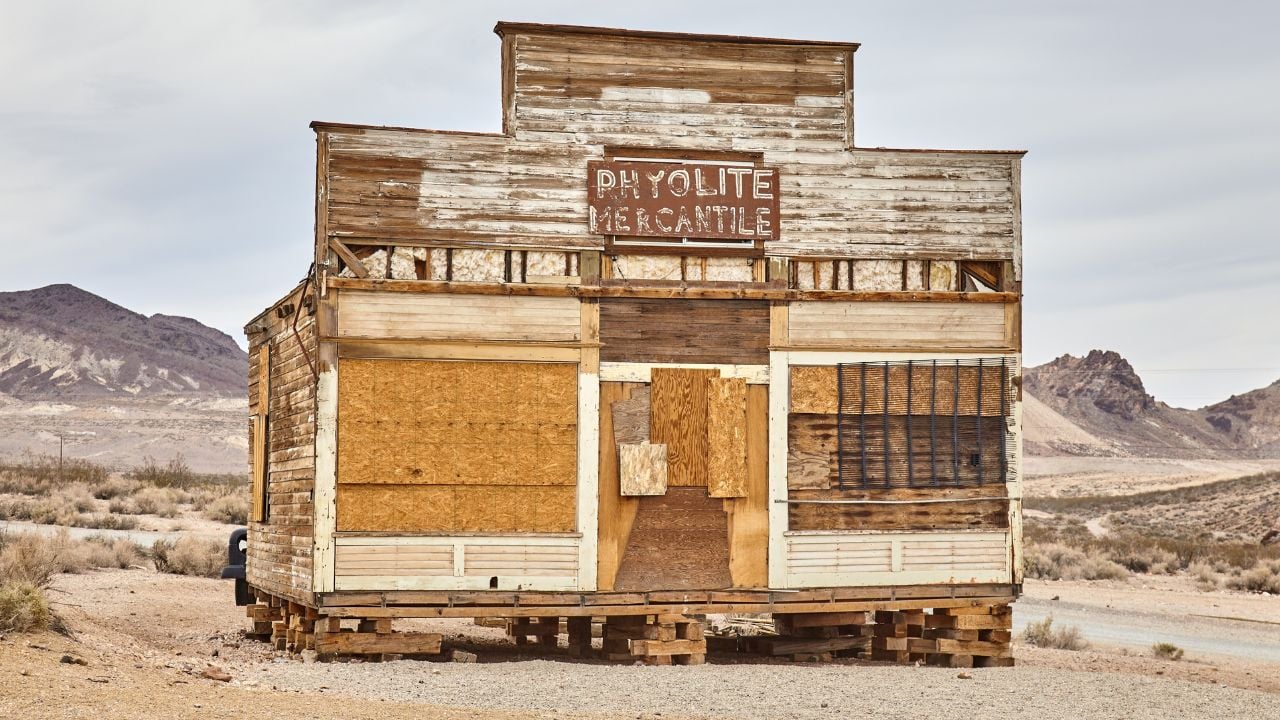
A hiker crouches at the edge of Rhyolite’s old Bottle House, camera on, one hand hovering over a shard of green glass poking out of the sand.
It looks like litter.
Federal law calls it evidence of a vanished mining boom. Slipping it into your pocket can turn a day trip into a felony case.
These are some of the Nevada ghost town items that aren’t finders keepers.
Note: This is general information, not legal advice. Laws governing the removal of historic material from Nevada’s ghost towns differ by site and are subject to change.
1. Delamar’s Building Stone
Delamar earned a nickname worse than any other Nevada boomtown: The Widow Maker.
Miners cracked open quartzite laced with gold in Delamar’s mines through the 1890s. The crushing process threw off a fine silica dust that scarred lungs for life.
Deadly dust.
More than 3,000 people worked and lived in Delamar by 1897, pulling millions in gold from the ground before the district dried up.
Stone walls from several of Delamar’s business buildings still stand along the hillside. Mining foundations show up from the surrounding hills, managed by the Bureau of Land Management (BLM) through its Caliente Field Office.
Prying a stone loose from one of those walls breaks the Archaeological Resources Protection Act (ARPA), the federal law protecting structures and portions of structures at least 100 years old on public land.
It’s the same category covering Delamar’s stone ruins.
Loose ore is treated differently.
ARPA excludes unworked minerals unless they sit in direct physical relationship with a protected structure, so a stray rock isn’t automatically a federal case the way a wall stone is.
Two vandalized cemeteries sit nearby. Nevada’s laws against disturbing a grave carry penalties steeper than anything tied to a rock.
2. Rhyolite’s Bottle Glass
Rhyolite once held as many as 5,000 people at its 1907 peak, complete with a stock exchange, an opera house, and electric lights years before some East Coast cities had them.
Almost nobody was left by 1920.
The Bureau of Land Management now manages Rhyolite as a historic area, protecting what’s left: A bank ruin, a restored train depot, and the famous Bottle House, built from roughly 50,000 discarded liquor and beer bottles.
Loose glass and metal debris still surface around the site after every windstorm.
Not a souvenir.
The same federal antiquities law that covers Delamar bars removing, damaging or even digging for any historic object on this stretch of public land.
BLM archaeologists lead free walking tours through the townsite in some years, pointing out exactly what visitors are allowed to look at and nothing more.
The $500 Line That Changes Everything
The Archaeological Resources Protection Act doesn’t punish every scrap the same way at a Nevada ghost town.
Anything tied to a historic site and old enough to count as an archaeological resource is off-limits from the very first piece.
The penalty, though, jumps hard once the combined value and repair cost clears $500.
Below that line, a first offense tops out at a $10,000 fine and a year in prison. Above it, the maximum doubles to $20,000 and two years.
A repeat offense can reach $100,000 and five years.
Federal prosecutors used that same law to send one Nevada artifact thief to prison for 37 months and order more than $102,000 in restitution, on top of his criminal fine.
3. Berlin’s Mill Hardware
Berlin never grew past about 300 people, small even by Nevada boomtown standards, with roughly 75 buildings crowded onto the hillside by the 1900s.
The Panic of 1907 hit the mining company’s finances hard. By 1911, Berlin sat mostly empty.
Nevada bought the whole site in 1970 and folded it into Berlin-Ichthyosaur State Park, preserving Berlin’s 30-stamp mill, one of the best-kept examples of its kind left in the state.
Every piece stays put.
Nevada’s own park rule spells it out in plain language: Removing, disturbing or damaging any historic structure, artifact, rock, fossil or other feature is against the law, backed by the Nevada Revised Statutes (NRS), section 407.250.
A first offense carries at least a misdemeanor charge. The fine scales up with whatever the missing piece would cost to replace.
4. Tybo’s Kiln Stone
Tybo’s charcoal kilns don’t need a ranger standing guard to stay protected.
The Archaeological Resources Protection Act (ARPA), the same federal law that covers Delamar’s stone ruins, protects a structure or a portion of a structure the moment it clears the 100-year age line.
Tybo’s population neared 1,000 by the late 1870s, complete with a school, a post office, and its own newspaper, all built around a silver strike high in Nye County.
Little of that survives now except the Tybo Charcoal Kilns, a set of stone beehive furnaces once used to bake wood into the fuel that ran the smelters.
The kilns have stood on the National Register of Historic Places since 1974, decades of paperwork backing up what ARPA already protects on its own.
Tybo sits on land the Bureau of Land Management manages as public land, the same category that covers Rhyolite and Delamar.
Chipping a piece of stone off a kiln, or walking off with a scrap of iron banding, breaks that same federal law.
Nobody has to catch you.
The law still applies whether a ranger is standing there or the kiln sits alone for a month at a time.
5. Seven Troughs’ Mine Debris
Seven Troughs boomed fast after gold turned up in the canyon in 1905, reaching roughly 350 residents within a couple of years.
A flash flood tore through the canyon on July 18, 1912, killing eight people and wiping out roughly a tenth of the district’s population in one night.
The post office closed for good in 1918.
Rusted mine equipment, foundation stone, and scattered cans still sit across the site, all of it on land the Bureau of Land Management protects as public land.
Seven Troughs falls under the same federal antiquities law that covers Rhyolite and Delamar, so hauling off a piece of machinery or a foundation stone is a federal matter, not a finders-keepers moment.
The canyon still floods.
That’s usually the bigger risk of a visit, not the law.
Psst! How much do you know about Nevada’s silver rushes and boomtowns? Take our quiz and see if you can ace it.
Quiz
Nevada Mining Boom IQ
Answer these on Nevada’s silver rushes, boomtowns, and the miners who built and lost them. We bet you can’t get them all right. Prove us wrong?
The richest silver strike in American history was named after a prospector named Henry Comstock. What happened to him afterward?
6. Fort Churchill's Adobe Bricks
Fort Churchill went up in 1860 after the Pyramid Lake War, built from adobe brick by soldiers stationed along the Carson River.
The Army abandoned it in 1869, just four years after the Civil War ended. The walls started melting back into the desert almost immediately.
Weather did what looting couldn't.
The Daughters of the American Revolution stepped in to protect the ruins for decades before Nevada folded the site into its state park system in 1957.
A self-guided trail now loops through what's left of the crumbling walls. Every one of those adobe bricks falls under the same NRS 407.250 protection that covers Berlin's stamp mill.
Pocketing a chunk of hardened adobe, even a piece already broken off, still counts as removing state property.
7. Gold Butte's Arrastra Stones
Gold Butte answers to two federal laws now, not one.
President Barack Obama placed the whole area under tighter federal protection in December 2016, creating Gold Butte National Monument and putting its mining ruins under the Antiquities Act on top of the usual public land rules.
That doubles the risk.
Gold Butte's mining camp went up almost overnight after copper and gold turned up in 1906. It emptied out again within a few years once the easy ore ran dry.
What's left includes stone foundations, two graves, and several arrastras, the crude circular mills Spanish and Mexican miners used to crush ore with a dragged stone wheel.
The Bureau of Land Management still runs the site. Its own visitor materials point hikers to the ghost town along the Gold Butte Backcountry Byway without ever suggesting they take anything home.
When Removal Is Just Theft
Not every Nevada ghost town answers to a federal antiquities law.
Techatticup Mine near Nelson and Gold Point in Esmeralda County both sit on private land, restored and maintained by their own owners rather than the Bureau of Land Management or Nevada's park system.
Take something from a privately run site like that. The law that applies isn't the Archaeological Resources Protection Act.
It's ordinary Nevada theft law.
Grand larceny under state statute covers anything worth $1,200 or more. A felony conviction can carry prison time without a single mention of "archaeological resource" in the charge.
A locked gate and a posted sign do the rest of the deterring.
Why Nevada Has 600 Ghost Towns
Nevada's own tourism office counts more than 600 ghost towns statewide, nearly five times its roughly 175 populated towns today.
Boom, then bust.
A rush could bring thousands of people chasing a single vein of gold or silver within months.
Remote locations made it worse.
Towns without a railroad connection or a reliable water source rarely survived a slowdown. Outdated mining methods left ore sitting in the ground for later technology to reach.
Nevada's tourism office asks visitors to leave every ghost town as they found it, snapping photographs instead of pocketing souvenirs.
Federal mining law added its own deadline on top of all that: At least $100 of assessment work on a claim every year, under the General Mining Law of 1872.
An abandoned claim reverted to open ground within months once a company's money ran out, ready for the next prospector to stake it fresh.
Nevada's Bureau of Land Management archaeologists have started leading free public tours through Rhyolite and a handful of the state's other ghost towns, some timed to Nevada Day weekend.
Archaeologist Ashton Jenks led one of those tours through Rhyolite in 2024 alongside site caretaker Karl Olsen. Jenks said opening even one roped-off building for the group was enough to pull in extra visitors who hadn't signed up for anything.
Is Dumpster Diving Legal in Nevada? Las Vegas Makes It Riskier Than People Realize
Las Vegas dumpsters look like fair game after a Strip resort tosses out perfectly good boxes and leftovers.
Nevada's trash laws don't see it that way. The city's own rules make it riskier than many divers expect.
Is Dumpster Diving Legal in Nevada? Las Vegas Makes It Riskier Than People Realize
Nevada's Dirty Secret? 20% of the Nation's Largest Landfills Are Here
Nevada holds a hefty slice of America's biggest landfills, tucked away from the casinos and ghost towns both.
A look at the state's dumping grounds shows where all that history, and everything else, eventually ends up.
Nevada's Dirty Secret? 20% of the Nation's Largest Landfills Are Here
