
9 Warning Signs Tourists Take Seriously That Floridians Walk Right Past

Only about 15% of Florida’s beaches post a lifeguard on duty.
The other 85% rely on nothing but a sign to keep swimmers safe.
Tourists read that sign like an order. Floridians don’t have to read it; they already know from years of living in the Sunshine State.
These are the warning signs tourists take seriously that Floridians barely notice.
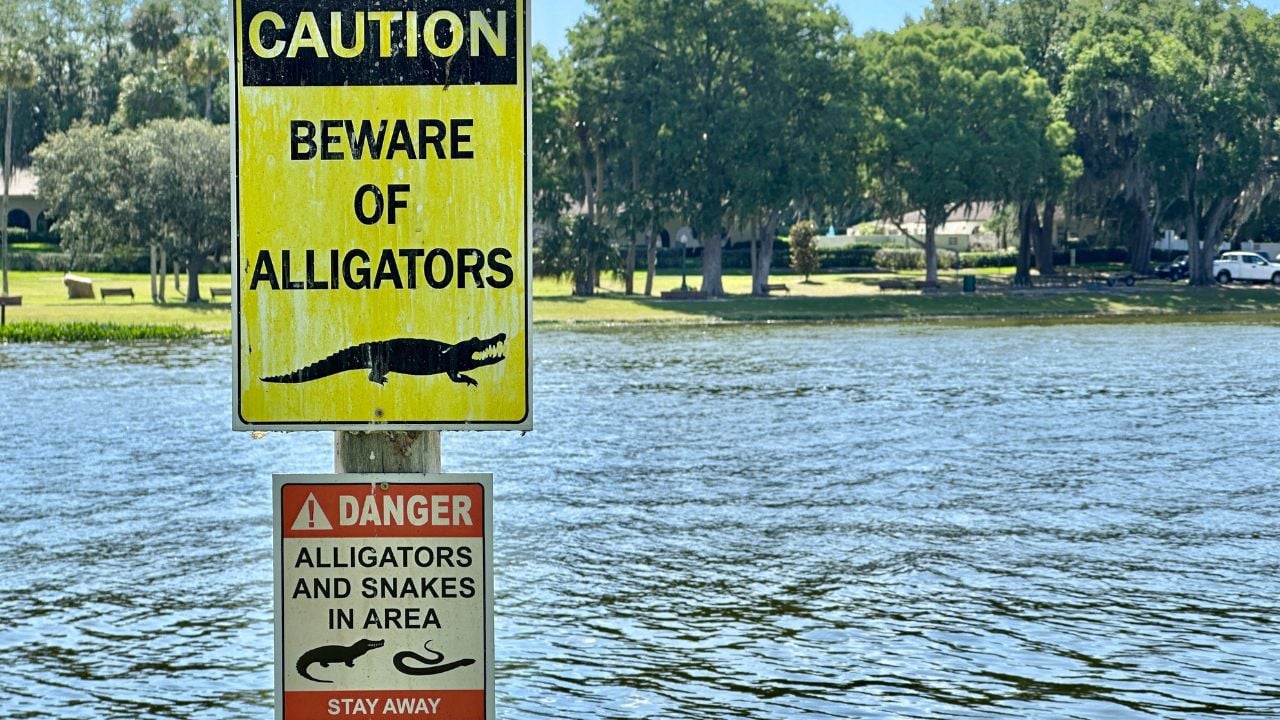
1. Alligator Warning Signs
Alligator warning signs, complete with a gator silhouette and the words “Beware! There are alligators and snakes in the area,” now stand at ponds, canals, and golf course water hazards across Florida.
Disney only started using that wording in 2016, after an alligator pulled a two-year-old from the shallows at the Grand Floridian Resort beside a no-swimming sign that never mentioned a gator.
A family checking into a Central Florida resort today reads that same warning at the water’s edge and keeps the kids on the boardwalk, cameras ready instead of toes in the water.
They don’t test it.
Many Floridians size up a pond themselves long before they reach a posted sign, treating any still water as gator territory out of habit built over a lifetime near it.
2. Double Red Beach Flags
A double red flag can shut down an entire Florida beach, and state law makes sure of it.
Since 2005, state law has required every public beach to fly the same five-color warning flag system, and a double red means the water is closed to swimmers, no exceptions.
Walton County backs that flag with a $500 ticket for anyone who wades in anyway.
Tourists get the message fast.
Floridians who’ve surfed or fished that same stretch for years know what color the flag will be without even having to look at it.
Florida’s Full Flag System, Explained
Florida’s beach flag system runs through five official colors, not just the double red visitors tend to remember.
Green marks calm water.
Yellow means moderate surf.
A single red flag means high hazard with strong currents, still legal to enter but strongly discouraged.
A purple flag flies alone or alongside another color to mark dangerous marine life like jellyfish or stingrays, and it has nothing to do with the surf.
3. Bear Crossing Warning Signs
Florida hangs bear crossing warning signs on the roads with the worst history of vehicle strikes, many of them clustered on the stretch around Ocala National Forest.
The Florida Fish and Wildlife Conservation Commission posts reduced-speed signs in the exact spots where bear deaths add up year after year.
Road strikes are the leading cause of bear deaths statewide, and 296 bears died on Florida roads in 2024 alone.
Tourists driving through for the day ease off the gas the moment a sign appears, eyes on the tree line for the bear.
It’s almost never there.
Residents who drive that same stretch to work every week know exactly which mile markers see the most collisions, and many hold highway speed everywhere else on the route.
4. Manatee Zone Speed Signs
A posted sign is all Florida uses to mark its slow-moving manatee zones, and boaters are supposed to read it as a hard limit, not a suggestion.
Tourists renting a pontoon for the weekend crawl through every idle-speed sign they see, worried about a fine they can’t afford on vacation.
Boaters who run the Caloosahatchee River for a living know exactly where the sanctuary buoys sit, and many hold speed right up to the posted line before easing off the throttle.
Not a foot past it.
Ignore that line entirely, and the fines escalate fast: A Cape Coral boater who kept blowing through the same zone was fined $4,000 for his eighth manatee-zone conviction on the river.
5. No Lifeguard Signs
Staffed lifeguard towers stand on only about 15% of Florida’s beaches.
The other 85% carry a sign instead: No lifeguard on duty, swim at your own risk.
Tourists take that sign at its word.
They stay shallow.
Many turn around and find a guarded beach instead.
Floridians who grew up on that same unguarded stretch often swim it exactly like they would a guarded beach because they’ve known how to read that particular sandbar and current their whole lives.
Psst! How much do you know about Florida’s wildlife and weather? Take our quiz and see how many you can get right.
Quiz
Florida Wildlife & Weather IQ
Answer these on Florida’s wild side, from gators to lightning. We bet you can’t get them all right. Prove us wrong?
Which Florida beach town has logged more documented shark bites than anywhere else on Earth, without a single recorded fatality?
6. Algae Bloom Warning Signs
The moment a Florida lake or spring tests positive for toxic blue-green algae, the state health department posts a warning sign.
The posted advisory is blunt: If you see a bloom, people and pets stay out of the water.
Tourists follow that instruction to the letter.
They don't risk it.
A family on a weeklong rental will skip the lake entirely and drive to a different spring for the rest of their trip.
Floridians who fish or kayak the same water every week know it won't last forever.
7. Sea Turtle Lighting Signs
Beachfront lights across Florida have to go dark or turn turtle-safe during nesting season, and small placards on the dune walkovers spell out exactly why.
Florida's nesting season runs from May 1 through October 31, and any white light visible from the beach can steer a hatchling toward a parking lot instead of the ocean.
Renters comply on day one.
A family in a beach house for a week will haul their chairs off the sand each night and fill in every hole they dug that day.
Floridians do, too. But unlike tourists, they do it on autopilot.
8. Hurricane Evacuation Route Signs
Standing blue signs mark Florida's hurricane evacuation routes long before any storm shows up on a map.
Those signs mark permanent infrastructure, and the route only matters once a county calls a mandatory order for that evacuation zone.
Visitors don't always know that.
Visitors who've just learned what the sign means will sometimes ask about it at the front desk the same day, even with clear skies overhead and nothing in the forecast.
Floridians drive past the same poles for years without a second look, and they only react once their zone gets the call.
9. Panther Crossing Signs
Florida built dozens of wildlife crossings and cut night speed limits on roads like State Road 29 for one endangered animal, the Florida panther.
The panther is one of the country's most endangered mammals, with a population that's grown back to just over 200 animals statewide.
Florida built 60 wildlife crossings and modified bridges so panthers could get under the highway instead of onto it.
Tourists slow to a crawl at every posted crossing sign, cameras out, hoping for a glimpse.
Daily commuters don't take their eyes off the road.
An adult male Florida panther can range across up to 200 square miles.
A driver who's made that commute for twenty years is more likely to spot a bobcat or a wild turkey than the actual animal the signs are named for.
9 Things That Instantly Mark You as a Florida Newcomer

A Florida newcomer's bumper picks up a gray crust every fall that no amount of scrubbing seems to touch.
Lovebugs are just the opener for a whole list of habits that give a newcomer away within their first year.
9 Things That Instantly Mark You as a Florida Newcomer
7 Arguments Florida and Alabama Will Never Settle

A surveyor drove a stone into the ground in 1799 to settle exactly where Alabama ends and Florida begins.
It didn't work, and the two states have kept arguing about that line, and just about everything else, ever since.
