
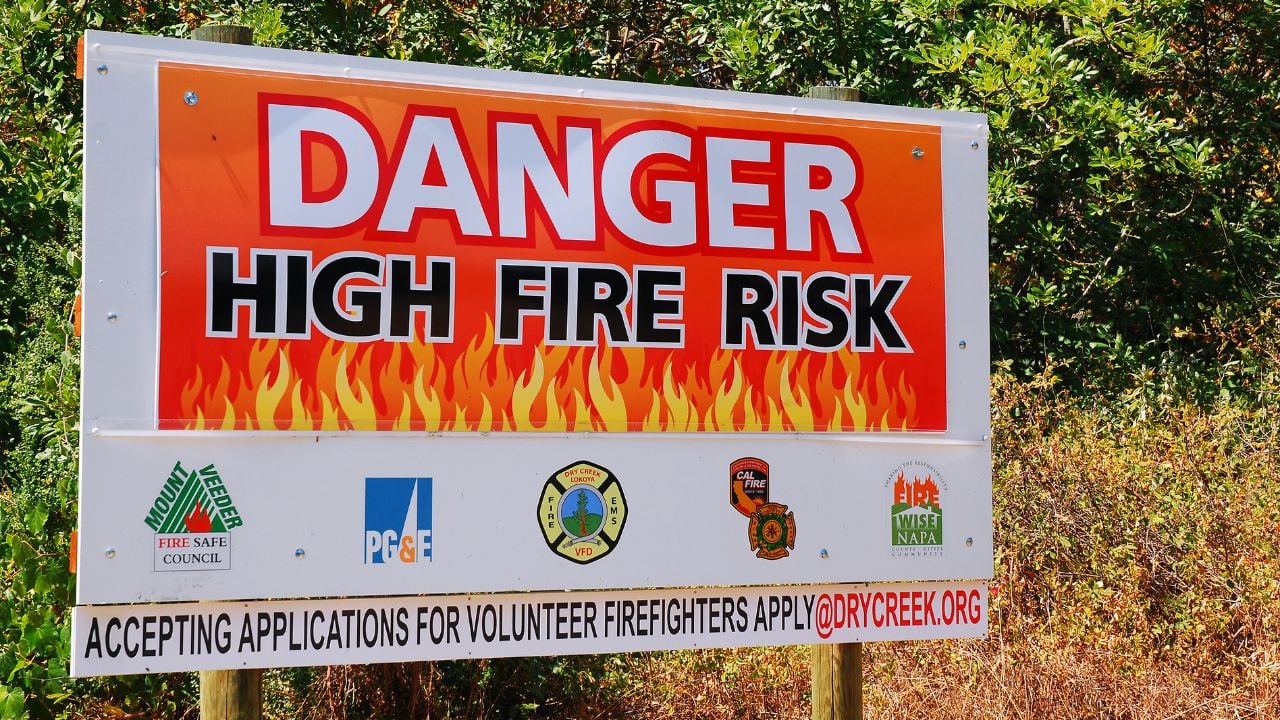
9 California Wildfire Defensible-Space Rules Homeowners Get Wrong

California’s defensible-space law, signed in 2004, tripled the required clearance from 30 feet to 100 feet when it took effect the following year.
Over two years later, the math still confuses some homeowners.
Some clear too little. Others strip their whole property bare when the law never required it.
These are the defensible-space rules California homeowners misread again and again.
Note: This is general information, not legal advice. Defensible space rules, zone requirements, and fines vary by county and are subject to change, so confirm the current requirements with CAL FIRE or your local fire department.
1. Zone 0 Isn’t Settled Everywhere
California homeowners often assume Zone 0, the five-foot ember-resistant ring closest to one’s house, is either the law everywhere already or the law nowhere yet.
Neither is true.
The state’s own version of the rule is still a draft.
Gov. Newsom ordered the Board of Forestry and Fire Protection to finish it by December 31, 2025, and that deadline passed with nothing finalized.
The board took up adoption of a final draft at its August 2026 meeting, months after its own deadline came and went.
Whatever version lands, it won’t reach every house at once.
The updated draft phases the rule in, leaning on education and outreach for five years rather than penalties.
Either way, several California communities already require Zone 0 today, ahead of the state.
Berkeley started enforcing its own five-foot vegetation ban on roughly 900 hillside homes in January 2026, months before the state settled its own rule.
San Diego’s ordinance already applies to new construction, with existing homes on the hook about a year later.
A homeowner in one of those cities already has a compliance date on the calendar.
A neighbor two counties over is still waiting on Sacramento.
2. 100 Feet Isn’t Bare Dirt
California’s 100-foot clearance rule doesn’t ask a homeowner to strip a yard down to bare dirt.
The requirement has stretched to 100 feet since 2005, but the standard is “lean, clean, and green,” not a moonscape.
Inside 30 feet, dead plants, grass, and weeds have to go, and trees need their canopies spaced at least 10 feet apart.
Past 30 feet, out to the full 100, grass just needs to stay under four inches, and healthy, well-spaced, watered plants are allowed to stay standing.
Homeowners who clear every living thing off their property beyond that are giving themselves extra work.
How California Splits the 100 Feet
California’s 100-foot rule breaks into three separate rings around a house: Zone 0 from 0 to 5 feet, Zone 1 from 5 to 30 feet, and Zone 2 from 30 to 100 feet.
Each ring carries its own standard, so a homeowner who only clears the ring closest to their house hasn’t finished the legal requirement, even if their yard already looks tidy.
3. Tree Spacing Isn’t One Number
California homeowners often treat the 10-foot tree-spacing rule as one flat number that applies to every yard.
It isn’t.
The state’s fire agency, CAL FIRE, ties the required spacing to the slope under the trees, not just the trees themselves.
On flat to mild ground, tree canopies need at least 10 feet of horizontal clearance between them, measured crown to crown.
On a moderate to steep slope, that same clearance triples to 30 feet because fire climbs a hillside far faster than it crosses flat ground.
Shrubs scale the same way, from twice a shrub’s width apart on flat ground up to six times that on a steep slope.
A homeowner who measures a flat 10 feet on a hillside lot and calls it done has left the yard under-cleared.
Shrubs and trees carry a vertical rule too, and it doesn’t change with slope.
The clearance between the top of a shrub and the branches above it has to equal three times that shrub’s height.
A four-foot shrub needs 12 feet of open air above it before the next branch starts.
Skip that vertical gap, and a ground fire climbs a shrub straight into the canopy.
Foresters call it ladder fuel.
4. Chapter 7A Isn’t Retroactive
California’s Chapter 7A building code sets strict rules for roofs and vents in a fire hazard zone, but it doesn’t reach back and grab a house that’s already standing.
The code has applied to new construction since 2008, along with additions and remodels big enough to need a building permit.
An older home built before that stays outside the mandate, Class-A roof or not.
It’s grandfathered in.
A homeowner who bought a 1970s house in a Very High Fire Hazard Severity Zone isn’t automatically out of compliance.
They’re just not required to fix it.
A voluntary upgrade, like ember-resistant vents or a new roof, still helps, and California’s wildfire mitigation program offers retrofitting assistance toward the cost.
5. Selling Now Means More Disclosure
California sellers in a high or very-high fire hazard zone have carried a defensible-space disclosure duty since 2021.
As of July 1, 2025, that duty grew a second half.
Sellers now also have to disclose their home’s hardening status: The roof material, whether vents carry ember-resistant screens, single-pane versus dual-pane windows, and what sits within five feet of the foundation.
A seller who only pulled together old brush-clearance paperwork is missing half the form.
It’s not enough anymore.
Buyers get something from this too.
They can see exactly which fixes a house still needs before they own it.
Psst! How wildfire-ready is your home’s defensible space? Run through this checklist and see where you stand.
6. Cleared Brush Alone Isn’t the Whole Discount
California’s insurance discount program for wildfire, called Safer from Wildfires, still credits a homeowner for cleared brush on its own.
Fair enough.
Where the assumption breaks down is stopping there.
The state’s own regulation doesn’t set a hard two-category gate.
It requires an insurer to credit every hardening or defensible-space action a homeowner completes, though how much credit is up to that insurer.
Many insurers reward more action with a bigger discount.
A homeowner who only clears brush can still get a discount, just usually a smaller one than a neighbor who also hardens the house.
One program sets a harder bar.
The Insurance Institute for Business & Home Safety’s Wildfire Prepared Home designation only goes to a house that finishes both the roof-and-vent hardening list and the five-foot ember-resistant zone together.
Skip either half, and the designation doesn’t happen, no matter how well the other half was done.
A homeowner banking on cleared brush alone for that designation, or for the biggest possible discount, is usually disappointed at renewal.
7. Your Zone May Have Changed
California finished its first update to local wildfire hazard maps in more than a decade in early 2025, following the statewide wildland maps the state fire agency put into effect in April 2024.
The new maps added fire hazard classifications to parts of Fresno, Clovis, and Madera that had never carried one before.
That 100-foot duty doesn’t arrive with the new map.
Inside the State Responsibility Area, where CAL FIRE answers the fire call, it already rides with the land under Public Resources Code 4291, map or no map.
Everywhere else, a city or county has 120 days to adopt the state’s very high zones by ordinance, and it has to post the new maps for public review within 30 days of receiving them.
Nobody mails you a notice.
A homeowner who checked their zone status years ago, and never checked again, may be sitting on a legal obligation they don’t know exists.
8. Warnings Come Before Fines
California homeowners who fail a defensible-space inspection often assume a fine follows automatically.
Historically, it hasn’t.
A 2015 state audit found CAL FIRE logged roughly 29,000 violations that fiscal year, and only 4% of them ended in an actual fine.
Education came first, citation second.
Enforcement swings wildly by county, though.
Kern County cites almost every violation its inspectors find.
Los Angeles County writes close to none.
Instead, Los Angeles can send a crew to clear the brush itself and bill the property owner.
Those bills escalate fast: A $31 inspection fee, then a $758 non-compliance fee, then a $1,740 administrative charge, plus a 200% penalty on anything paid late.
The state’s default is a warning.
One county’s default is a bill nobody wants.
9. Your HOA Doesn’t Decide This
California homeowners inside a homeowners association, or HOA, sometimes assume the group’s landscaping rules beat the state’s fire law.
That’s backward.
Under Civil Code 4205, an HOA can’t use its CC&Rs, the covenants, conditions, and restrictions that govern the community, or its architectural rules to force a homeowner to keep a property in a condition that breaks state or local fire law, including the 100-foot defensible-space requirement.
State fire law overrides the HOA’s rule, every time.
The bigger risk isn’t even the HOA.
A homeowner who keeps unsafe landscaping just to satisfy the association can find an insurer denies a wildfire claim later, since carriers treat defensible space as a condition of coverage.
That’s a worse outcome than any HOA fine.
Psst! How much do you know about California’s wildfires and the science behind fighting them? Take our quiz and see how many you can get right.
Quiz
California Wildfire IQ
Answer these questions on California’s biggest wildfires, its firefighting fleet, and the fine print behind defensible space, and see how many you can get right.
Which wildfire holds the record as the largest in California history by acreage?
Some Insurers Watch From Above
Some California insurers now review a property's defensible space from above, using aerial images to flag overhanging branches or a sagging roofline instead of sending someone to the door.
Homeowners rarely get a warning before that photo affects a renewal.
Not even a heads-up.
California Assemblymember Lisa Calderon introduced Assembly Bill 75 last year to close exactly that gap, requiring an insurer to notify a homeowner before an aerial image can count against their policy.
The bill would also let a homeowner see the flagged photo and fix the problem before a nonrenewal takes effect.
10 Things California Residents Can't Legally Toss in a Household Garbage Bin

Scrape tonight's dinner plate into the kitchen trash, and in California that scrape might break a state law.
Food scraps are only the start of what the household bin isn't allowed to hold anymore.
10 Things California Residents Can't Legally Toss in a Household Garbage Bin
9 California Squatter Laws That Cost Homeowners Who Ignore Them
A family's cabin above Highway 50 near Lake Tahoe sits buried under snow every winter, and nobody checks on it until spring.
This April, the padlock on the door isn't the one they left, and someone else's boots are drying by the stove.
9 California Squatter Laws That Cost Homeowners Who Ignore Them
