
9 California Roadside Attractions Worth the Detour, According to Locals

California has designated more than 1,100 official historical landmarks, and a surprising number of them sit on plain highway shoulders instead of behind museum glass.
Many out-of-state drivers speed right past them, eyes on the next gas station.
Locals know better than that.
These are the California roadside attractions worth the detour.
1. Salvation Mountain
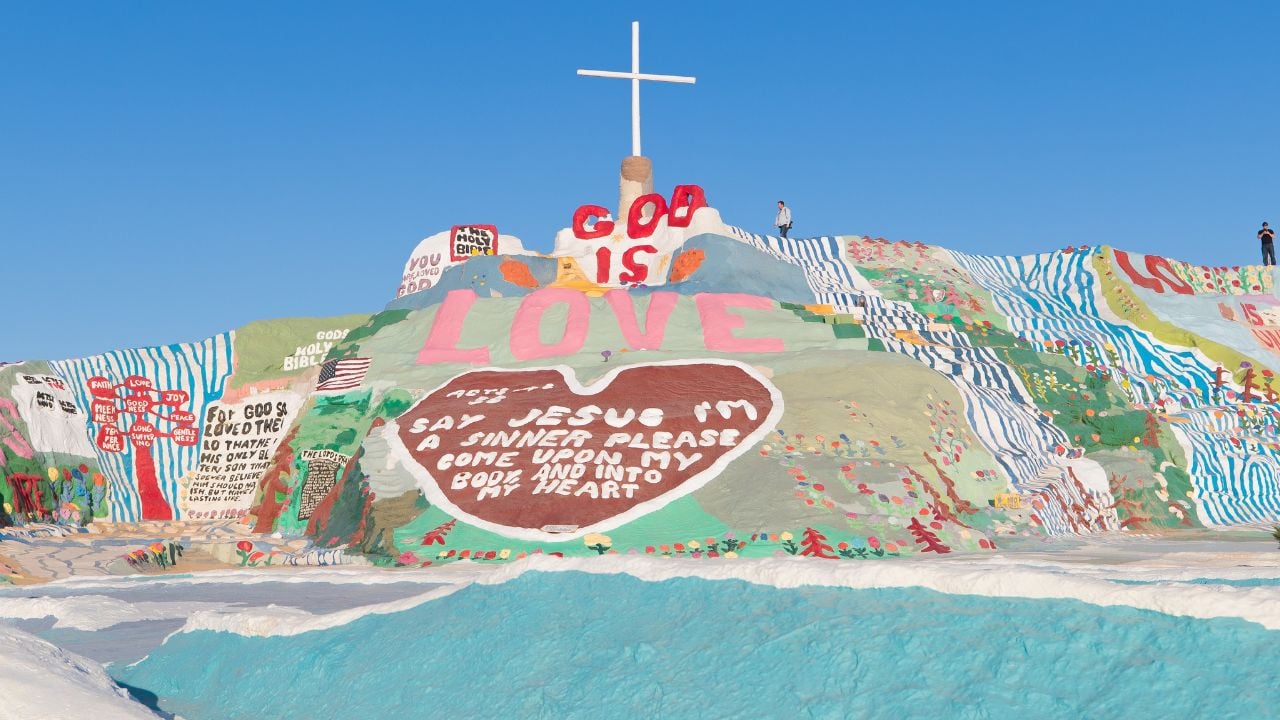
Salvation Mountain rises out of the desert outside Niland, in California’s Imperial Valley, a hillside painted over in an estimated half a million gallons of latex paint.
Leonard Knight built the whole thing by hand over 28 years, layering adobe, straw, and paint until the words “God Is Love” covered the entire hill.
He never charged admission.
Knight died in 2014, but volunteers from the surrounding Imperial Valley and nearby Slab City still keep the gate open every day, sunrise to sunset, free of charge.
Local volunteers point first-time visitors toward Salvation Mountain before anything else near the Salton Sea.
No ticket booth.
Just a mountain, and the neighbors who refuse to let it fade.
2. Cabazon Dinosaurs
The Cabazon Dinosaurs tower over Interstate 10 outside Palm Springs, California, a pair of steel-and-concrete giants sculptor Claude Bell started welding together in 1964.
Dinny, the brontosaurus, stretches 150 feet long and took Bell eleven years to finish.
Coachella Valley residents already treat the exit as a built-in pit stop, not just a landmark they wave at through the windshield.
Locals duck inside Dinny’s hollow belly, now a gift shop, the same way they’d stop for gas.
Kids dig for fossils in the sand pit out back.
It beats a rest stop.
3. Elmer’s Bottle Tree Ranch
Elmer’s Bottle Tree Ranch sits on old Route 66 in Oro Grande, California, north of Victorville, a two-acre yard holding more than 200 bottle trees that Elmer Long started welding together in 2000.
He built them from desert junk he and his father collected on childhood camping trips.
Long passed away in 2019.
His son, Elliot, still tends the property for free, and High Desert locals keep sending friends there instead of letting them drive the National Trails Highway straight past it.
It’s free to walk through.
Old typewriters, traffic lights, and sewing machines hang between the glass.
4. Wigwam Motel
The Wigwam Motel still rents out nineteen concrete teepees along Foothill Boulevard in San Bernardino, California, the last of seven Wigwam Villages architect Frank Redford built between 1933 and 1949.
The Patel family, San Bernardino motel owners themselves, bought the run-down property in 2002 and restored it room by room.
They kept the kidney-shaped pool.
Route 66 locals point visitors toward the Wigwam over any chain hotel near the freeway, the same way they’d recommend a favorite diner.
Every room still sits inside its own concrete cone.
What a National Register Listing Doesn’t Do
The Wigwam Motel’s spot on the National Register of Historic Places, a California landmark along old Route 66, sounds like government protection, but it isn’t one.
The designation only recognizes a site’s history.
It doesn’t stop a private owner from tearing a building down.
It doesn’t come with any government money to maintain it, either.
What it does offer is a federal tax break for owners who restore a listed building instead of demolishing it.
That’s why a family willing to do the work, like the Patels, matters more than any plaque.
5. Trees of Mystery
Trees of Mystery greets drivers on Highway 101 near Klamath, California, with a 49-foot Paul Bunyan statue and his 35-foot Babe the Blue Ox, both waving and talking to passing cars through a hidden speaker.
The park has run since 1931, long before Del Norte County saw much tourism beyond logging.
A gondola opened in 2001, carrying riders through the redwood canopy to a ridge with ocean views.
Local families still buy season passes.
They skip the statues and head straight for the trail.
Tourists never do that.
Psst! How much do you know about California’s roadside history? Take our quiz and see how many you can get right.
Quiz
California Roadside IQ
Answer these questions on California’s kitschiest landmarks and highway history. We bet you can’t get them all right. Prove us wrong?
Which pink motel and restaurant in San Luis Obispo is famous for a men’s restroom with a rock waterfall urinal?
6. Giant Artichoke
The Giant Artichoke has marked the edge of Castroville since 1963, a twenty-foot concrete statue restaurant owner Ray Bei built to turn a roadside vegetable stand into a stop.
Castroville still calls itself the Artichoke Capital of the World.
That claim used to lean on a spring festival that pulled crowds in from across Monterey County.
The festival moved out to the Monterey County Fairgrounds years ago, and organizers shut it down for good in 2025, citing rising costs.
Marilyn Monroe was crowned the town's first Artichoke Queen there in 1948.
That was years before she was famous.
Salinas Valley locals still treat the restaurant and produce stand next door as proof.
Not a parade.
They fry, steam, and stuff artichokes into pizza there every day of the week, festival or not.
7. Donut Hole
The Donut Hole still lets drivers steer straight through two 26-foot doughnuts in La Puente, California, a drive-through bakery built in 1968.
Cash only, then and now.
San Gabriel Valley locals treat it as a coffee run, not a tourist stop, looping through for a dozen glazed on the way to work.
The dough gets made fresh every morning, same as it always has.
Out-of-towners come for the photo.
Locals come back for the apple fritters.
8. Mystery Spot
The Mystery Spot has pulled cars off the road outside Santa Cruz, California, since mechanic and inventor George Prather bought the land in 1940 and opened his tilted cabin to the public the following year.
Balls roll uphill inside.
Guides look taller or shorter than each other depending on where they stand.
Santa Cruz County families have treated a walk through the gravity house as a rite of passage for out-of-town guests for more than 80 years, tickets and all.
It earned California Historical Landmark status in 2014.
Book ahead in summer.
Tours sell out by afternoon.
9. Old Faithful Geyser of California
Old Faithful Geyser of California erupts every fifteen to thirty minutes on a ranch outside Calistoga, one of only three predictable geysers on Earth that scientists call "Old Faithful."
Napa Valley locals send wine-tasting guests there on purpose, a free-flowing break between vineyard stops that doesn't need a reservation or a tasting fee.
Llamas and horned sheep wander a small petting area near the picnic tables.
Researchers have tracked the geyser's rhythm shifting in the days before a few major Northern California earthquakes.
Locals watch the clock.
It still goes off on schedule.
Nobody's Handing These a Grant
California's roadside attractions get almost no help from the government once a landmark plaque goes up.
One federal program does fund places like these.
It's called the Route 66 Corridor Preservation Program, run by the National Park Service, which has awarded $2.72 million since 2001, spread across all eight states the highway crosses.
An owner still has to match every one of those dollars themselves.
It isn't free money.
California owners have a second option closer to home, the state's Mills Act, which lets a city cut the property tax on a historic building by 40 to 60 percent in exchange for the owner's ongoing upkeep.
That's a tax break, not a check.
The owner still foots the restoration bill.
Elliot Long still walks his father's bottle trees, answering whatever a stranger asks about them.
No employee handbook covers that.
9 Things Californians Do That Instantly Give Them Away in Another State

Californians carry habits that follow them anywhere they move, right down to how they complain about gas prices.
These are the signs that give a Californian away within minutes, wherever they land.
9 Things Californians Do That Instantly Give Them Away in Another State
10 California Beachcombing Rules That Can Cost Visitors a Fine
A relaxed day on a California beach can turn into a citation faster than many visitors expect.
These are the beachcombing rules that catch out-of-towners off guard.
10 California Beachcombing Rules That Can Cost Visitors a Fine
