

8 Things Ohioans Believe About Their Own State That Aren’t True

Think you know Ohio inside and out?
Every history class says Ohio became a state in 1803, and Congress left a piece of paperwork on that unfinished for generations.
These are the widely repeated “facts” about Ohio that turn out to be false.
1. First in Flight, Sort Of
Ohio calls itself the “Birthplace of Aviation” right on its own license plates.
North Carolina’s plates counter with “First in Flight.”
Only one of those two states can point to the exact spot where a plane first left the ground under its own power.
The Wright brothers designed and tested their gliders and engines out of a bicycle shop in Dayton, Ohio, but the first powered, controlled flight happened over the dunes near Kitty Hawk, North Carolina, on December 17, 1903.
Dayton got the workshop.
Kitty Hawk got the moment.
2. Toledo War
Many people assume Ohio’s border with Michigan has always run exactly where it does today, fixed the moment Ohio became a state.
It hasn’t.
Ohio and Michigan nearly fought over that line in a standoff called the Toledo War, which ran through 1835 and 1836 over a 468-square-mile strip of land along the Michigan border.
Both sides called up their militias.
Ohio Governor Robert Lucas marched roughly 600 militiamen toward Toledo, and Michigan’s 24-year-old territorial governor, Stevens T. Mason, met them with about 1,000 men of his own.
Not much of a battle.
Congress settled it in 1836 by giving Ohio the Toledo Strip and handing Michigan a much bigger consolation prize: More than 9,000 square miles of the Upper Peninsula, plus statehood of its own.
That settlement is also why the state line still angles northeast instead of running straight, a diagonal known as the Harris Line that survives on the map because two states almost came to blows over it.
State borders, it turns out, aren’t as settled as they look.
3. Ohio’s Missing Paperwork
Ohio joined the Union on March 1, 1803, or so every civics class insists.
Nobody noticed the paperwork was missing for 150 years.
Congress approved Ohio’s request to become a state but never passed a resolution formally admitting it as the 17th state.
It was an oversight nobody caught until Ohio’s teachers went looking for the original documents ahead of the state’s 150th birthday.
The Library of Congress came up empty.
President Dwight D. Eisenhower signed the fix on August 7, 1953, admitting Ohio to the Union retroactively, backdated to that same March 1 date.
Not a clean handoff.
4. Johnny Appleseed’s True Home
Ohio claims Johnny Appleseed as one of its own, and the state has good reason to.
Johnny Appleseed was born John Chapman in Leominster, Massachusetts, in 1774, more than 650 miles by today’s roads from the orchards that made him famous.
Not an Ohio native.
He didn’t set foot in Ohio until adulthood.
Chapman spent decades planting apple tree nurseries across Richland, Ashland, Wayne, and Knox counties, then followed the frontier into Ohio’s Defiance and Auglaize counties before moving on toward Indiana.
Those apples were mostly for cider, not eating.
A wandering nurseryman from Massachusetts, not an Ohio native, is the man people picture every time someone says “Johnny Appleseed.”
5. Buckeye Nut
Ohio’s own nickname comes from a nut many Ohioans assume is as harmless as the candy named after it.
The Ohio buckeye tree gives the state its “Buckeye State” nickname, and its glossy brown nuts look enough like the peanut-butter candy named after them that many Ohioans figure the actual nut must be just as safe to eat.
It’s not.
Ohio State University’s extension office warns that raw buckeyes contain aesculin, a toxic glycoside, along with tannic acid that can cause vomiting, diarrhea, and worse in both people and livestock.
Not a chestnut substitute, and not a candy substitute either.
Some Native American communities did eat buckeyes after roasting, peeling, and leaching them in water for days to pull the toxins out, and Ohio made the tree its official state tree in 1953, the same year Congress finally sorted out the statehood paperwork.
6. Cleveland’s River Fires
Ohio’s Cuyahoga River, which runs through Cleveland, carries a reputation built on one very misunderstood fire.
The Cuyahoga caught fire on June 22, 1969, and that blaze became the symbol of America’s pollution crisis, inspiring the modern environmental movement.
It wasn’t the river’s first fire.
Bigger fires came first.
The Cuyahoga had caught fire regularly for a century, including a 1952 blaze that caused $1.3 million in damage, more than twenty times the 1969 fire’s $50,000 in losses.
Firefighters put the famous 1969 fire out in about 24 minutes.
National coverage ran a photo from the bigger 1952 fire anyway, and that’s still the image many people picture.
7. Ohio’s Presidential Count
Ohio calls itself the “Mother of Presidents,” and the nickname isn’t wrong, just incomplete.
Seven U.S. presidents were born within Ohio’s borders: Grant, Hayes, Garfield, Benjamin Harrison, McKinley, Taft, and Harding.
That’s not nothing.
Virginia produced more.
Virginia is the birthplace of eight presidents, including George Washington, Thomas Jefferson, and James Madison, which makes it the true leader by that measure, not Ohio.
Ohio’s the modern-era leader. Virginia still owns the all-time record.
8. Statehouse Roof
Ohio’s own capitol building breaks the mold every other state capitol follows.
Many people picture a state capitol with a big rounded dome on top, the way the U.S. Capitol looks.
Not Ohio’s.
Architects built the Greek Revival statehouse in Columbus with a low cupola instead of a dome, a design that took 22 years to finish, from 1839 to 1861.
Prisoners from the Ohio Penitentiary laid the foundation and ground floors, before complaints from paid tradesmen changed how the rest of the building got built.
Cheaper than a dome, and the Statehouse still ranks among the ten oldest capitols still in continuous use today.
The rotunda floor beneath that cupola tells its own story: Nearly 5,000 pieces of hand-cut marble, pulled from as far away as Portugal and Italy.
Restoration crews found proof of that old prison labor decades later, uncovering graffiti scratched into the stone, including one inmate’s sketch signed with the name Badger.
Psst! Two of these Ohio claims are true, and one is a lie. Can you spot the lie?
9 Grocery Aisles That Look Completely Different in Ohio Than They Did 20 Years Ago

A shopper pushing a cart through a southwest Ohio Kroger walks straight past a dark window where a full bank branch used to sit.
Grocery aisles across the state have swapped out a lot more than that over the past 20 years.
9 Grocery Aisles That Look Completely Different in Ohio Than They Did 20 Years Ago
The States With the Worst Drivers, Ranked. Here’s Where Ohio Falls
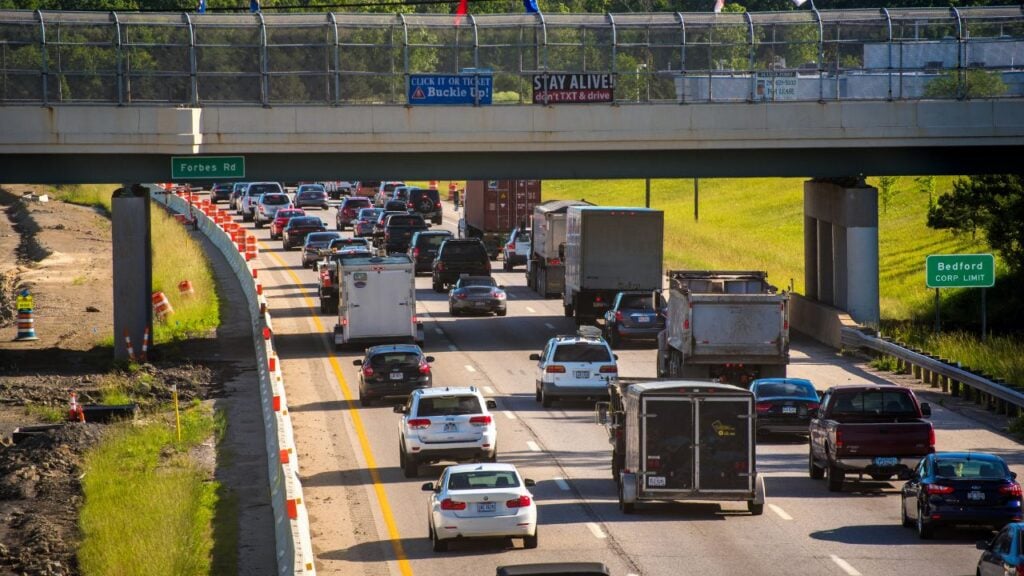
Ohio’s traffic deaths dropped for the fourth year in a row, but a new nationwide study measured something else entirely: How the state’s drivers behave behind the wheel.
The ranking doesn’t flatter every state, Ohio included.
The States With the Worst Drivers, Ranked. Here’s Where Ohio Falls
