
8 Gift Card Traps New Yorkers Don’t See Coming

New York City residents alone are sitting on over $55 million in forgotten gift card money as of early this year.
And that number is only for legally sold gift cards that the state Comptroller’s office knows about.
These are the gift card traps catching New Yorkers off guard even when they think they’re being careful.
Note: This is general information, not legal advice. New York’s gift card rules, fee limits and any dollar figures are subject to change.
Buying a Drained Card off the Rack
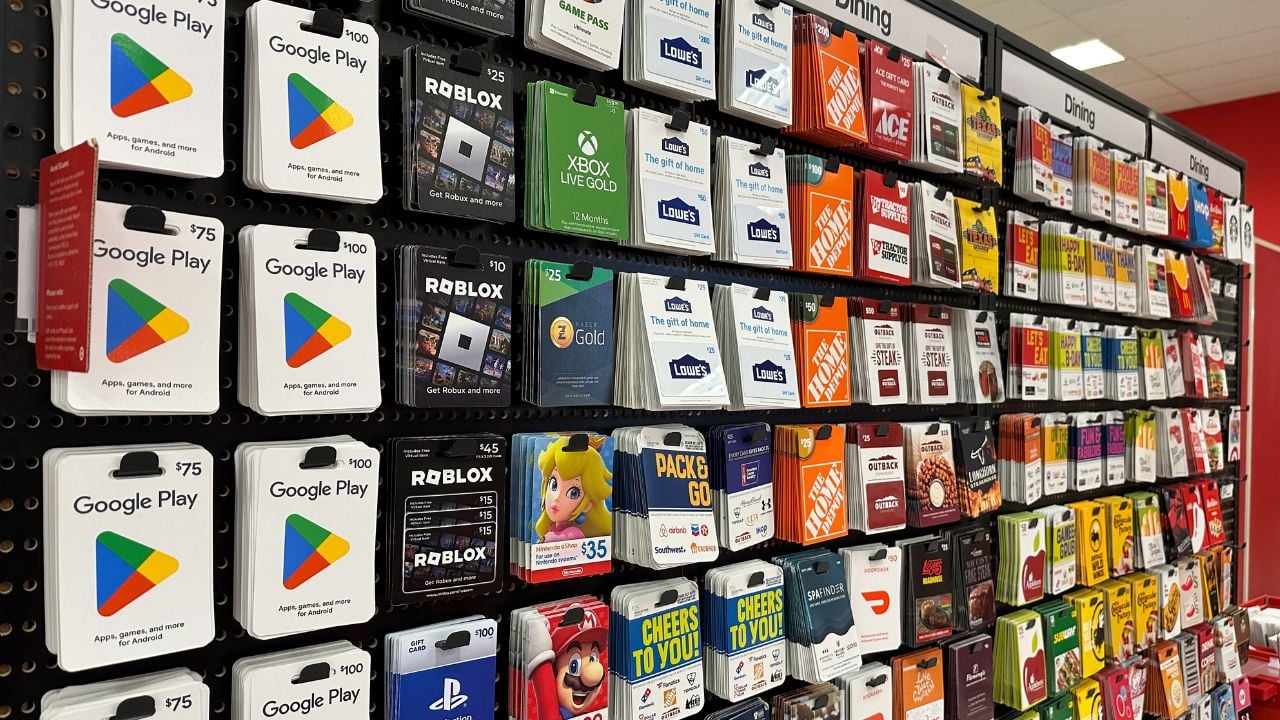
A gift card display in nearly any New York store can hide a card that’s already been robbed.
Thieves peel back the protective sticker or scratch off the panel on the back of a card, photograph the code and personal identification number (PIN) underneath, then press everything back into place so the packaging looks untouched.
The card sits back on the rack like nothing happened.
Nothing did, not yet.
The moment a shopper buys it and someone activates the balance, the thief who already has the code drains it first, often before the card even reaches a wallet.
The Federal Trade Commission (FTC) logged more than 41,000 reports of drained and tampered gift cards in 2024, totaling $217 million in losses nationwide.
Run a finger over the back of any card before buying it.
A sticker that feels raised, torn or re-glued is reason enough to grab a different card and flag it for the cashier.
Falling for a Barcode-Swap Sticker
A New York shopper can do everything right and still fall for a swapped barcode.
Scammers print a sticker carrying their own card’s barcode and slide it through the plastic window of the packaging, covering the card’s actual barcode underneath.
The cashier scans what looks like a normal gift card.
It’s the wrong card.
The Better Business Bureau has warned shoppers to check for a raised or double-layered barcode before paying, the giveaway a swapped sticker leaves behind.
The register never questions which barcode it’s reading.
It just loads the money wherever the top layer points.
Trusting a Bonus Card’s Fine Print
New York’s gift card law, General Business Law 396-i, bans nearly every fee a retailer can charge and sets a nine-year floor on when a card can expire.
New York’s ban doesn’t cover any card handed out as a promotional card, a reward or a loyalty perk instead of something a shopper paid for.
Free doesn’t mean protected.
The $10 bonus card stapled to a $50 receipt plays by different rules than the $50 card sitting right next to it.
It can carry its own expiration date, and it can carry a fee because New York’s ban only reaches gift certificates someone bought with their own money.
Read the fine print on any bonus card before treating it like store credit that lasts forever.
Letting Your Balance Go Inactive for Five Years
A New York gift card can’t legally expire before nine years, but the money on one can leave the store’s books years sooner than that.
State law lets a retailer turn an inactive gift-card balance over to the Comptroller’s Office of Unclaimed Funds after five years of no activity, even though the card itself is still technically valid.
New York State Comptroller Thomas DiNapoli’s office recovered more than $27 million in gift-card money in 2023 alone.
New York City residents were owed the most of it, close to $40 million, followed by Long Islanders at $10.8 million and Hudson Valley residents at $7.4 million.
The money isn’t gone.
It just isn’t sitting where a shopper expects to find it anymore.
What New York’s Nine-Year Rule Doesn’t Cover
New York’s Office of Unclaimed Funds holds a swept gift-card balance with no deadline attached.
A balance swept there in year six is still fully claimable in year twenty, though it earns no interest while it waits.
Getting it back means filing a free claim through the Comptroller’s own website instead of swiping a card at the store.
The office returns an average of $1.5 million in unclaimed funds of every kind each day.
Gift cards make up only one slice of that total.
Psst! Think you know the difference between a gift card myth and a gift card fact? Flip these cards and see how many you get right.
Tossing Your Card With a Few Dollars Left
New York shoppers holding a gift card with $3 left on it almost always toss it, sure the last few dollars aren’t worth the hassle.
That’s the assumption nobody at the register has any reason to correct.
State law says otherwise.
Any ordinary New York gift certificate, meaning any card that isn’t a promotional card or a bank-network open-loop card, has to be redeemed for cash on request once its balance drops under $5.
Nobody has to spend that last bit on more stuff at the same store.
A shopper who pitches the card instead of cashing it out isn’t done with it, not yet.
It goes dormant, and New York sweeps a dormant balance into the Comptroller’s Office of Unclaimed Funds after five years, the same shelf as every other forgotten card in the state.
Retailers keep that float in the meantime, and a shopper who never asks simply forfeits it.
Ask the cashier for the cash instead.
Paying an Activation Fee You Didn’t Expect
Open-loop gift cards, the Visa- or Mastercard-branded ones sold at pharmacies and grocery stores instead of a single retailer, are the one category New York’s fee ban doesn’t fully close.
New York law still allows a one-time activation fee on these cards, capped at $9, tied to the issuer’s cost of putting the card into circulation.
So a $50 open-loop card can run a shopper as much as $59 out of pocket at the register, all within the rules.
That’s not a violation.
Shoppers who assume the phrase “New York banned gift card fees” covers everything run into a surprise at checkout.
Read the sticker on the display rack.
It usually lists the activation fee in tiny print right under the card’s face value.
Handing Codes to a Fake Boss or Utility
Gift cards have become scammers’ go-to demand in New York, whether the caller claims to be a boss, a utility company, a government agency or a panicked relative.
The pitch always ends the same way.
Read me the numbers on the back.
That’s the giveaway.
No genuine boss, utility or government office ever asks an employee or a customer to settle up with gift card codes read over the phone.
New York took the pattern seriously enough to write it into law.
A 2022 law now requires every retailer that sells gift cards to post a warning sign at the display or the register, spelling out what to do if a purchase looks like it’s headed toward a scam.
The sign won’t stop a determined scammer, but a cashier trained to recognize the pattern sometimes does.
Checking Your Balance Through the Wrong Link
A gift card’s balance seems like a two-second thing to check, so New York shoppers often just search it instead of going straight to the retailer’s own site.
That shortcut is exactly what scammers count on.
Fake balance-check phone numbers circulate online, and so do bogus Quick Response (QR) codes stuck on stickers pressed right over the originals, both built to steal the card number and personal identification number (PIN) the instant someone dials the number or scans the code.
One wrong click is all it takes.
The balance is gone.
Check a balance only through the number or website printed on the retailer’s own gift card page.
A link from a text message or a search result routes through a server nobody at the actual store controls.
Where to Report a Bad Card
A New York shopper who spots a tampered card, loses money to a gift card scam, or can’t get a retailer to honor a legitimate balance has more than one place to turn.
The store itself is the first stop, since many retailers can flag or freeze a compromised card number within minutes once a receipt and the card number are on hand.
Try that first.
New York’s Division of Consumer Protection takes complaints about gift card practices statewide.
The Attorney General’s office looks into patterns of fraud big enough to investigate.
The Federal Trade Commission (FTC) collects reports at ReportFraud.ftc.gov, and that database is where the national numbers on drained and swapped cards come from in the first place.
The FTC funnels every report into its Consumer Sentinel Network, a database open to any federal, state or local law enforcement agency working a case.
New York’s Attorney General runs its own consumer hotline for exactly this, 1-800-771-7755, a different number than whatever’s printed on the back of the card.
9 Things New York Landlords Can Legally Do That Renters Assume Are Illegal
New York’s Good Cause Eviction law has spread to more than a dozen cities since it passed in 2024, and many renters assume the whole state now works in their favor.
It doesn’t, and the landlord moves that catch people off guard have nothing to do with a gift card rack.
9 Things New York Landlords Can Legally Do That Renters Assume Are Illegal
10 Words New Yorkers Use That Confuse Everyone Else

New York doesn’t run on one accent or one set of words, and the vocabulary changes at county lines more than many outsiders expect.
These are the words that separate New Yorkers from the rest of the country, and sometimes from each other.
