
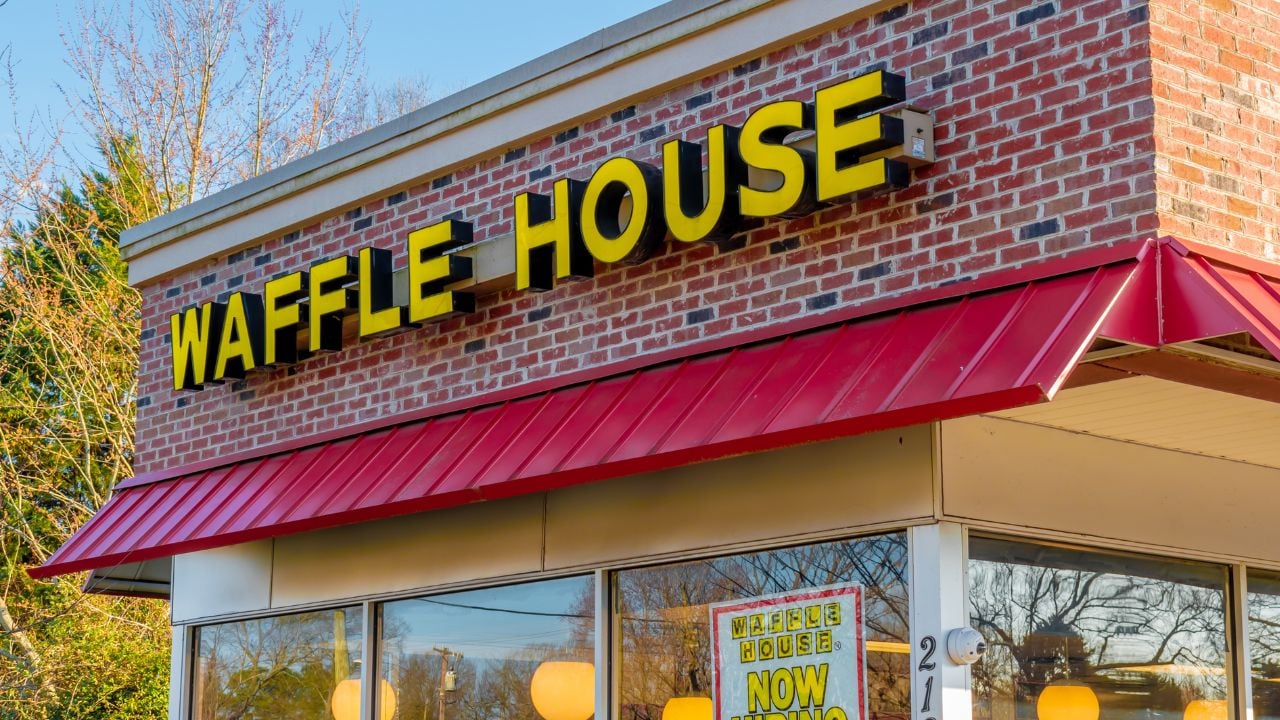
9 Unwritten Waffle House Rules Many Alabamians Follow After Midnight

Chainwide, Waffle House reportedly plates around 238 hash browns every single minute.
Across one overnight shift, Alabama’s stretch of the chain alone moves through more of them than a lot of kitchens see in an entire week.
These are the unwritten Waffle House rules Alabama’s late-night regulars follow after midnight.
1. Ordering Ahead of the Rush
Waffle House rolled out delivery in 2025 for exactly the hours regulars already know best, 9 p.m. to 7 a.m.
The timing wasn’t random.
Orders placed between midnight and 5 a.m. had jumped 44% nationwide the year before, and the chain built the new option around that exact window.
About 500 stores carried it at launch, routed through a delivery partner instead of a dining room line.
Regulars caught on fast.
Instead of walking in cold during the after-last-call crush, many regulars place the order first and time their arrival around it.
It beats standing behind six people who all hit the door at once.
2. Solo at the Counter
Waffle House regulars leave the booths open for parties of two or more.
After midnight, a solo diner who forgets that turns into the reason a group of four ends up waiting by the door.
The counter has room.
A stool at the counter also puts a solo regular near enough to watch the whole grill in action while eating.
Bar-close is when this rule earns its keep, when six- and eight-person groups start pouring in at once looking for a booth.
Six people don’t fit at a counter.
A solo regular who claims a whole booth at 2 a.m. leaves the next group circling the parking lot instead.
3. Keeping Your Order Simple
Waffle House lets regulars get creative with a hash brown order, piling on extra toppings or asking for something that isn’t quite on the menu.
During a slow Tuesday afternoon, the cook has time for that.
After midnight on a weekend, the cook doesn’t.
Bar-close changes the math.
A cook working a ticket rail already stacked eight deep doesn’t need a ninth order with six modifications read out one at a time.
Save the elaborate version for daylight, and keep the overnight order close to what’s already printed.
Regulars learn this by watching one rush happen.
Everyone else learns it by causing a rush.
4. The Grill’s Pace
Waffle House runs on one grill and, overnight, often just one cook working it alone.
Chainwide, the company reportedly plates something like 238 hash browns every minute, and every one of those tickets still comes out in the order it was called.
No cutting the line.
A regular who’s hungry and impatient at 3 a.m. still waits their turn behind whoever ordered first, not whoever complained loudest.
Heckling the cook, tapping the counter, or asking twice in five minutes, none of it moves a ticket any faster.
It just makes the wait feel longer.
Regulars know the grill is already moving as fast as one person and one griddle can move it.
5. Reading the Jukebox Room
Waffle House still runs an actual jukebox in many locations, and after midnight it turns into shared property among total strangers.
Nobody agreed to share a soundtrack.
They end up sharing one anyway, and the unwritten rule is to check what’s already queued before stacking up picks of their own.
One song fits the room.
Five songs from the same person don’t, especially when half the counter is trying to eat in something like peace after a long shift.
Read the room, then pick one.
Regulars treat the jukebox as shared space, not a personal speaker for the next hour.
6. One Server, Whole Floor
Waffle House often narrows its overnight crew down to a single server working every table in the dining room.
That’s the same person taking orders, running plates, refilling coffee, and ringing up the register, all at once.
One person handles it all.
Regulars have learned to bundle their requests instead of flagging her down three separate times for coffee, then water, then the check.
One trip covers it.
Saying please and thank you moves things along too, since a server splitting her attention six ways doesn’t have time to sort out who’s asking nicely and who isn’t.
Regulars who’ve watched one person run a packed floor alone know the patience isn’t about mood.
It’s about how many hands she has.
7. Keeping the Peace
Waffle House sees a rowdier crowd right after last call, when the bars empty out and a fresh, unpredictable wave of customers walks in at once.
That’s the volatile hour.
The unwritten rule for regulars is simple: Stay out of whatever’s brewing two booths over.
Don’t referee a stranger’s argument, don’t record it for laughs, and don’t add commentary from across the room.
Watch, don’t join.
Staff have handled this exact scene a hundred times before, and regulars know the fastest way through it is to let them.
It’s usually over in a few minutes, and the counter goes back to normal like nothing happened.
8. Tipping Like It Counts
Waffle House runs its overnight shift on one server and one cook, sometimes covering a full dining room alone until the sun comes up.
Regulars tip like they know it.
A group of friends from just outside Cullman put that math to the test in 2022.
Twelve of them left a single overnight server $1,125.25 on a $74.75 bill.
When she brought the check over, they motioned her back and started counting out $100 bills.
She never saw it coming.
That’s the extreme version of a habit many Alabama regulars practice: Tipping well on a $7 ticket instead of rounding down because the total looks small.
One overnight server covering a packed dining room alone earns every dollar of it.
9. Leaving When It’s Dark
Waffle House almost never turns off its lights, so when a regular pulls up to a dark building at 3 a.m., they don’t assume bad luck.
They assume something’s wrong.
A closed Waffle House is rare enough that regulars read it as a warning, not a coincidence.
The unwritten rule is short: Don’t idle in the lot wondering why. Just leave and check back later.
Why Waffle House Almost Never Goes Dark
Waffle House’s reputation for staying open runs deep enough that the Federal Emergency Management Agency (FEMA) built a disaster tool around it, called the Waffle House Index.
The index dates to 2011, after a tornado tore through Joplin, Missouri, and both local Waffle Houses stayed open through the disaster.
FEMA grades locations green for normal, yellow for a limited menu, or red for closed, and red is rare enough that regulars read it as serious trouble.
The Shortened Menu Warning
Regulars who’ve watched a hurricane season roll through Alabama know a shortened Waffle House menu is often the clearest local sign of how bad a storm turned out.
Fewer items mean worse trouble.
A full lot and a working griddle at 3 a.m. still means the neighborhood around it came through fine.
That’s the yellow reading on FEMA’s scale, the stretch between a normal night and a closed sign.
Regulars who’ve sat through one storm know the difference between the two by the length of the menu, not by asking anybody.
Psst! How much do you know about Waffle House’s history and culture? Take our quiz and see how many you can get right.
Quiz
Waffle House IQ
Answer these questions on Waffle House history and trivia. We bet you can’t get them all right. Prove us wrong?
What’s the name of Waffle House’s own in-house record label, founded in 1984?
8 Things Alabamians Once Memorized That Their Phones Remember for Them Now
A national survey found that 82% of parents can't recite their own child's phone number anymore, since that job now belongs to a contacts app.
Alabamians used to carry a lot more information around in their heads before smartphones took over the job.
8 Things Alabamians Once Memorized That Their Phones Remember for Them Now
10 U.S. Towns With Unusual Mail Delivery
For more than a century, mail carriers on a Wisconsin lake have leapt off a moving boat just to make their deliveries, and nobody there thinks that's strange.
A handful of U.S. towns still get their mail in ways the rest of the country gave up on generations ago.
10 U.S. Towns Where Residents Still Get Their Mail in an Unusual Way, including 2 in Alaska
