
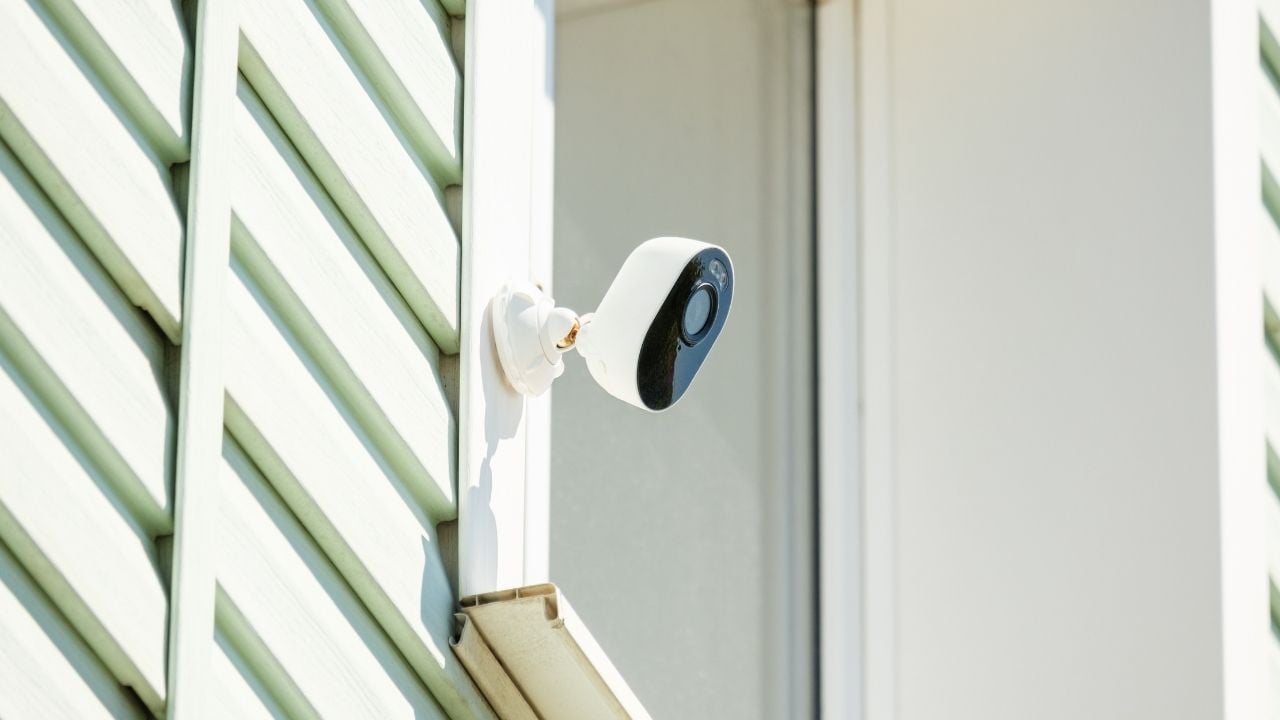
7 Rules That Decide What Georgians Can Do About a Neighbor’s Camera Pointed at Their Yard

Point a camera at the wrong patch of a neighbor’s backyard in Georgia, and the charge isn’t a warning.
It’s a felony, one that can carry up to five years in prison.
Many homeowners who install a camera, or fume about a camera aimed their way, have no idea where Georgia draws that line.
These are the rules that decide what a Georgia homeowner can do about a neighbor’s camera pointed at their yard.
Note: This is general information, not legal advice. Georgia’s privacy and property laws are subject to change.
1. Your Yard’s Public-View Line
Can a neighbor’s camera aimed at your driveway ever break the law in Georgia? Only if it’s watching a spot no one on the sidewalk could already see.
A camera aimed at a driveway, a front yard, or a porch that anyone walking down the sidewalk could see isn’t watching a private place under Georgia law.
That holds even when the footage bothers the person walking through it.
More Georgia driveways sit under that kind of lens every year, part of a national shift: Nearly four in ten American homes now own a video doorbell trained on the front step.
Gwinnett County, Georgia’s second-most populous county and one of metro Atlanta’s most subdivision-heavy stretches, shows that shift about as clearly as anywhere in the state.
Georgia’s surveillance statute, the Official Code of Georgia Annotated (O.C.G.A.) § 16-11-62, only bans recording someone’s activities in a “private place and out of public view.”
There’s no privacy claim to file.
A homeowner annoyed that a neighbor’s camera catches the mail carrier, the dog walker, or their own car pulling in has no legal complaint to raise because none of that ever left public view.
2. The Fenced-Yard Rule Flip
The moment a camera crosses into a space hidden from that same public view, Georgia’s rule flips.
A backyard blocked by a privacy fence, a tall hedge, or a house that breaks the sightline counts as a place with a reasonable expectation of privacy.
Forsyth County’s new-build subdivisions along the Georgia 400 corridor, among the fastest-growing in the country, are full of exactly that kind of yard, with six-foot privacy fencing standard on lot after lot.
Point a lens through that gap, and Georgia stops treating it as a nuisance complaint.
It’s a felony.
O.C.G.A. § 16-11-62(2) bans recording someone’s activities in a private place, out of public view, without their consent, and a conviction carries up to five years in prison or a fine as high as $10,000.
The security-camera exception that protects a homeowner watching their own property doesn’t stretch across the property line into a neighbor’s fenced yard.
That’s the line between background noise and a felony.
3. What the Microphone Can Legally Catch
Talk to a friend in your own Georgia backyard, and it’s easy to assume nobody but the two of you is listening.
A neighbor’s camera sitting just past the fence line can pick up every word of it, and whether that’s legal turns on a rule many homeowners misread.
Georgia is a one-party consent state under O.C.G.A. § 16-11-66(a): Anyone who is part of a conversation can record it without saying so, even secretly.
That covers a homeowner’s own doorbell exchange with a delivery driver.
That part’s fine.
It doesn’t cover a camera that happens to catch what you say in your own yard when you’re not talking to whoever owns that camera.
The camera’s owner was never a party to that conversation, so the one-party exception in O.C.G.A. § 16-11-66 never kicks in for what their device just picked up.
That leaves the underlying ban in O.C.G.A. § 16-11-62(1) standing on its own: Recording, in a clandestine manner, the private conversation of another that originates in a private place.
A homeowner whose own backyard conversation gets swept up that way is the one with standing to complain, not the camera’s owner.
Some states require every person in the conversation to agree before anyone records it.
Georgia doesn’t, but that leniency stops at conversations the camera’s owner is part of.
4. The Camera-Smashing Backfire
Georgia’s criminal code doesn’t spare a homeowner who takes a hammer, a spray can, or a pair of wire cutters to a neighbor’s camera.
Property stays property, even when it’s pointed somewhere you don’t like.
Damaging it without consent runs straight into Georgia’s criminal damage and trespass statutes.
It’s a bad trade.
File a complaint instead, and the camera’s owner is the one explaining themselves.
Take matters into your own hands, and the roles reverse in front of a judge.
Georgia’s $500 Line Between a Misdemeanor and a Felony
Georgia draws a hard dollar line between the two charges a homeowner can face for damaging a neighbor’s camera.
Damage of $500 or less usually falls under criminal trespass, a misdemeanor punishable by up to 12 months in jail and a fine up to $1,000.
Once you count wiring, mounting hardware, and the whole unit, damage past $500 moves the case to Georgia’s second-degree property statute, and the charge becomes a felony.
5. The Revenge-Camera Backfire
Revenge gets no carve-out in Georgia’s privacy law.
Installing a second camera and pointing it straight at a neighbor’s window, patio, or fenced yard is one way homeowners try to get even.
It runs into the exact statute that protects a homeowner from being watched in the first place.
O.C.G.A. § 16-11-62(2) applies the same way no matter who started the dispute: What matters is whether the footage shows a private place, out of public view, recorded without consent.
A camera set up purely to retaliate satisfies both conditions.
Two wrongs still add up to two possible felonies.
6. The Property-Stepping Crime
Confronting the camera in person feels like the direct fix, but Georgia treats setting foot on a neighbor’s land without permission as its own crime.
Setting foot on someone else’s property without permission is criminal trespass, a misdemeanor carrying up to 12 months in jail.
That’s trespassing.
Cross that line to eavesdrop or secretly watch what’s happening on the property, and Georgia’s eavesdropping law adds a second, more serious charge on top of the trespass.
O.C.G.A. § 16-11-62(3) separately bans going onto someone else’s property for the purpose of eavesdropping on their conversations or secretly observing their activities there.
Walking up to confront a neighbor face to face, or pulling their camera off its mount, happens out in the open, not in secret.
That stays ordinary trespass, and criminal damage to property if the confrontation breaks the camera, not this second eavesdropping charge.
One angry walk across the property line made to watch or listen in secret can still turn a single complaint into two counts.
Stay on your own side of the fence.
Psst! How much do you know about Georgia’s camera and privacy laws? Take our myth-or-fact quiz and see how many you can get right.
7. Lawful Moves That Work
Georgia gives a homeowner several lawful paths that don’t involve a hammer or a hidden camera of their own.
A written request to reposition or remove the camera, kept for your own records, is the easiest first move.
A police report citing O.C.G.A. § 16-11-62 gives an officer a named statute to check the camera against, rather than a vague noise or nuisance complaint.
Georgia’s courts also recognize a civil claim for intruding on someone’s private affairs.
That right traces back to a 1905 ruling from the Georgia Supreme Court, one of the first courts in the country to recognize a legal right to privacy at all.
Georgia’s Court of Appeals has since allowed a civil claim for intruding on someone’s seclusion when the intrusion would offend an ordinary person.
If a camera pointed at your yard also breaks your neighborhood’s own rules on top of state law, that’s a separate complaint for the homeowners association to sort out, not a state matter.
Paperwork beats payback.
Small claims court handles disputes under $15,000 without hiring a lawyer, an option many homeowners overlook when a neighbor won’t reposition a camera after a written request.
A homeowner files that case at the magistrate court in their own county, the same court that handles evictions in Fulton County, DeKalb County, and every other county in the state.
Keep dated photos of the camera’s angle and copies of any written requests you sent, since that paper trail is what moves a police report or a civil claim forward.
9 Tailgate Mistakes That Instantly Mark You as Not From Georgia

Sanford Stadium packs in just over 93,000 fans on a Saturday, close to the entire population of Athens-Clarke County.
Georgians navigate that crowd by a rulebook out-of-staters never had to learn, and it starts hours before kickoff.
9 Tailgate Mistakes That Instantly Mark You as Not From Georgia
5 Lidl Bakery Finds Georgia Shoppers Grab Before They Sell Out

Lidl prices its butter croissant at 49 cents, a number that hasn’t moved in years.
That price only holds if there’s still one left in the case by the time a Georgia shopper gets there.
5 Lidl Bakery Finds Georgia Shoppers Grab Before They Sell Out
