
4 Small-Town Missouri Fixtures Missourians Are Fighting to Save

Excelsior Springs has already spent roughly $1 million keeping the floor of its 1930s bathhouse from collapsing into the pool ceiling below it.
Another $2.5 million would finish the job.
Missouri towns are running that arithmetic on buildings all over the state right now, mostly with money they raised themselves.
These are the small-town Missouri fixtures Missourians are fighting to save.
1. Grand Auglaize Bridge
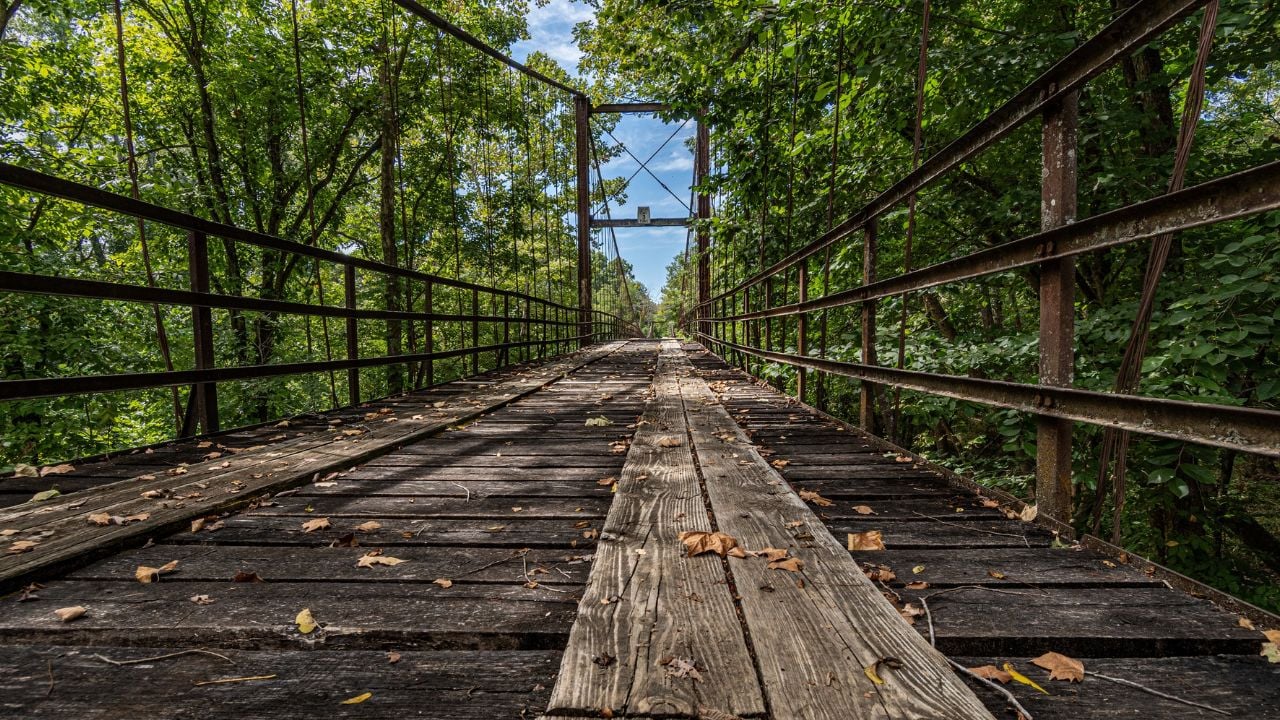
The Grand Auglaize Bridge has carried travelers over the Grand Auglaize Creek near the Village of Brumley, Missouri, since around 1930.
Locals call it the Brumley swinging bridge, and it was the last bridge of its kind in Missouri still open to cars.
A 2021 inspection changed that.
The Missouri Department of Transportation closed the bridge to both vehicles and foot traffic that year.
Missouri Preservation put the price of fixing it at $650,000, money Miller County didn’t have in its budget.
Local volunteers had already formed a nonprofit called Save the Historical Brumley Swinging Bridge to fight for it.
Voters said yes.
Miller County residents approved a four-year, one-eighth-cent sales tax on April 2, 2024, to fund the bridge’s rehabilitation.
As of the preservation group’s most recent public update, contractor bids were expected in late 2024, with construction running through 2025 and a reopening targeted for 2026.
2. Hall of Waters
Excelsior Springs, Missouri, built its identity around the mineral water flowing beneath downtown, and the Hall of Waters is where that water still surfaces.
The 1930s bathhouse-turned-city-hall made Places in Peril in 2019 and the National Trust’s 11 Most Endangered Places the following year.
Decades of deferred maintenance had left its roof leaking and its floors sagging.
The city didn’t walk away.
Excelsior Springs has already spent roughly $1 million shoring up the water bar floor and the swimming pool ceiling beneath it.
The city’s preservation project page calls that work a life-safety priority.
Another $2.5 million would fund the rest: A stabilized tower, a restored east wing, and entrances that meet accessibility requirements on a building that still houses city offices every day.
Where the Hall of Waters’ Money Comes From
The $1 million Excelsior Springs has spent so far traces back to a 2020 Save America’s Treasures grant.
That grant put $500,000 toward the Hall of Waters and required the city to match it dollar for dollar.
The Downtown Excelsior Partnership, which runs the city’s accredited Main Street program, reported about $6.5 million in taxable retail sales in the historic district in 2021.
Local officials point to that kind of activity when they argue the Hall of Waters is worth finishing.
3. DeLozier Building
The DeLozier Building has anchored the courthouse square in Clinton, Missouri, since 1887, when it opened as the Henry County Bank.
That bank failed.
The local post office moved in next, then Dunning Furniture, until that store closed in the 1980s.
Tracy DeLozier saved it first.
He bought the vacant building in 1994 and donated it to the Henry County Historical Society, renaming it for his late wife, Juanita.
The society now rents out its ballrooms for private and public events to help cover the cost of holding the place together.
Missouri Preservation put the DeLozier Building on its 2024 Places in Peril list.
Without new funding and expert help, the historical society’s limited resources won’t be enough to stop the deterioration.
4. Anna Bell Chapel
Anna Bell Chapel has stood above the Missouri River in New Haven, Missouri, since 1892.
A formerly enslaved woman named Anna Pryor Bell raised the money that bought the land and built the church.
Congregants renamed it in her honor after she died in 1905.
The chapel anchored New Haven’s Black community for 100 years, until its five remaining, elderly members closed its doors in 1995.
New Haven resident David Smith kept watch after that, paying the insurance and utilities and mowing the lawn for 25 years.
He turned to the New Haven Preservation Society for help in 2020.
The society took ownership and found the building had settled so badly it needed to be lifted off its foundation.
The chapel got new footing.
By 2023, a capital campaign had raised enough to stabilize the structure and set it on that new foundation, according to Missouri Preservation.
Lead paint, damaged windows, and outdated wiring are still waiting on the next round of funding.
The National Trust for Historic Preservation named Anna Bell Chapel one of 30 historically Black churches nationwide to win a preservation grant in February 2025.
Psst! How much do you know about Missouri’s Main Street history? Take our quiz and see how many you can get right.
Quiz
Missouri Main Street IQ
Answer these questions on Missouri’s small-town landmarks and Main Street history. We bet you can’t get them all right. Prove us wrong?
A single 1881 disaster is often credited with saving Weston’s entire 19th-century Main Street by ending its river trade before railroads and big-box stores could remake the town. What kind of disaster was it?
Englewood Theater
Englewood Theater sat empty in Independence, Missouri, for almost 20 years after the neighborhood movie house went dark.
Friends of the Englewood Theater, a nonprofit formed to save the building, closed on its purchase in November 2025.
The theater finally changed hands.
Brent Schondelmeyer, a former president of the Jackson County Historical Society, leads Friends of the Englewood Theater.
The theater has since been added to the National Register of Historic Places, a status that can unlock preservation tax credits.
Architects call reroofing the building a top priority, since keeping it watertight comes before any other work can start.
The nonprofit wants the restored Englewood to work as a community hub, hosting movies, meetings, and local events under one roof again.
How Missouri Decides What's "In Peril"
Missouri Preservation started calling attention to endangered landmarks back in 2000, under a blunter name: Most Endangered.
The name didn't stick.
The nonprofit renamed the program Places in Peril in 2015.
Every property on the list starts the same way: A resident nominates it, and a volunteer committee of preservation professionals and enthusiasts decides whether it qualifies.
Anyone can file a nomination through the group's website, no membership or preservation credentials required.
That's exactly how a small-town bank building or a Main Street bathhouse ends up on a statewide list in the first place.
Missouri Preservation runs an interactive map that tracks every building that has ever made the Places in Peril list, tagged as saved, in progress, needing help, or lost.
Clicking through it turns up small-town landmarks in nearly every corner of the state, from courthouse squares to river towns.
The North Taylor Fund has sponsored the announcement for the past two years running.
9 Things Missourians Are Tired of Explaining to Everyone Who Moves In
St. Louis pizza runs on a cheese blend engineered back in 1947, and it doesn't behave like any other pizza cheese in the country.
Missouri has a whole list of quirks like that one, the kind lifelong residents end up explaining to every new neighbor from somewhere else.
9 Things Missourians Are Tired of Explaining to Everyone Who Moves In
9 Things Missourians Say That Baffle Everyone Else
A stranger orders dessert at a St. Louis custard stand, and the server tips it upside down without warning.
Regulars barely look up because that upside-down move is just one of the sayings and habits that give Missouri its vocabulary.
