
9 Things Missourians Are Tired of Explaining to Everyone Who Moves In

St. Louis pizza runs on a cheese blend engineered in 1947. It doesn’t behave like any other pizza cheese in the country.
Missouri has a whole list of such quirks that lifelong residents have to explain to out-of-staters.
These are the things Missourians are tired of explaining to everyone who moves in.
1. Missouri’s Lettered Highways
Missouri’s rural highways carry a naming system found almost nowhere else in the country.
Route Z, Route AA, Route HH: Letters replace numbers on thousands of miles of state roads.
A newcomer’s GPS calls out “turn onto Route Z,” and many assume the app glitched.
It didn’t.
Missouri’s supplemental highway system took shape in the 1930s and expanded fast under a 1952 program that turned close to 12,000 miles of farm-to-market roads into a permanent, state-maintained network.
Missouri chose letters so drivers wouldn’t confuse these new roads with the state’s numbered highways.
Double letters like Route AA usually mark a shorter spur off a longer route.
Longtime Missourians rattle off directions by letter without a second thought.
Send a transplant down Route HH, and the explaining starts before they’ve even unpacked.
2. “Where’d You Go to High School?”
One of Missouri’s biggest cities, St. Louis, has a reputation for skipping past “where do you work” and asking something else entirely.
A coworker or new neighbor asks a new arrival where they went to high school within the first conversation, sometimes within the first five minutes.
It’s not idle curiosity.
By the early 1960s, the city’s parishes had opened around 30 high schools, a dense cluster of Catholic institutions with many within a few miles of each other, and each school carried its own reputation, income bracket, and social circle.
Longtime residents still read the answer like a shorthand background check.
A transplant who names a school three states away gets a blank stare, then a full explanation of what the question was asking.
3. Toasted Ravioli, Not Boiled
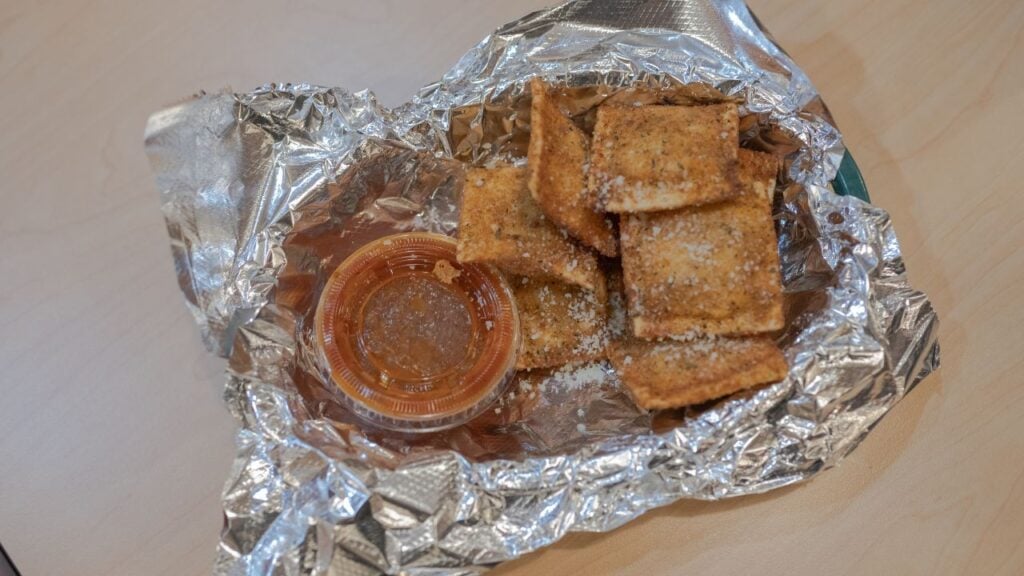
Missouri put its own spin on ravioli, and it involves a deep fryer instead of a pot of boiling water.
Toasted ravioli shows up as the default starter on menus across the state: Breaded, deep-fried pasta pockets dusted with Parmesan and served with marinara for dipping.
St. Louis’s Hill neighborhood gets credit for inventing it in the 1940s, though two rival restaurants still argue over which kitchen dropped the ravioli into hot oil by accident first.
Newcomers who order it expecting tender, boiled pasta get a crunchy, golden pocket instead.
A Missourian at the table jumps in before the confusion even registers, walking the newcomer through the swap and the Hill’s accidental origin story.
The explanation comes before the first bite.
4. Missour-ee or Missour-uh?
Missouri can’t agree on how to pronounce its own name, and it’s been arguing about it for more than a century.
More than 90% of Missourians say “Missour-ee,” landing hard on that final vowel.
A smaller group, concentrated in the state’s western and northwestern corners, says “Missour-uh” instead, the same region that raised former president Harry Truman.
His western roots fit the pattern.
Pick one version around a newcomer just settling in, and a Missourian will correct them on the spot, then hand over a short history lesson on why the state never settled it.
The History Behind Missouri’s Pronunciation Split
Missouri’s two pronunciations trace back to different roots entirely, according to University of Missouri dialect research.
The “-ee” ending likely traces to French explorers, who were among the first Europeans to use the name and would have pronounced its final vowel the French way.
The “-uh” ending grew out of an English spelling pronunciation instead, as the lightly stressed final syllable gradually shrank down to a plain “uh” sound.
Today, the “-ee” version reads as the default across the state, and the “-uh” version still holds on strongest in that same western stretch.
5. Kansas City Barbecue vs. St. Louis Barbecue
Missouri splits into two rival barbecue camps, stitched together by about 250 miles of highway.
Kansas City runs on a thick, molasses-sweetened tomato sauce and burnt ends carved off a smoked brisket.
St. Louis sticks to a thinner, vinegar-tangy sauce and pork spare ribs trimmed of their cartilage, a cut that carries the city’s name nationally.
Order “Missouri barbecue” in either city, and a local will ask, politely, which half of the state you mean.
Newcomers who don’t know both styles exist end up picking a side by accident.
A regular behind the counter sets them straight, walking through the sauce and the cut until St. Louis ribs and Kansas City burnt ends stop looking the same.
6. Cardinals Baseball Isn’t Optional
Missouri takes its Cardinals baseball more seriously than a regular-season record usually explains.
The team has won 11 World Series titles, second only to the Yankees, and once sold out 165 consecutive games before that streak finally broke in 2008.
A newcomer who treats a Tuesday night game against a last-place team as background noise learns fast that Missourians don’t.
A coworker walks them through it before the game’s even over, explaining that Cardinals baseball has been Missouri’s shared obsession for generations and a losing record never loosens the grip.
Grocery store lines break into recap conversations with total strangers.
A newcomer standing there ends up in the recap too.
7. Squares, Not Triangles
Missouri’s own St. Louis pizza breaks a few rules newcomers grew up with, starting with the cut.
St. Louis pizzerias slice every pie into small squares, the “party cut,” instead of wedges radiating out from the center.
The crust runs thin and cracker-crisp.
The cheese swaps out mozzarella for Provel, a blend of provolone, Swiss, and cheddar built in 1947 to skip the stretch mozzarella is known for.
It never stretches.
A newcomer expecting a cheese pull for their photo gets a clean, non-stringy bite instead, and a Missourian explains the whole history before the second slice.
Psst! How much do you know about Missouri’s history? Take our quiz and see how many you can get right.
Quiz
Missouri History IQ
Answer nine questions on Missouri firsts, hometowns, and geography. We bet you can’t get them all right. Prove us wrong?
Mark Twain was born in a tiny Missouri town that shares its name with a completely different U.S. state. Which one?
8. Weather That Flips Overnight
Missouri's weather can drop more than 40 degrees within a single hour, a swing newcomers rarely believe is possible until they've lived through one.
On November 11, 1911, the temperature in Columbia, Missouri, hit 82 degrees by early afternoon, then fell to 38 degrees about an hour later as a cold front blew through.
Several other Missouri cities recorded swings of 60 degrees or more within that same day.
No day since has matched that record, but Missouri's spring and fall cold fronts still move fast enough to turn a warm morning into a cold evening within hours.
Longtime Missourians warn newcomers before their first spring here: Check the forecast at breakfast, then check it again by lunch because it can look completely different by dinner.
A newcomer who packs for the morning forecast finds the afternoon weather completely different.
Longtime Missourians keep a jacket in the car through May, just in case.
9. Two Cities, One Missouri
Missouri's two biggest cities, St. Louis and Kansas City, sit about 248 miles apart, a drive of almost four hours down I-70.
St. Louis leans toward the Mississippi River, Illinois, and an East Coast-adjacent identity.
Kansas City leans toward the Great Plains and everything west of it.
St. Louis and Kansas City feel like different worlds inside one state.
Each city insists it's the city that speaks for Missouri, and neither holds the actual capital.
That title belongs to Jefferson City, a small river town many newcomers can't place on a map until they've lived in the state a while.
Ask someone from St. Louis to name Missouri's best city, and Kansas City won't come up.
Ask someone from Kansas City the same question, and the answer flips completely.
A longtime Missourian usually explains the rivalry to a newcomer before they can commit to a side, warning them to stay neutral until they've spent time in both cities.
Newcomers who ignore that advice and pick a side too early usually have to walk it back the first time they visit the other half of the state.
8 Things Missourians Do That Confuse Everyone Who Moves There
Explaining isn't the only side of this. Missourians also do things that leave newcomers scratching their heads before anyone's said a word.
From directions that run on letters instead of numbers to a greeting that comes in at full volume, the confusion runs in more directions than one.
8 Things Missourians Do That Confuse Everyone Who Moves There
8 Hy-Vee Bakery Buys Missouri Shoppers Grab Every Week
A Missouri grocery run means more than milk and eggs at Hy-Vee, whose bakery case has its own set of regulars.
From a French silk pie sized for a crowd to a cookie cake that skips the sheet-cake wait, shoppers know exactly which case to walk toward.
