
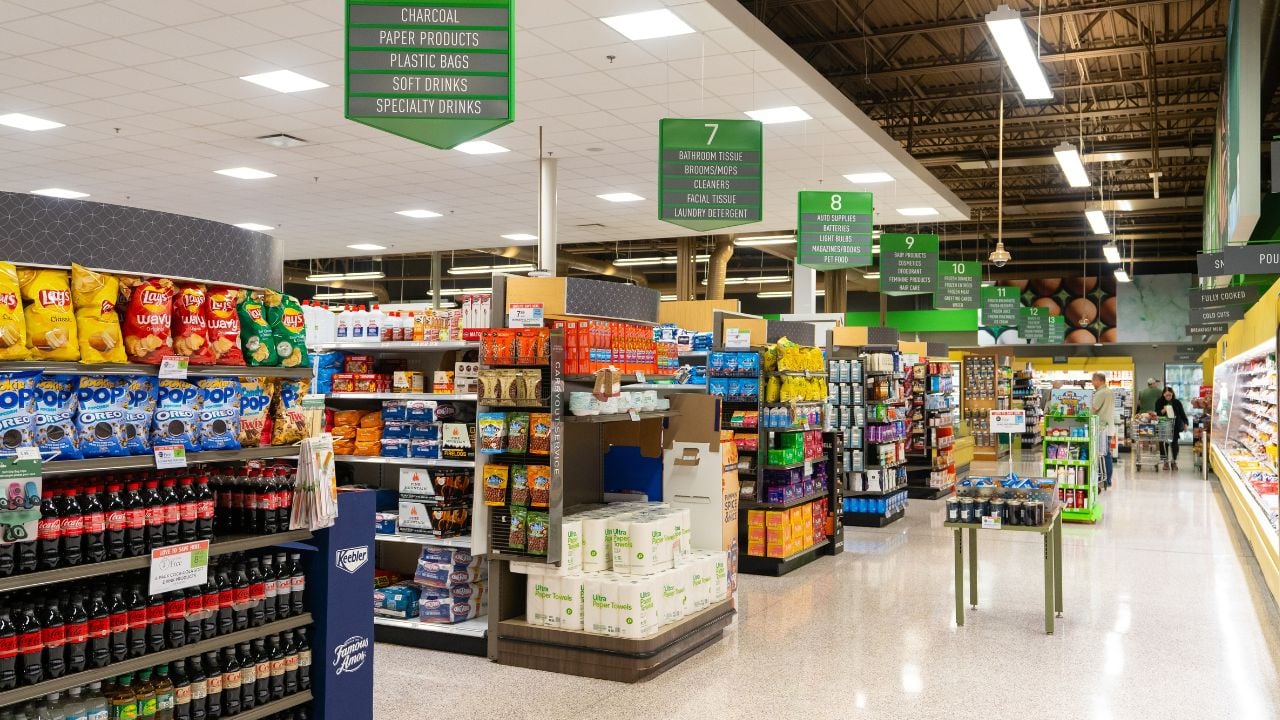
8 Publix Store Details Floridians Often Don’t Notice on Their Own

There’s a difference between knowing your way around Publix and knowing what everything in it means.
Many Floridians pass the same clues every week without realizing there’s anything to figure out.
These are the Publix store details shoppers often don’t notice on their own.
1. Teal Tags, Two Organic Standards
Publix marks organic items with teal shelf tags, and two different standards ride on them.
The U.S. Department of Agriculture (USDA) Organic icon marks a product made with 95% or more certified organic ingredients.
The second teal tag reads Made With 70% Organic, which means at least 70% organic ingredients and not enough for the USDA seal.
They’re not the same tier.
The two tags sit on the same shelf edge, so it’s worth reading which one a product carries.
Publix’s nutrition FAQ says those teal tags turn up in produce, meat, dairy, grocery, and household products.
2. Limits of the Better Choice Tag
Publix hangs a green shelf tag called Better Choice, and it looks like a stamp of approval.
It isn’t quite that.
Publix’s registered dietitian nutritionists compare groups of similar products first, one cereal against another.
The tag then goes to the item carrying more of the nutrients you need, like fiber.
Less of what you don’t need counts too, like saturated fat, added sodium, or added sugar.
A Better Choice cookie is still a cookie.
It just beats the cookie next to it.
Before you toss a Better Choice item in your cart, remember what the tag promises.
It flags a small shift inside a category, not a guarantee that the whole category is good for you.
3. Save Tags and Clearance Tags
Publix marks a temporary price cut with a shelf tag that reads “Save.”
A separate tag reads “Clearance.”
Publix’s shelf-tag guide defines “Clearance” as a product that will soon be unavailable, not a short-term markdown like “Save.”
If you’re hunting for a one-time deal, it’s easy to assume every sale tag means the same thing.
Save and Clearance don’t.
One flags a temporary price.
The other flags a product on its way out.
4. Local Means the Whole State
Publix hangs a Local shelf tag, and the label means more than a sticker suggesting nearby.
In a Florida store, it means the item was grown, harvested, or manufactured in Florida.
In 2023, Publix was one of more than 100 retailers in the state’s Fresh From Florida network, a partnership it had kept since the early 2000s.
The test is the state line, not a vague radius or a nearby region.
A Pensacola jar counts.
Publix works with local produce growers in seven states.
Among the Florida suppliers it names is a Homestead dragon fruit farm, JC Tropicals, which Publix has bought from for more than 20 years.
Pick up a carton of strawberries carrying that tag, and the berries came from somewhere inside the state line.
Psst! How many of these Publix aisle habits do you already have? Run through the checklist and see where you stand.
5. Two Seafood Sourcing Tiers
Publix labels its seafood with sourcing icons, and they aren’t interchangeable.
The higher tier reads Sustainably Sourced.
The lower tier reads Responsibly Sourced.
Not the same grade.
Wild-caught fish earns the top tier only when a certification program recognized by the Global Sustainable Seafood Initiative has certified the fishery.
The lower tag goes to wild-caught fish whose stock the Sustainable Fisheries Partnership rates healthy and well managed.
A fishery still working toward that rating through an improvement project lands there too.
Farmed seafood splits the same way, with the top tier certified at the farm, the hatchery, the plant, and the feed supplier.
The lower tier needs the farm alone.
Publix rolled both labels out onto frozen-case shelf tags and the price tags at the full-service counter.
So the next time you compare two salmon fillets, you’re comparing two different certification standards, whether you notice it or not.
6. GreenWise Rules by Department
Publix builds GreenWise on more than one rule, and which rule applies depends on the department.
For GreenWise meat and poultry, Publix adds a raising standard on top of the ingredient rules.
Those animals are raised without antibiotics or added hormones.
Two different promises.
You might picture GreenWise as one shelf.
That’s not how it works.
GreenWise dairy sits in the dairy case, GreenWise chicken sits in the meat case, and GreenWise seafood sits in the seafood department.
The standard follows the product, not one dedicated aisle.
GreenWise Standards Follow the Least Expected Aisles
Publix’s GreenWise rules stack differently by department.
Publix says GreenWise dairy comes from animals that haven’t received rbST, an artificial growth hormone.
Farmed GreenWise seafood carries extra rules on top of Publix’s sourcing grade.
It has to be raised without antibiotics or hormones, and without bisulfate, phosphates, or other processing aids.
7. What Made Without Rules Out
Publix’s shelf-tag guide includes a separate icon called Made Without.
Not an organic claim.
It marks a product made without a named list of preservatives, flavors, and colors, and Publix publishes that whole list.
High-fructose corn syrup sits on that list, and so do artificial colors, from azo dyes to certified colors.
That’s a different promise than the teal organic tags sitting on the same shelf edge.
If you’re chasing fewer additives rather than organic certification, watch for Made Without instead of trusting the GreenWise name alone.
8. Your Shopping List’s Aisle Sort
Publix’s online shopping list does something easy to miss: Add items to it, and it sorts them by aisle.
Publix’s product-catalog FAQ puts it plainly: Items added to your shopping list will display by aisle for your selected store.
Add milk, GreenWise chicken, and a Local-tagged carton of strawberries to a saved list.
The list then groups them by the aisle each one sits in at your regular Publix.
Switch your selected store to a different Publix, say a store across town, and the same list re-sorts for that store instead.
The list carries only what you added yourself, not anything you ordered online.
Those sit under My Order.
Publix also makes a saved list shareable, so whoever does the shopping walks the same order.
Publix Liquors’ Separate Entrance
Publix sells beer and wine right on the regular shelves.
Hard liquor never makes it that far.
Florida law limits a package-store license to alcohol, plus a short list of exceptions like bar supplies, mixers, and tobacco.
It also bars an interior opening into another building or room, apart from a private office or storeroom customers can’t enter.
That’s why Publix routes every bottle of vodka or whiskey to a separate Publix Liquors store instead of the regular checkout lanes.
Publix puts many of those stores close to its supermarkets, so both fit in one shopping trip.
It’s a different door and a different register.
Publix operates in eight states, and liquor rules vary sharply once you cross the Florida line.
Three of the other seven, Alabama, North Carolina, and Virginia, are control states, where government-run stores sell liquor.
The remaining four, Georgia, Kentucky, South Carolina, and Tennessee, license private retailers instead.
Publix Liquors isn’t Florida-only.
It has more than 350 stores across the southeast.
Publix points shoppers toward locations near Myrtle Beach and Louisville as well as Miami Beach and Orlando.
7 Free Things at Publix Most Floridians Never Ask For
A free cookie at the bakery counter is the only freebie many Publix shoppers can name.
Publix offers several more, from a dietitian’s advice to a few other perks many Floridians never think to ask for.
7 Free Things at Publix Most Floridians Never Ask For
9 Strange Florida Laws About What Residents Can Throw in the Trash

Florida has no opinion on how a resident folds their bedsheets.
But skip the plastic wrap on a mattress at the curb, and Miami-Dade County can fine that same resident $100 on trash day.
9 Strange Florida Laws About What Residents Can Throw in the Trash
