
8 Things Nevada Does Better That Arizonans Won’t Admit

Ever compare what Arizona takes out of a paycheck with what Nevada takes?
The Arizona Department of Revenue charges a flat 2.5% on every worker’s wages, no matter the bracket.
Nevada charges zero.
That’s just the start.
These are the things Nevada does better that Arizonans won’t always admit.
Note: This is general information, not legal or tax advice. State laws and tax rates are subject to change.
Bars With No Last Call
Where Arizona shuts every bar down for the night, Nevada never bothered writing a closing time into law.
State law forces Arizona’s bars to stop pouring by 2 a.m., with taps and bottles going dark again until 6 a.m.
Nevada’s bars, taverns, and casino lounges can pour 24 hours a day, and grocery and convenience stores sell packaged liquor around the clock too.
A blackjack table in Las Vegas still has drinks flowing at the exact hour an Arizona bartender is locking the front door.
Slot Machines at the Gas Station
Nevada puts slot machines in gas stations.
State law lets any qualifying restricted license holder, whether a bar, convenience store, grocery store, or drugstore, run up to 15 machines.
The games just have to stay secondary to the main business.
Arizona keeps its casino floors off Main Street.
Casino-style gambling stays locked inside tribal land under gaming compacts, with no slot machines allowed in any bar, gas station, or grocery store statewide.
A Phoenix commuter has to drive to a reservation to place the same two-dollar bet a Nevada shopper makes buying gas.
A Head Start on Legal Weed
Nevada opened dispensary doors for recreational sales at midnight on July 1, 2017, after voters approved a ballot measure the year before.
Nevada’s launch made it the fifth state with legal recreational sales, coming after Colorado, Washington, Oregon, and Alaska already had dispensaries open.
Arizona took a very different path to its first legal sale.
Voters approved Proposition 207 in November 2020, but licensed dispensaries didn’t open for recreational sales until January 22, 2021.
Nevada’s head start ran more than three years, long enough for its dispensaries to build a loyal customer base before Arizona’s doors ever opened.
Cheaper State Parks
A day at a Nevada state park can cost as little as $5 per vehicle, with an annual pass running $100.
Nevada also sells a $30 annual permit for residents 65 and older.
The math changes fast once a driver crosses into Arizona.
Day-use entry at most Arizona state parks runs $10 to $30 per vehicle, depending on the park and the day.
The standard rate is $10 for a single visitor and $20 for two to four people, with premium parks charging more on weekends.
A Nevada family can make four separate trips for what one Arizona family pays to get in the gate once.
Psst! How much do you know about Nevada beyond the Strip? Take our quiz and see how many you can get right.
Quiz
Nevada IQ
Answer these questions on Nevada’s history, land, and legends. We bet you can’t get them all right. Prove us wrong?
Nevada officials named State Route 375 something unusual in 1996 because of how close it runs to a secretive military site. What did they call it?
Zero State Income Tax
Nevada collects nothing from a paycheck for state income tax.
Arizona's flat 2.5% rate applies to every dollar of wage income a worker earns, according to the Arizona Department of Revenue.
That gap holds steady whether someone earns $40,000 or $400,000, since Arizona's rate doesn't rise with income.
Nevada also ranks 20th nationally for overall tax competitiveness, according to the Tax Foundation.
That whole share stays in an Arizona worker's pocket the moment they take a Nevada job instead.
What Arizona's 2.5% Costs You
Arizona's flat tax pulls money out of every paycheck at the same rate, no matter the job or the bracket.
A worker with $60,000 in taxable income in Arizona owes $1,500 in state income tax on it.
That same worker crossing into Nevada owes the state nothing at all.
A Faster Way Out of a Marriage
A divorce filed in Nevada can be finalized before an Arizona filing even clears its mandatory wait.
State law sets no waiting period once someone files, only a six-week residency requirement before the paperwork can go in.
The court still checks that six-week residency before signing off, but nothing else stands between filing and a final decree.
Getting divorced in Arizona takes patience Nevada never asks for.
State law requires the filer to wait a minimum of 60 days after serving the other spouse, no matter how amicable the split.
Nevada can close the same case two months sooner.
The Grass-Removal Law
A law signed in 2021 already forces commercial and government properties across Nevada to rip out grass that serves no purpose.
State law bans nonfunctional grass on commercial, government, and multi-family property, with removal required by 2027, not just requested.
Arizona's answer to the same river problem looks different.
The state paused new groundwater permits for growing Phoenix-area suburbs in 2023, a limit on future building rather than a rule on water already being used.
The Colorado River shortage still cut nearly 7 billion gallons from Nevada's supply in 2024, enough water to cover more than 40,000 households for a year.
That's the exact math a mandatory removal law is built to survive, and Arizona's newest homeowners are still waiting on one.
The Renewable Energy Law
Half of Nevada's electricity has to come from renewable sources by 2030, under a binding law Governor Sisolak signed in 2019.
Arizona's regulators chose to tear up the rulebook instead.
Regulators at the Arizona Corporation Commission voted in March 2026 to eliminate the state's renewable energy standard, after utilities met the old 15% target years early.
Those rules had governed Arizona utilities since 2006, until the commission voted them out.
The commission said the old rules had cost ratepayers more than $2.3 billion in surcharges over two decades.
Nevada's binding target stops at 50%, but state lawmakers have also set an aspirational goal of 100% zero-carbon power by 2050.
Arizona's utilities now answer to no statewide renewable requirement at all.
Arizona's One Advantage
Nevada loses this one to Arizona.
Arizona's minimum wage sits at $15.15 an hour, more than three dollars above Nevada's $12 floor, according to the U.S. Department of Labor.
Nevada eliminated its old two-tier wage system and settled on a flat $12 an hour for every employer.
That rate took effect in July 2024, after voters approved it in 2022.
A full-time worker earning the state minimum takes home more than $6,000 a year extra just by clocking in on the Arizona side of the border.
7 Nevada Ghost Town Finds That Are Illegal to Remove
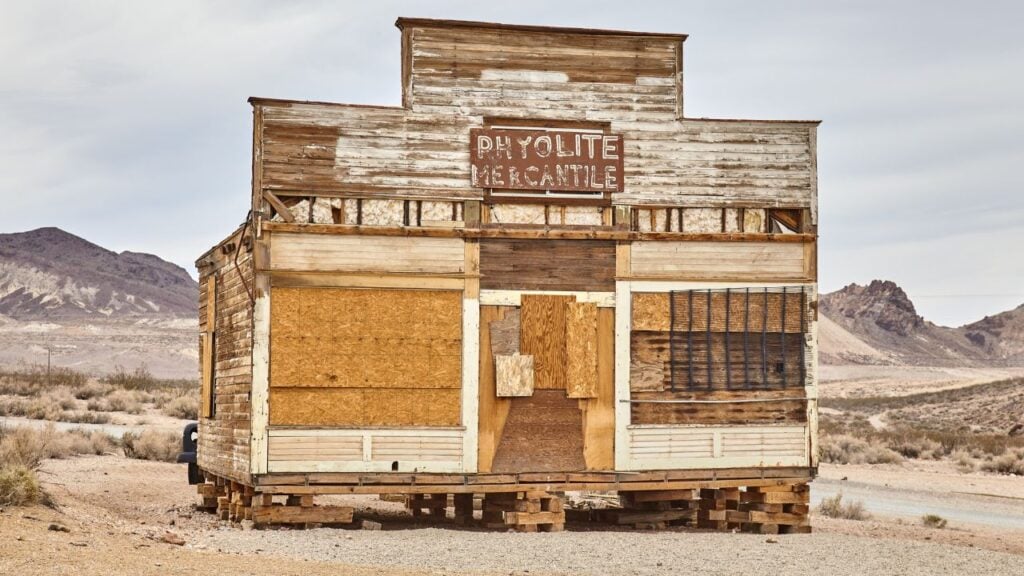
A rusted bottle half-buried in the sand outside Rhyolite looks like litter to many hikers.
Federal law calls it evidence of Nevada's mining boom instead, and pocketing it can turn an afternoon at the ghost town into a felony case.
7 Nevada Ghost Town Finds That Are Illegal to Remove
10 Household Items Nevada Residents Aren't Allowed to Put in the Trash

A dead car battery tossed in a Henderson trash can breaks Nevada law, not just a homeowner association rule.
State law sets fines starting at $100 per violation, and covers every county, not just the busiest one.
10 Household Items Nevada Residents Aren't Allowed to Put in the Trash
