
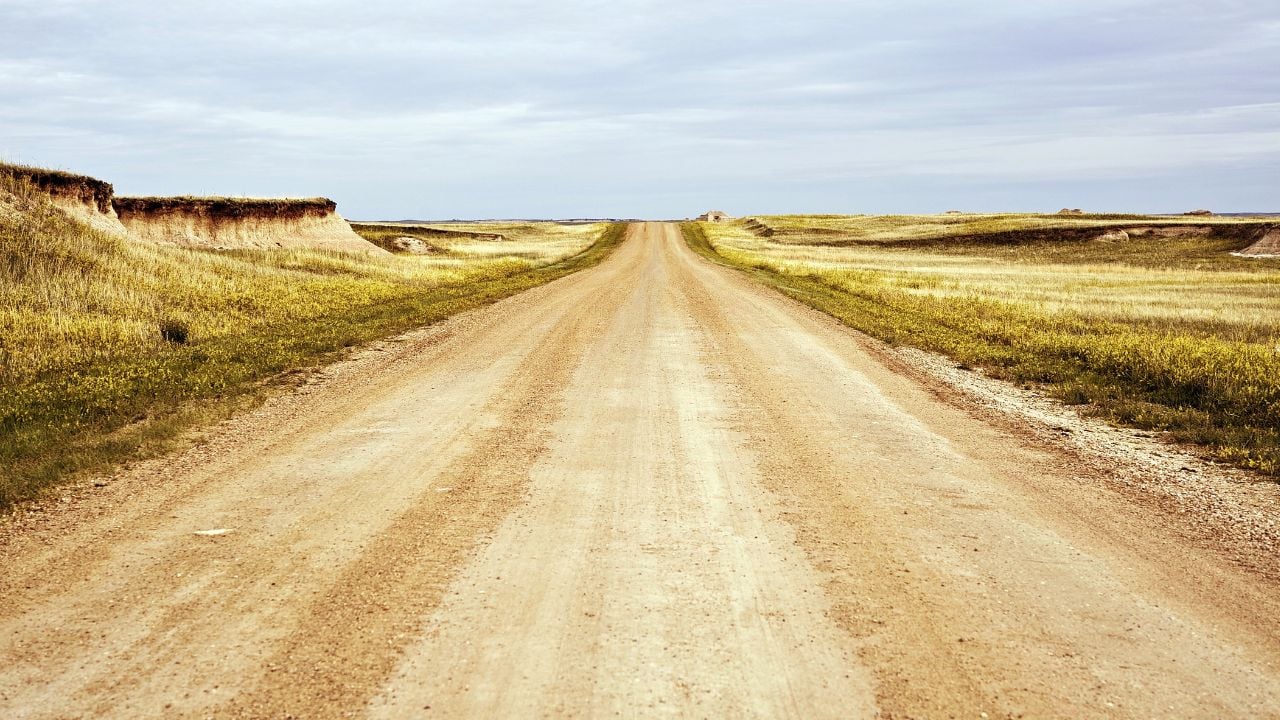
6 Section Line Rules That Decide Who Crosses South Dakota Land

A South Dakota rancher can fence straight across a public section line and stay within the law, as long as they handle one small detail right.
Skipping it is a misdemeanor.
It’s one entry in a long list of rules that decide exactly who’s allowed on that ground, and when.
These are the section line rules that decide who crosses South Dakota land.
Note: This is general information, not legal advice. Section-line highway rules are set at the county and township level, so confirm current details with your county or township office.
1. Open by Default
South Dakota law creates a public highway along every section line in the state the moment the township grid was platted.
It doesn’t matter whether a road crew ever touched that ground.
That’s automatic.
The rule traces to an 1870 territorial law, almost two decades before South Dakota became a state.
It still covers the entire grid of square-mile section lines platted across the state today.
A rancher whose fence line has sat undisturbed for fifty years still owns land next to a public right-of-way on paper.
That’s true unless a county or township board formally closed that particular stretch.
2. Thirty-Three Feet on Each Side
South Dakota measures every section-line highway at exactly 66 feet wide, split equally between the two properties that share the line.
Each side gets thirty-three feet.
That width is wide enough for the public to drive across a section line, not just walk it.
A rancher can push a truck, a herd of livestock, or a loaded trailer through that 66-foot strip, the same as any county road allows.
A road authority can still buy extra width beyond that default, or take it through eminent domain.
It can even take an uneven amount on each side, to dodge a stand of trees, a barn, or rough terrain.
A grassy fence line that has never seen a grader still guarantees that same full-width crossing underneath it.
3. County or Township Vote
Closing a section line takes more than a fence and a “No Trespassing” sign.
A county commission can vote to vacate or relocate a section-line highway under its jurisdiction.
Or a township board of supervisors can do the same for a line under its township’s jurisdiction.
Neither board can vote a line away if it provides access to 40 acres or more of public land or public water.
It takes a vote.
A board can still close a section line to vehicles without fully vacating it, but only once the road itself has become unsafe to drive.
Psst! Think you know South Dakota’s section-line rules? Flip each card and see how many you call right.
4. Gate Requirement
A landowner can string a fence straight across a section line, but only under narrow conditions.
The line has to be unimproved first, meaning nobody has ever altered it to carry vehicle traffic or used it regularly as a public right-of-way.
Even then, the landowner has to build and maintain a gate wherever that fence crosses the line.
The gate stays unlocked.
If it’s too small or too hard to open, anyone the closed line affects can file a request with the county sheriff.
The landowner then has seven days to fix it before facing a Class 2 misdemeanor charge.
What Makes a South Dakota Section Line Unimproved
South Dakota draws the line between an improved and an unimproved section line with one practical test: Has the public used it to drive?
A section line counts as improved once it shows a well-worn vehicle trail, or once someone has intentionally reshaped the natural terrain to allow driving.
Anything short of that, a stretch that has only ever been prairie grass, brush, or a plowed field, stays unimproved.
That’s what lets a landowner fence across it under the gate rule.
5. Narrow Lane for Hunters
South Dakota lets hunters treat an open section line as public ground, but the legal lane is narrow.
A hunter can pursue small game and waterfowl on foot inside the 66-foot right-of-way.
The animal itself has to have taken flight or started running from inside that strip, or from directly overhead.
State law doesn’t let a hunter take big game from that right-of-way.
That’s the whole rule.
A hunter can still walk an open section line to reach other land they already have permission to hunt, public ground or a private field with the owner’s OK.
A hunter working a section line for waterfowl also has to stay 660 feet from any occupied home, school, or church.
6. No Duty to Keep It Safe
The public right to cross a section line comes with a trade-off for the landowner.
If someone crosses an unimproved line without an invitation, the landowner owes no duty of care and no warning about what’s out there.
Step in a badger hole out there, and the landowner isn’t on the hook.
The one exception is a hazard the landowner created on purpose, through willful and wanton conduct, like rigging a trap or deliberately hiding a danger.
That still counts against them.
Everywhere else, the immunity is the point: It’s what lets the public cross a section line without needing the landowner’s permission or upkeep in the first place.
Landlocked Without a Section Line
The section-line grid crosses the entire state, but a handful of tracts still end up landlocked with no line reaching them at all.
State law protects the owner of an isolated tract of at least ten acres, or a smaller residential tract of at least five acres.
That owner can condemn a private easement across a neighbor’s land to reach a public highway.
It’s a lawsuit.
The catch is that a tract next to a section-line right-of-way doesn’t count as isolated in the first place.
That’s true whenever a passable road could be built within that 66-foot strip to reach a highway.
The section line has to come first.
Don’t Be This Person: 15 DMV Behaviors South Dakotans Can’t Stand
A trip to South Dakota’s Department of Motor Vehicles (DMV) tests everyone’s patience, and some customers make it worse for the whole line.
The rudest habits aren’t a mystery to the people working the counter.
Some customers treat a 30-minute wait like a personal insult, while others act like nobody else in the room is in a hurry too.
Don’t Be This Person: 15 DMV Behaviors South Dakotans Can’t Stand
15 Nostalgic Things That’ll Take Old-Timer South Dakotans Down Memory Lane

South Dakota still has a few vintage diners and drive-ins hanging on, but many of the state’s old-school details have disappeared.
Old-timer South Dakotans remember a stretch when a pencil doubled as a cassette-tape fix and half the state’s daily habits looked nothing like they do now.
15 Nostalgic Things That’ll Take Old-Timer South Dakotans Down Memory Lane
