
4 Things Oklahomans Do When the Wind Picks Up That Nobody Else Would

Oklahomans know the drill when the wind turns: a siren test here, a burn ban there, and a bill that shows up later.
Each city and county does its own thing, so what you hear and what you’re told to do can change depending on where you live.
Here’s what Oklahomans do when the gusts arrive, and what it costs them.
1. Built for 135
Oklahoma has a basement problem, and it isn’t by choice.
The state’s clay-heavy soil swells and shrinks with the seasons, which cracks basement walls and makes them expensive to build.
Many Oklahoma homes don’t have a basement, according to reporting from National Public Radio (NPR).
That means there’s no basement to run to when the wind picks up.
So, a bolted-down safe room or the innermost closet or bathroom becomes the fallback instead.
Moore didn’t stop at the fallback.
After an EF5 tornado tore through the city in May 2013, the Oklahoma City suburb rewrote its building code.
New homes there now have to withstand sustained winds of 135 mph, up from the old 90-mph standard, according to the Christian Science Monitor.
The code also requires reinforced roof sheathing, hurricane clips, continuous bracing, and wind-resistant garage doors.
That reporting described the result as among the most stringent residential building codes in the nation.
Oklahoma’s Department of Emergency Management still helps with the shelter itself, running the SoonerSafe rebate program to offset part of what a safe room costs to install.
Between the two, a new house in Moore is built to survive the wind before anyone even talks about where to hide from it.
2. One Name, Not a Network
People don’t just check the weather when the wind turns severe.
They check one person.
That kind of trust traces back to one building.
Norman is home to the National Weather Center, run by the National Oceanic and Atmospheric Administration (NOAA).
The University of Oklahoma’s School of Meteorology sits inside that same complex, beside NOAA’s Storm Prediction Center and the division that trains forecasters nationwide.
For decades, the best-known face of that pipeline was Gary England, chief meteorologist at the Oklahoma City television station KWTV News 9.
England is credited with bringing local television its first commercially owned Doppler radar.
England graduated from the University of Oklahoma in 1965 with a degree in mathematics and meteorology.
He later returned to the school as its Consulting Meteorologist-in-Residence and spent more than 40 years walking viewers through tornado coverage live, on air, as it happened.
England died in June 2025 at 85, and stations across the state paused coverage to remember him.
Oklahomans grow up a few miles from the same building that produces the federal warnings the rest of the country reads on their phones.
The local meteorologist reading those warnings out loud grew up a few miles from it too.
What Oklahoma’s Wind Alerts Mean
Oklahoma’s National Weather Service forecast offices don’t wait for a tornado to put out a wind alert.
A Wind Advisory covers sustained winds in the 31 to 39 mph range, or frequent gusts between roughly 46 and 57 mph.
A High Wind Warning starts at sustained winds of 40 mph or gusts of 58 mph and up, the range that starts pulling shingles and tipping over trailers.
Both categories sit well above Oklahoma’s everyday breeze, which is why locals treat an actual alert as an instruction, not background noise.
3. Nation’s Highest Premiums
Oklahoma’s wind eventually shows up on a bill.
Oklahoma led the country with 151 tornadoes in 2024.
It also posted the third-highest hailstorm count of any state that year, 767, according to an Insurify analysis reported by Live Insurance News.
By 2026, that translated into the priciest homeowners insurance in the country.
Oklahoma’s average annual premium reached $7,255, the highest of any state, according to a Kiplinger ranking of 2026 home insurance costs.
No exceptions.
Nobody else pays more, for exactly this reason.
So Oklahomans don’t treat wind and hail coverage as optional the way someone in a calmer state might.
Skipping it here isn’t a way to save money on a policy; it’s a way to pay for the roof twice.
Psst! How Oklahoma are you when the wind kicks up? Check off what’s true for you and see where you land.
4. Driving Toward the Storm
The state doesn’t just tolerate storm chasers.
It trains them.
Norman is home to NOAA’s National Severe Storms Laboratory (NSSL), headquartered inside that same National Weather Center complex mentioned earlier.
The lab is dedicated full time to observing severe thunderstorms in the field.
NSSL researchers drive mobile radar trucks and launch weather balloons directly at forming tornadoes as part of ongoing field projects.
That work happens out of one Norman address and nowhere else in the country.
A wall cloud that would send much of the country running gets a different reaction here.
Phones come out.
Front porches fill up, and somebody usually knows which direction the rotation is moving before anyone checks an app.
A Patchwork of Test Days
Cities run outdoor warning sirens on a schedule, but that schedule isn’t the same from one city to the next.
No two agree.
Edmond tests its sirens on the first Saturday of every month at noon, and Tahlequah runs a monthly test on the second Saturday instead.
Moore and Midwest City skip the monthly version, sounding their sirens every Saturday at noon instead.
Duncan tests on a different day altogether, sounding its lake and city sirens together every Monday just before noon.
Every city skips the test outright when severe weather is already in the forecast.
An out-of-stater hears that noise on a random weekday and reaches for their phone.
An Oklahoman checks which city they’re in and what day it is instead.
If the sky already looks wrong, that same siren gets a different reaction: Inside, now, no debate.
Burn Ban Season
The wind isn’t only a roof problem.
It’s a wildfire problem too.
When wind rises alongside dry conditions and low humidity, Oklahoma counties start issuing burn bans.
The National Weather Service starts posting Red Flag Warnings at the same time, and local coverage of both spreads fast across the state.
So before an Oklahoman lights a grill, a burn pile, or a stack of fireworks on a gusty afternoon, they check the ban map for their county first.
Skip that step, and the fine is the least of the problem.
The state has watched that math play out before.
Governor Kevin Stitt reported wind gusts topping 65 mph in March 2025, as wildfires forced roughly 4,000 people to evacuate the city of Woodward, according to NBC News.
That’s close to a third of the city’s population.
A single spark on a windy, dry day in Oklahoma can still outrun a fire department before anyone smells smoke.
3 Storm Shelter Programs Oklahoma Homeowners Don’t Always Claim
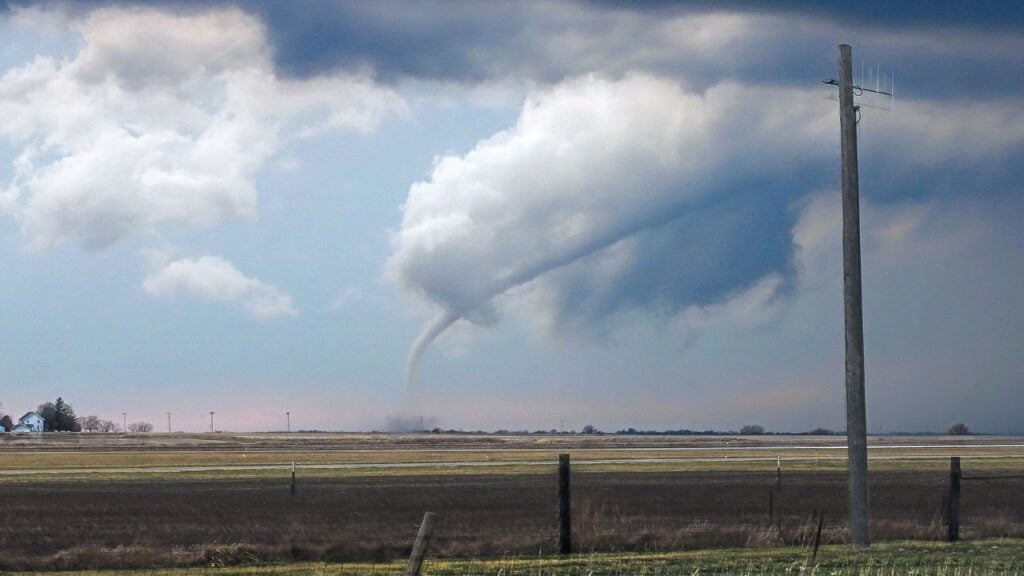
A storm shelter can cost thousands of dollars, but Oklahoma homeowners don’t necessarily have to cover the whole bill themselves.
The state offers one rebate, and tribal nations, the U.S. Department of Agriculture (USDA), and even the property tax system offer other ways certain homeowners can save.
3 Storm Shelter Programs Oklahoma Homeowners Don’t Always Claim
