
9 Colorado Words and Phrases That Make No Sense to the Rest of the Country

Coloradans don’t mean to be confusing.
The words we’re about to cover here are everyday talk to them, even when they leave out-of-staters staring.
These are the Colorado words and phrases that make no sense to the rest of the country.
1. 14er
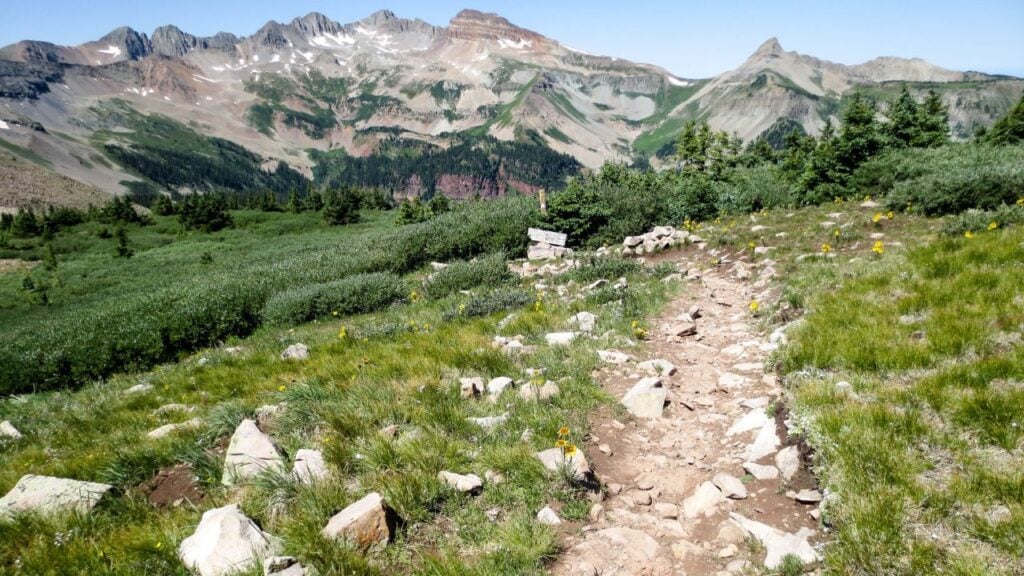
A 14er is Colorado’s shorthand for any peak that climbs past 14,000 feet, and the state has more of them than any other in the country.
14ers.com puts the tally at 58, though other lists run closer to 53 depending on how strict the prominence cutoff is.
Fifty-eight, give or take.
Ask a Coloradan how many they’ve “bagged,” and they know exactly what you mean: How many of those peaks they’ve personally hiked to the top of.
A newcomer from Ohio hearing “14er” for the first time pictures a grocery run, not a mountain summit.
2. Slopper
In Pueblo, a slopper is a meal, not a mess, whatever the word suggests.
The dish is an open-face cheeseburger patty, bun and all, drowned in green chile sauce and topped with onions.
Messy is the whole point.
Colorado’s agriculture department has singled it out as a Colorado Proud dish built on locally grown Pueblo chile.
Eating a slopper properly takes more than a fork, since the green chile sauce calls for a spoon and the burger underneath still needs a knife.
Outside Colorado, a server hearing “slopper” for the first time usually asks you to repeat it, slower, as if you might be describing a medical event.
3. LoDo
LoDo is Denver-speak for Lower Downtown, the name locals reach for instead of saying the two words in full.
It’s the nickname for the 23-block historic district around Union Station, once a rough warehouse strip and now Denver’s brick-loft, brewery and Rockies-game neighborhood.
A Kansas visitor can spend a whole trip thinking LoDo is somebody’s name before a local finally sets them straight.
They’re not alone.
Denver has kept building the habit since, too, stacking on RiNo for the River North Art District.
It’s picked up a handful of other clipped nicknames that only mean something once you already live there.
4. Front Range
The Front Range is the strip of cities running along the Rockies’ eastern edge, roughly from Fort Collins down through Denver, Colorado Springs and Pueblo.
Locals throw the term around as if the whole state already knows exactly where it starts and stops.
That corridor is home to about 85% of the state’s population.
Almost all of it.
Weather forecasts, traffic reports and school closures all key off it, too.
Many out-of-staters assume “Front Range” names the mountains themselves.
The cities below, where most of the state lives, works and sits in traffic, rarely cross their mind.
5. Western Slope
The Western Slope is what people call the half of the state that isn’t the Front Range.
Many point to the Continental Divide as a rough eastern edge, but even that boundary isn’t official.
Nobody agrees on exactly where the western and southern edges stop, either.
That’s anywhere from Grand Junction to Steamboat Springs to somewhere closer to the Utah line.
It doesn’t matter.
People still use the phrase constantly, the way New Englanders say “the Cape.”
A transplant hears it for months before realizing it’s a fuzzy region, not just a hiking direction.
6. Brown Cloud
The Brown Cloud is what the state’s capital calls its smog, and the phrase isn’t flattering.
It’s what locals started calling the haze that settles over the city during winter temperature inversions, a term that stuck sometime in the 1970s.
Denver sits in a bowl between the mountains and the plains, and warm air settles on top and pins the cold air underneath during those inversions.
Exhaust and dust have nowhere to go, so the skyline turns a dingy tan for a few days at a time.
An out-of-stater reading “Brown Cloud” in a forecast assumes it’s a storm system with a nickname, not smog sitting over the city.
A Coloradan checking the forecast for a Brown Cloud day sounds like they’re describing the weather.
Not a metaphor.
Psst! How much do you know about Colorado’s history? Take our quiz and see how many you can get right.
Quiz
Colorado History IQ
These nine questions dig into Colorado firsts and milestones, and many people miss at least two. Think you can beat the odds?
Colorado earned the nickname “Centennial State” because it joined the Union in the same year as what event?
7. Native
Native is the word Coloradans turned into a badge, printed on a green mountain-outline sticker seen on bumpers statewide.
The sticker has been around since a Lakewood teenager named Eric Glade designed it in the late 1970s.
It doesn't mean what an out-of-stater would guess.
Being born there isn't required.
Living there long enough, sometimes a decade or more, earns a Coloradan the right to roll their eyes at somebody newer.
Visitors read the sticker and assume it's about birth certificates.
It isn't.
To Coloradans, it's a ranking system that rewards how long you've stuck around, not when you were born.
The Sticker's Comeback
Colorado's "Native" sticker got popular enough that newcomers eventually printed an answer to it.
One version reads "Not a Native, but I got here as fast as I could."
The family that designed the original sticker went on to trademark the concept and print spin-offs, including versions for other states.
Colorado's sticker is still the design people recognize on sight.
8. Poudre
The Poudre is what locals in Colorado's Fort Collins call the Cache la Poudre River, and they'll let a newcomer mangle its name exactly once.
Spelled out, "Cache la Poudre" reads like French for powder, and nearly every visitor pronounces it that way on the first try.
It happens every time.
Coloradans say "POO-der" instead, a name that traces back to 1836, when fur trappers stashed gunpowder along the riverbank to lighten their load before a snowstorm.
A Fort Collins bartender has heard the French pronunciation a thousand times, and corrects it before the beer even hits the counter.
9. The Springs
The Springs is what Coloradans call the state's second-largest city, no "Colorado" needed.
That's how locals talk about it in the city magazine, too.
A newcomer hearing it for the first time has no idea whether "the Springs" means a town, a spa or a punchline they missed.
What residents of the Springs call themselves is a mess.
No consensus exists.
Colorado Springs never settled on an official demonym the way Denver has Denverites, so locals have argued for years between Springsite, Springer and Springster.
A reader poll run by the city magazine picked Springster as the favorite, but nothing official has ever settled the argument.
Say any one of those three demonyms out loud in the Springs, and somebody will argue with your choice before you finish the sentence.
That argument has been running for decades, with no sign anyone in the Springs wants it settled.
7 Local Customs New Colorado Residents Accidentally Break
Just under 41% of Colorado's population was born in the state, according to a Denver Gazette review of Census data, and that share has barely moved in a decade.
That means many of the people breaking Colorado's unwritten rules right now are the same people who will be correcting the next newcomer on them in a few years.
7 Local Customs New Colorado Residents Accidentally Break
Test Your Knowledge: US Geography Facts Most Americans Don't Know

Somewhere in the United States, a person can stand in four states at once, while somewhere else in the same country holds the hottest place on Earth.
That same country holds the Everglades, the largest subtropical wilderness in the country, and Denali, the tallest mountain in North America, though many people couldn't place either on a map.
Test Your Knowledge: US Geography Facts Most Americans Don't Know
