
7 Things Indiana and Illinois Drivers Do Differently at the State Line

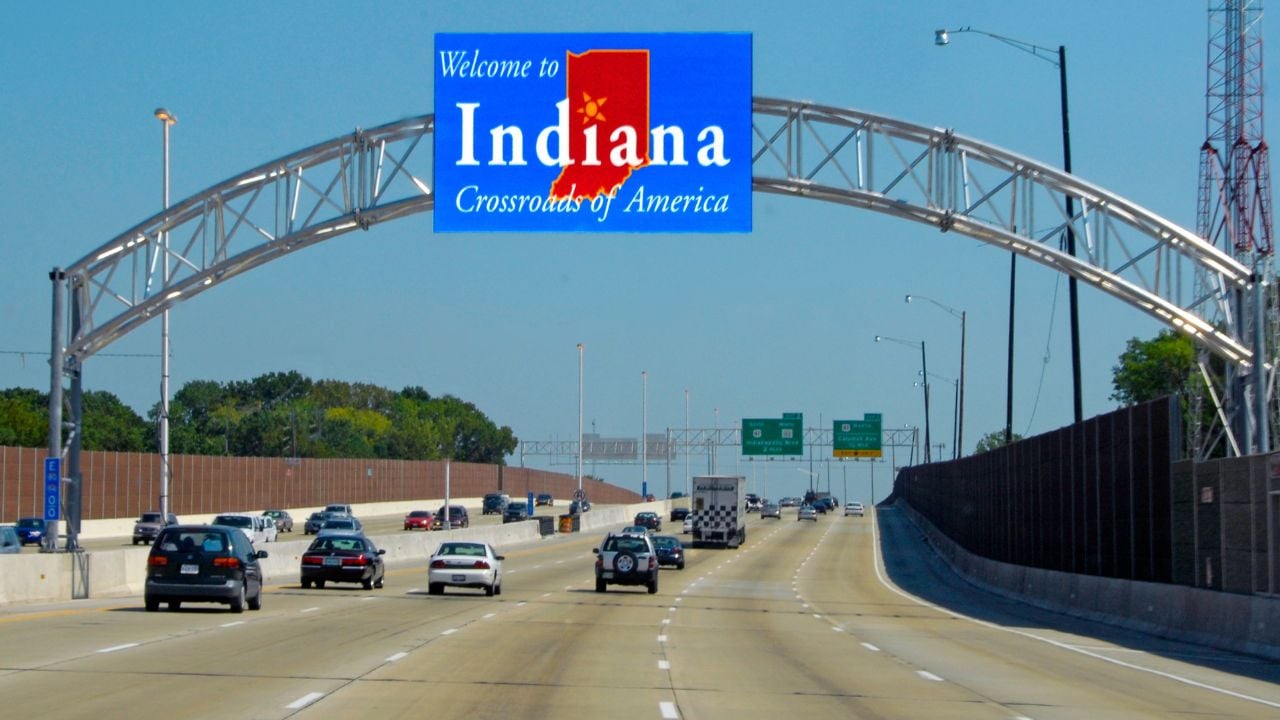
You’re cruising down the highway, and the only sign you’ve left one state is a welcome sign on the shoulder.
Hoosiers and Illinoisans share that road but not the same rulebook, and some of the differences can catch drivers off guard.
Here’s what changes behind the wheel when you cross between the two states.
Note: This is general information, not legal advice. Traffic laws and requirements vary by state and are subject to change.
1. Studded Tires
Indiana drivers can run studded tires from October 1 through May 1 under state law.
Illinois doesn’t allow that trade.
Studded tires are banned for everyday drivers there, full stop, no seasonal window at all.
A car that’s road-legal for a Hoosier winter needs different rubber the moment it crosses west.
Indiana Code 9-19-18-3 sets those exact dates, and states that allow studs at all still fence them into the coldest months because they chew up bare pavement fast.
2. License Plates
Indiana is a one-plate state.
Only a rear plate is required on cars, trucks, and minivans registered there.
Illinois requires both a front and a rear plate on every passenger vehicle.
A Hoosier’s bare front bumper suddenly looks like a missing part once the car is parked on an Illinois street.
Skipping that front plate starts at a $75 fine there, on top of whatever else a ticket adds.
3. Move-Over Fines
Both states require drivers to slow down and move over for a stopped emergency vehicle.
Illinois just calls its version by name.
Scott’s Law carries fines running from $250 to $10,000 for a first offense.
Starting January 1, 2026, it also covers emergency vehicles that are still moving, not just ones parked on the shoulder.
No household name yet.
Indiana’s version of the rule doesn’t carry that kind of nickname or that kind of headline fine.
How a Scott’s Law Ticket Can Grow
Scott’s Law in Illinois doesn’t stop at a fine.
A violation that damages property becomes a Class A misdemeanor, and one that causes an injury or death can be charged as a Class 4 felony.
Either one can cost a license for 90 days to two years, on top of whatever a court adds for the crash that caused it.
4. Cannabis in the Car
Indiana treats any amount of marijuana in a vehicle as a crime, full stop.
Illinois allows it, with rules.
Legal cannabis has to ride in a sealed, odor-proof, child-resistant container that’s out of the driver’s reach, typically the trunk.
Breaking that rule is a Class A misdemeanor in Illinois, with fines running $75 to $2,500.
A container that rode loose in an Illinois cupholder becomes a problem the moment the car heads east.
The limit is lower for visitors, too.
An out-of-state driver in Illinois can carry up to 30 grams of cannabis flower, half the 60-gram limit that applies to Illinois residents.
5. Handheld Phone Bans
Both states ban holding a phone while driving now, but they got there years apart.
Illinois passed its ban back in 2014.
That’s six years apart.
Indiana’s law didn’t take effect until July 1, 2020, and the state didn’t start adding points to a driving record for it until a year later.
A habit that’s been illegal for a decade on one side of the line is still fairly new law on the other.
A first offense tops out around $75 for an adult driver in Indiana, though a driver under 21 can face a fine up to $500.
6. Red Light Cameras
Indiana has no red light cameras anywhere in the state.
There’s no enabling law for them, so no Hoosier city runs one.
Indiana allows only a narrow work-zone speed-camera pilot, capped at four sites statewide and only when a road crew is out there working.
Not so next door.
Illinois leans the other way.
Illinois drivers have paid more than $1.5 billion in red-light camera fines since 2008, and Chicago alone accounts for well over half of that total.
Running a yellow light means something different depending on which side of the line it happens on.
7. Truck Speed Limits
Passenger cars can run 70 mph on rural interstates in both states.
Big rigs don’t get the same deal in Indiana.
Heavy trucks are capped at 65 mph there, five under the cars around them.
The gap closes there.
Illinois raised its truck limit to match cars back in 2014.
A semi that has to ease off in one state can open back up the moment it crosses into the other.
Six bills have tried to change that since 2017.
Every one of them died at the Indiana statehouse, largely on the argument that a loaded semi simply needs more room to stop than a car does.
Psst! See how Indiana and Illinois stack up on the rules of the road. Sort the table below by state and see what changes.
The Busiest Crossing Point
Indiana and Illinois funnel the bulk of that daily crossing through one corridor.
The Borman Expressway carries Interstates 80 and 94 together for 14 miles through Northwest Indiana before the routes split back apart on the Illinois side.
About 200,000 vehicles a day cross near the state line there.
It’s one stretch of pavement.
Two different rulebooks share it, and drivers switch between them every single day.
A dashboard full of studded tires, two license plates, and a phone mount doesn’t mean much once the pavement changes states.
The rules keep moving even after the car stops.
10 Things Hoosiers Do That Confuse Everyone Who Moves to Indiana

A new neighbor in Kokomo shows up to a pitch-in with nothing but a bottle of wine, and nobody says a word about it.
Many Hoosiers would rather let a newcomer figure it out than embarrass anyone over an empty casserole dish.
10 Things Hoosiers Do That Confuse Everyone Who Moves to Indiana
5 Indiana Basketball Traditions That Baffle the Rest of the Country

More than 40,000 people packed into Milan, Indiana, on a March night in 1954, back when the whole town held about 1,150 people.
They came because the local high school team had just won the state title.
Out-of-staters still can’t quite explain why the whole state stops for a tournament almost nobody outside it follows this closely, every single March.
5 Indiana Basketball Traditions That Baffle the Rest of the Country
