
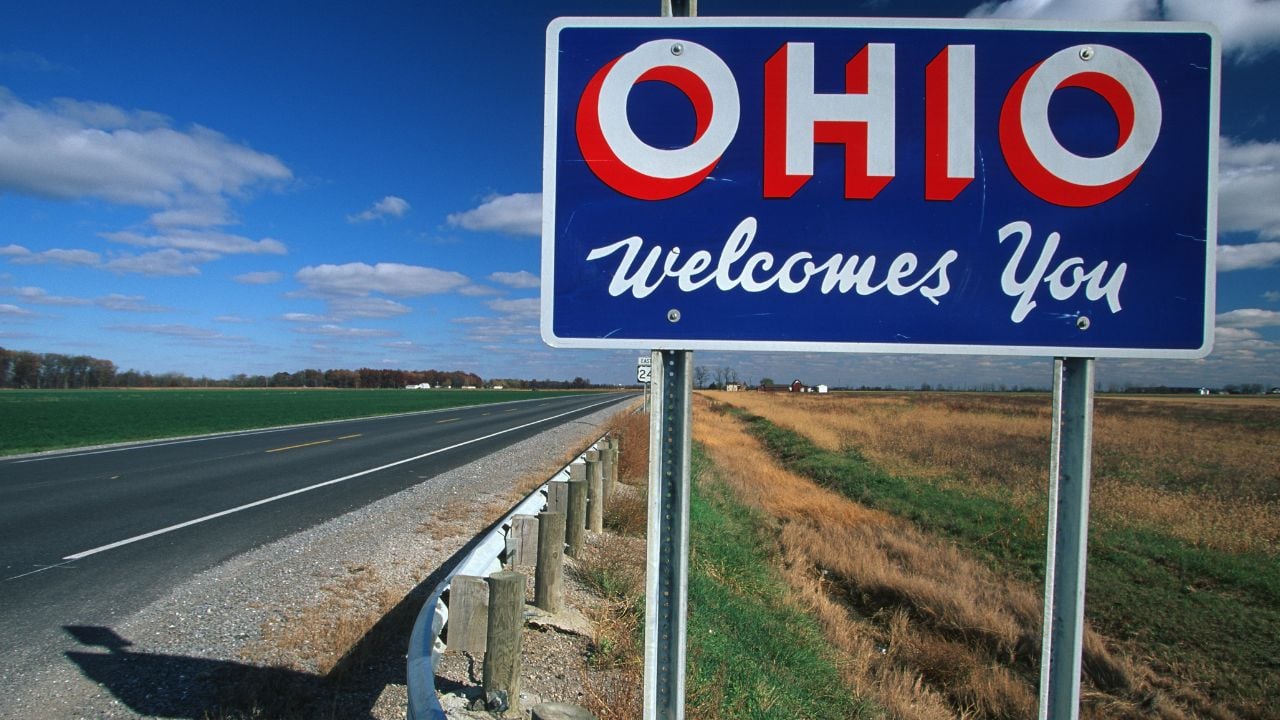
8 Things That Change the Second You Cross From Pennsylvania Into Ohio

Heading over to Ohio for the day?
You may not feel a thing at the state line, but your wallet just might.
A few of the things you count on at home work differently over there, and not always the way you’d guess.
Here’s what you can expect the second you cross from Pennsylvania into Ohio.
Note: This is general information, not legal or tax advice. Rates, fees, and fines are subject to change.
1. Radar in Local Cruisers
The first cruiser you pass near Hubbard can clock you with radar.
The township officer you passed a mile back in Sharon couldn’t.
Pennsylvania is the only state in the country that keeps radar out of local police hands, according to the Pennsylvania Municipal League.
Only the State Police get to use radar.
Municipal officers in Pennsylvania time you with a certified stopwatch or an electronic timing device instead, under 75 Pa.C.S. § 3368(c).
That ends at the line.
Ohio Revised Code 4511.091 places no such restriction, so a local cruiser on the Ohio side can carry the same radar gun a trooper does.
If you’re used to easing off the gas only when a State Police car shows up, that habit stops protecting you past the line.
A Pennsylvania Senate bill filed in 2026, Senate Bill 1237, would let municipal police use radar after State Police training.
The bill was still sitting in the Senate Transportation Committee in April.
2. Turnpike Cash Lanes
The Pennsylvania Turnpike collects every toll electronically, through E-ZPass or a Toll By Plate invoice mailed to the car’s registered owner.
You never stop, and nobody takes a dollar bill.
When you cross onto the Ohio Turnpike, the toll plaza starts taking cash again at dedicated cash lanes.
On the Ohio Turnpike, a cash-and-credit-card rate sits beside the E-ZPass rate.
Cash is back.
A passenger car running the whole Ohio Turnpike westbound pays $19 with E-ZPass in 2026 and $27.75 in cash or on a card, according to the Bryan Times.
So, keep your transponder on the windshield after the line because the cheaper Ohio rate is the E-ZPass rate.
3. Gas Tax
About 19 cents a gallon in gas tax disappears from your fill-up on I-80 at the state line.
Pennsylvania’s tax on gasoline runs 57.6 cents a gallon in 2026, according to the state Department of Revenue.
Ohio’s gas tax is 38.5 cents, a rate untouched in state law since 2019.
On a 15-gallon tank, that’s about $2.87 in tax you don’t pay on the Ohio side.
You see it at the pump, too.
In late September 2026, AAA’s state averages had regular at $4.55 a gallon in Pennsylvania and $4.40 in Ohio.
If your needle is under a quarter when you clear the state line, a few more miles pays for a coffee.
Fill up in Ohio.
4. Inspection Sticker
Ohio doesn’t require a yearly safety inspection, according to Kelley Blue Book‘s state-by-state guide.
You’ll notice it the second you’re on the Ohio side: Every car around you is missing the sticker Pennsylvania makes you carry.
Pennsylvania makes you pass a safety inspection every year, and the sticker is good for one year from the month of inspection.
The sticker disappears.
A certified inspector at a Hermitage tire shop told Youngstown TV station WKBN in 2021 that the shop sees many Ohio cars that wouldn’t pass a Pennsylvania check.
Ohio does run one emissions program, E-Check, but only in seven counties around Cleveland, nowhere near the Pennsylvania line.
Cross into Ohio, and the sticker check is simply gone.
Where Ohio’s E-Check Applies
Ohio’s E-Check runs only in Cuyahoga, Geauga, Lake, Lorain, Medina, Portage, and Summit counties.
If your car is registered in one of those seven counties, it needs an emissions test, not a safety inspection.
A passing certificate stays valid for 365 days.
Ohio’s environmental agency posts which model years have to test each year, so check the list before you assume your car is due.
5. Sales Tax on Clothes
You pay sales tax on a sweatshirt the moment you buy it in Ohio.
Not in Pennsylvania.
Pennsylvania exempts most clothing from its 6% sales tax, along with groceries.
Ohio’s list of exemptions covers grocery food but not clothing, so a sweatshirt rings up with tax at the state rate of 5.75%.
That’s before the county chips in.
Your county and transit authority add up to 3% more, and the counties along the Pennsylvania line run 6.75% to 7.5% all in.
So, a $60 sweatshirt carries no tax in Erie and $4.05 to $4.50 in tax once Ohio’s state and local rates stack.
Not year-round, though.
Ohio suspends the tax on clothing priced at $75 or less for three days every August, according to Ohio’s Department of Taxation.
In 2026, that stretch runs from August 7 through August 9.
October isn’t August.
The sweatshirt costs less on the Pennsylvania side if you shop there this fall.
Psst! How much do you know about the Ohio side of the line? Flip through these cards and see how many you can call right.
6. Phone Fine
Holding your phone at the wheel costs up to three times as much once you’re past the state line.
Both states now ban holding a phone while you drive, but the ticket doesn’t cost the same on each side.
Pennsylvania’s Paul Miller’s Law started charging fines on June 5, 2026, at $50 plus court costs, Fox 29 reported.
Ohio’s distracted-driving law lets a judge fine you up to $150 the first time.
A second offense within two years runs up to $250.
A third reaches $500, with a possible 90-day license suspension.
Steep on both sides.
If it’s your first offense, a court in Ohio may let you take a distracted-driving course instead of paying the fine and taking the points.
Mount the phone before you reach the line, and you never have to learn either price.
7. Cigarette Tax
A pack of cigarettes carries a dollar less tax on the Ohio side of the state line.
Pennsylvania charges $2.60 a pack, or 13 cents a stick.
The same rate covers little cigars, too.
Ohio’s rate is 80 mills a cigarette, which works out to $1.60 on a pack of 20 under state law.
Ohio hasn’t touched that number since July 2015.
That’s $10 on your carton.
A pack-a-day smoker pays about $949 a year in state tax in Pennsylvania and $584 in Ohio.
8. Fireworks Days
The days you’re allowed to set off fireworks change at the state line.
Pennsylvania’s State Police list an age, a distance, and a curfew, but no list of legal days.
You have to be 18 and stay 150 feet from any building or vehicle, and your town can stop you between 10 p.m. and 10 a.m.
Ohio keeps a list.
State law allows consumer fireworks only on listed days.
The list runs New Year’s Day, Chinese New Year, Cinco de Mayo, Memorial Day weekend, Juneteenth, the days around the Fourth, Labor Day weekend, Diwali, and New Year’s Eve.
After Labor Day, the list has nothing until Diwali, so lighting a fountain in your Ohio backyard in October breaks state law.
Any township or city in Ohio can shorten that list or ban fireworks outright.
Back across the state line, the same fountain is legal any day in October, as long as your neighbor’s house is 150 feet away.
What Changes If You Work Across the Line
If you stock shelves in Sharon, the minimum wage for the same job across the line in Youngstown starts $3.75 an hour higher.
Pennsylvania still pays the federal floor of $7.25, according to the federal Department of Labor’s state table, updated July 1, 2026.
Ohio’s minimum wage rose to $11 an hour on January 1, 2026.
A full 40-hour week puts an extra $150 in your paycheck.
Not a small gap.
Tipped workers get $5.50 an hour in Ohio, and Pennsylvania’s tipped floor is $2.83.
Your tipped base nearly doubles at the line, too.
Ohio’s $11 rate applies at businesses with more than $405,000 in yearly gross receipts, while smaller employers and 14- and 15-year-old workers stay at $7.25.
Ohio also adjusts the minimum wage every January by a set formula.
7 Arguments Ohioans Have About Whether Their City Is Midwest at All

Thirty-two of Ohio’s counties carry an official Appalachian designation from the Appalachian Regional Commission, while the Census Bureau’s map counts the whole state as Midwest.
Both maps can’t be right, and Ohioans have been arguing about it for years.
7 Arguments Ohioans Have About Whether Their City Is Midwest at All
11 Old-Fashioned Wellness Habits Ohioans Never Needed an App to Track

Roughly 1 in 5 Ohio adults report no exercise beyond their regular job in the past 30 days, according to America’s Health Rankings.
Earlier generations never called it exercise, but they built movement and other healthy routines into ordinary life.
11 Old-Fashioned Wellness Habits Ohioans Never Needed an App to Track
