
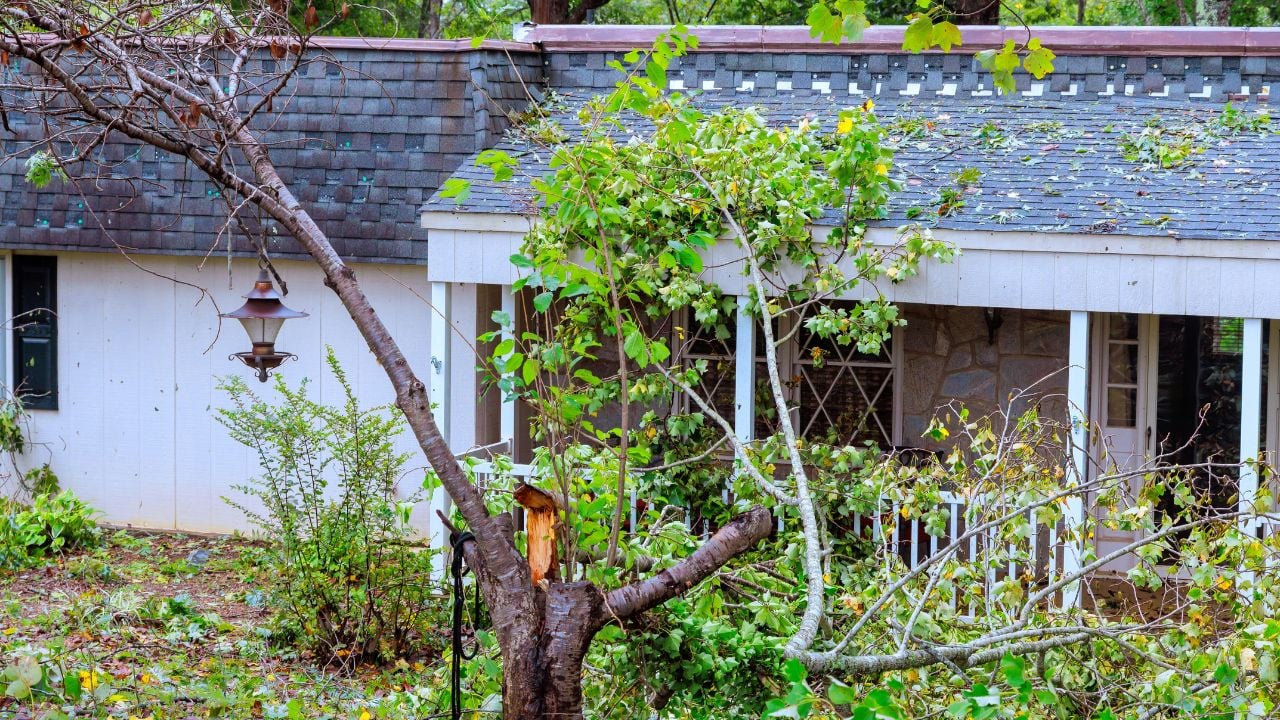
7 Trees Georgia Homeowners Should Never Plant Within Twenty Feet of Their House

That cute little tree at the garden center won’t stay little for long.
Some of the trees Georgians plant grow fast and big. They don’t always hold up well when the weather turns.
Here are the trees you should keep at least twenty feet away from your house.
1. Silver Maple Spread
A mature silver maple is a large tree, 50 to 80 feet tall and 40 to 60 feet wide, according to North Carolina State Extension.
University of Georgia Extension’s shade-tree guide says you should space large shade trees at least half their mature canopy width from any structure.
Half of a 40-to-60-foot spread is 20 to 30 feet.
Twenty feet is the floor.
The tree’s roots are shallow and will disturb driveways and sidewalks.
They will also invade septic systems and other drains.
Its wood is weak and breaks easily in storms and with snow loads.
A University of Georgia Extension 2017 article, “Summer Storms Result in Downed Trees Across Georgia,” lists willow, silver maple and Bradford pear among soft-wooded, fast-growing trees.
The advice is to avoid planting these types of trees close to your house or near high traffic areas.
2. Weeping Willow Roots
If you’re weighing a weeping willow, University of Florida Extension warns against locating a willow near underground water or sewer lines.
The same goes for septic tank drain fields, where the roots could cause significant damage.
The tree’s spread is listed at 30 to 50 feet.
The roots spread about three times the distance from the trunk to the edge of the canopy.
By that rule, a 30-to-50-foot spread puts the canopy edge 15 to 25 feet from the trunk and the roots out to about 45 to 75 feet.
Your house falls inside.
How Far a Tree’s Roots Extend
The Georgia Forestry Commission measures a tree’s total root zone from the trunk’s diameter at 4.5 feet above the ground.
Each inch of trunk diameter adds 1.5 feet of radius to that root zone.
A tree with a 16-inch trunk has a root zone with a 24-foot radius, which extends past a 20-foot gap.
You can run that math on any tree in your yard.
Wrap a tape around the trunk at 4.5 feet, then divide the circumference in inches by 3.14 to get the diameter in inches.
3. Bradford Pear Crown Splits
Bradford pears tend to split apart, and one incident can cost a tree as much as half its crown and trunk diameter, according to the Georgia Forestry Commission.
North Carolina State Extension traces the splits to branches that grow at upright angles from weak joints that break with age, wind and ice.
The tree grows 30 to 50 feet tall.
A tree that tall stands well above a 20-foot gap.
The commission says the limited life of these trees is a function of structural failure.
Not natural causes.
A tree more than 10 years old is unlikely to be pruned to eliminate that failure.
North Carolina State Extension calls the tree problematic and says you should consider alternatives.
4. Water Oak Limb Breakage
Mississippi State University Extension puts oaks in its large-tree class and says you should keep large trees at least 20 feet from walls.
According to North Carolina State Extension, a mature water oak is 50 to 80 feet tall and 50 to 70 feet wide.
Under the half-canopy-width guide from University of Georgia Extension, that spread works out to 25 to 35 feet from your wall.
That’s more than twenty.
Its limbs are notoriously weak and at risk for breakage, particularly in high winds or during winter snow and ice storms.
The species may live only 30 to 50 years.
5. Loblolly Pine Flammability
A loblolly pine grows 60 to 90 feet tall on a straight trunk up to 3 feet in diameter.
That beats a 20-foot gap by 40 to 70 feet.
North Carolina State Extension calls the species susceptible to wind damage.
Its flammability rating is high.
The tree shouldn’t be planted within the defensible space of your home, the fire-safe buffer around a house.
Psst! How closely do the trees in your yard follow spacing guidelines? Run through this checklist and see how many statements you can check off.
6. Leyland Cypress Toppling Risk
If you plant a Leyland cypress, you’re planting a tree that grows 60 to 70 feet tall.
It stays 10 to 15 feet wide.
A 60-foot cypress is 40 feet taller than a 20-foot gap between it and your house.
Large Leyland cypress trees tend to topple over, according to North Carolina State Extension.
Its roots are relatively shallow.
The tree is poorly adapted to areas with hot summers.
A 2017 University of Georgia Extension article on downed trees says many Leyland cypress trees were blown over by wind in the storms it describes.
The tree is also susceptible to canker and root rot.
Both are incurable.
7. Eastern Cottonwood Brittleness
If you’re choosing a tree for the home landscape, North Carolina State Extension calls the eastern cottonwood a poor selection.
It’s messy, weedy and brittle.
Its roots may also cause damage to sidewalks or sewer lines.
The tree grows 75 to 100 feet tall and 35 to 60 feet wide.
It’s relatively short-lived, up to 70 years, and can deteriorate rapidly.
Half of that width is 17.5 to 30 feet, so your 20-foot gap falls short for any cottonwood wider than 40 feet.
Forty feet is the line.
Sweetgum Gumballs
If you’re picking a shade tree, University of Georgia Extension’s shade-tree guide lists sweetgum among its Short-Term Shade Tree Solutions.
That category covers trees with undesirable traits or pest problems.
They’re meant only as a temporary tree, if at all.
Sweetgum is also marked as messy and requiring consistent maintenance.
North Carolina State Extension says the sweetgum’s fruit litters the ground between December and April.
That’s five months of fruit.
That fruit is a litter problem in lawn and patio areas.
The tree’s spread is 40 to 50 feet, which puts the crown’s edge 20 to 25 feet from the trunk.
If your patio sits 20 feet away, it’s at or under that edge.
Tree of Heaven at Any Distance
North Carolina State Extension calls tree of heaven, known by its scientific name Ailanthus altissima, very invasive and difficult to eradicate once it’s established.
It’s hard to remove.
The tree will grow in the cracks of pavement.
A crack in your driveway is a place where a seedling can take hold.
Suckers, the shoots that rise from its roots, spread it too.
The wood of this 40-to-60-foot tree is soft, weak and coarse-grained.
A University of Georgia Field Report article from 2011, “Now Is the Time to Plant Trees in Georgia Landscapes,” lists Ailanthus among trees to avoid.
Weak structure, messiness, disease problems and weediness are the reasons given for that list.
If seedlings show up in your yard, North Carolina State Extension says to pull them up while they’re young, before they flower.
Crushed leaves and broken stems can give off a foul odor.
12 Home Maintenance Jobs Georgians Forget About Until Something Breaks

University of Georgia Extension says Georgia is part of what entomologists and pest management professionals refer to as the termite belt.
Flushing a water heater, clearing a condensate drain and renewing a termite bond are three of the jobs.
12 Home Maintenance Jobs Georgians Forget About Until Something Breaks
9 Georgia Fence and Property-Line Rules That Start Neighbor Feuds
You think the line between your yard and your neighbor’s is settled, but it might not be.
Boundary trees and spite fences are two of the topics.
9 Georgia Fence and Property-Line Rules That Start Neighbor Feuds
