
7 Nebraska Farm Vehicle Rules That Turn a Harvest Drive Into a Ticket

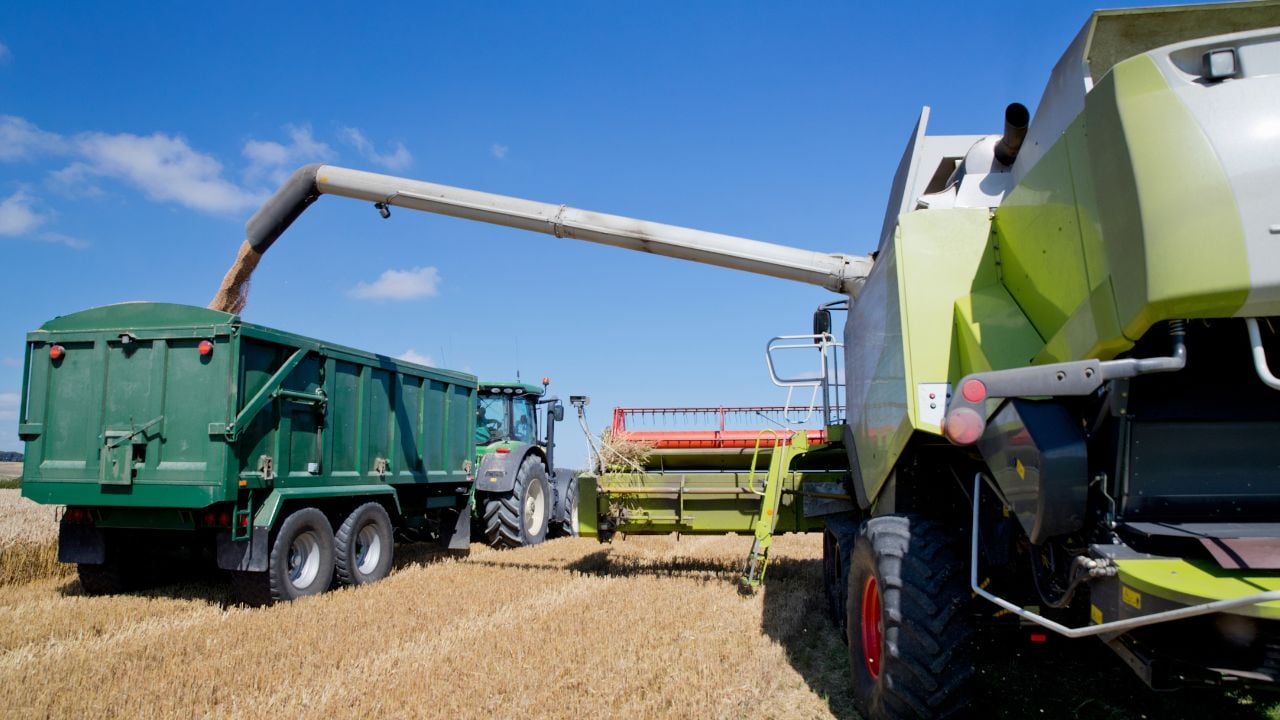
Harvest season means long days and lots of farm equipment on public roads.
Nebraskans who farm know the drive home from the field is part of the job.
But some of the rules that apply to farm vehicles are easy to miss.
Check these rules before you pull onto the road this fall so a ticket doesn’t follow.
Note: This is general information, not legal advice. Traffic and equipment rules are subject to change, so confirm the current requirements with the Nebraska Department of Transportation and the Nebraska Department of Motor Vehicles.
1. Combine Width Limit
Like any vehicle on a Nebraska road, your combine can’t go past a total width of 102 inches, or 8 feet 6 inches, without an exception.
On the Interstate, the statute lists no farm exceptions to that cap.
Off the Interstate, a combine 18 feet wide or less can move in the normal course of farm operations.
That works in daylight, or after dark if you fully meet the clearance light rules.
A combine wider than 18 feet is limited to 25 miles or less on highways, in daylight, with a well-lighted pilot vehicle or a flagperson out in front.
After dark, the combine has to fully meet the clearance light rules while the pilot vehicle or flagperson leads.
Nebraska Extension’s harvest-safety advice is to haul the combine head separately when you’re moving on a roadway.
Go past those limits, and you’ve broken the Rules of the Road, which makes it a traffic infraction unless a section says otherwise.
2. Slow-Moving Vehicle Emblem
Your farm vehicle needs a slow-moving vehicle emblem on its rear if it normally travels under 25 mph.
Driving on the roadway without one is unlawful, which makes it a traffic infraction under the general Rules of the Road penalty.
The emblem is a base-down triangle of fluorescent yellow-orange film with a 14-inch base and a reflective red border.
You mount it on the rear, two to six feet above the roadway.
State law says the emblem has to be maintained in a “clean, reflective condition.”
A dust-caked emblem on your grain cart falls short of that.
Nebraska Extension’s harvest-safety advice also includes putting reflective tape on machines to improve their visibility to motorists.
Lights don’t replace the emblem: State law says the emblem requirement is in addition to any lighting devices required by law.
3. Nighttime Clearance Lights
From sunset to sunrise, a combine, wagon, rack or farm tractor has to display clearance lights once it reaches 80 inches wide, load included.
The same duty applies when any part or load extends 40 inches or more to the left of the chassis center.
That means two clearance lights on the left side, an amber light at the front and a red light at the rear.
Each has to be visible from 300 feet under normal atmospheric conditions.
The duty also applies at other times when there isn’t enough light to see the vehicle clearly.
The statute lets you use suitable reflectors of like color and equal visibility in place of the lights.
Nebraska Extension’s harvest-safety advice is to avoid traveling after sunset and at busy times, such as the start and end of school days.
A violation of the lighting rule is a Class III misdemeanor.
After a conviction, the judge has to direct you to show proof that the lights now meet the law before you drive that vehicle on a highway again.
Ignoring that direction is an additional offense under the same statute.
4. Truck and Trailer Height Limit
A loaded farm truck, or a trailer carrying a combine, has to stay under the height cap of 14 feet 6 inches.
Combines, and the vehicles hauling them, can reach 15 feet 6 inches when they’re moving into or through Nebraska in daylight to harvest.
Exceeding that height without an exception is a Rules of the Road violation, so the general traffic infraction penalty applies.
The same statute says no one has to raise, alter or rebuild a wire, bridge or underpass to let a vehicle taller than 12 feet 6 inches through.
If you own, lease or drive a vehicle that tall, you assume the risk of loss to it and its load.
You and the others involved are also jointly liable for damage to overhead obstructions.
Nebraska Extension’s harvest-safety advice is to lower portable augers completely before you move them, so they don’t hit electrical lines.
Psst! How much do you know about roads and farm country? Take our quiz and see if you can ace it.
Quiz
Nebraska Road IQ
Answer ten questions on speed limits, seat belts, learner’s permits and farm country. We bet you can’t get them all right. Prove us wrong?
Under Nebraska’s seat belt law, enforcement is a secondary action. What does that mean for a driver?
5. Freeway Ban
A farm vehicle that counts as an implement of husbandry, whether self-propelled or towed, can't use or enter a freeway at any time without a permit.
The permit comes from the Nebraska Department of Transportation, or from the local authority on a freeway the department doesn't run.
The department's rules issue Interstate permits for implements of husbandry only for a farm equipment dealer or the dealer's carriers.
In Sarpy and Cass Counties, the department also issues a free permit for temporary movement of implements of husbandry on US-34/75, between the Bay Road and US-34 interchanges.
A violation of the freeway rule carries the general Rules of the Road penalty, which is a traffic infraction unless a section says otherwise.
Check with the Department of Transportation before you leave the yard.
What Counts as an Implement of Husbandry
Nebraska law defines an implement of husbandry as a vehicle or implement designed and adapted exclusively for agricultural, horticultural or livestock-raising operations.
A vehicle or implement built to lift or carry an implement of husbandry qualifies too.
The definition adds a second test: The vehicle has to be used primarily off any highway.
A vehicle you use mainly on the highway misses that second test.
For weight limits, the statute says an implement of husbandry includes a farm tractor with or without a towed farm implement.
It also includes a self-propelled farm implement, a fertilizer spreader and a mixer-feed truck that a livestock-raising operation uses to feed livestock.
6. Bridge and Culvert Weight Limits
You can't drive an implement of husbandry across a bridge, or a culvert with a span of more than 60 inches, when it's over the weight limit.
The weight that counts is your axle weight, axle grouping or gross weight, measured against the state limit or the limit posted on the bridge.
On highways other than the Interstate, state law exempts an implement of husbandry from the state's axle, axle-group and gross weight limits.
Bridges are the catch.
Crossing over the limit is a Rules of the Road violation, so the general penalty applies: Unless a section says otherwise, it's a traffic infraction.
That exemption stays subject to any ordinances or resolutions that local authorities have enacted.
7. Class O License Limit
Your Class O license doesn't cover a commercial motor vehicle, including a farm truck that qualifies as one.
Under section 60-4,141, no one may operate a commercial motor vehicle on a highway without a valid commercial driver's license (CDL), and a violation is a Class III misdemeanor.
A covered farm vehicle is the exception.
The Nebraska Department of Motor Vehicles says a Class O license is required to operate a covered farm vehicle, so a qualifying truck can skip the CDL.
To qualify, the truck has to be carrying agricultural commodities, livestock, or machinery or supplies to or from a farm or ranch.
It also has to be traveling in the state where it's registered or in another state.
A farm or ranch owner or operator, an employee or a family member has to be driving.
The truck needs a special license plate or other designation from the state.
It can't run for hire, but if you farm on a crop-share lease, hauling your landlord's share still counts.
A truck rated at 26,001 pounds or more has to stay in Nebraska or within 150 air miles of the farm or ranch.
A truck-tractor and semitrailer is out if the driver is under 18 or the load needs hazardous-materials placards.
If your truck is a commercial motor vehicle and misses any of those elements, the exemption doesn't reach it.
Signal Lights and Hand Signals
State law excuses vehicles used solely for agricultural purposes from keeping brake and turn-signal lights in working order.
For implements of husbandry designed for farm work, the statute words that excuse as applying during daylight hours.
You still have to signal.
The statute says the operator has to comply with the requirements for hand and arm signals, or for signal lights if the vehicle has them.
Under section 60-6,161, you give a turn signal continuously for at least the last 100 feet before you turn.
Under section 60-6,163, hand and arm signals go out from the left side of the vehicle with your left arm.
That's arm out level for a left turn, hand and forearm up for a right turn, and hand and arm down to stop or slow.
Nebraska Extension's harvest-safety advice is to use turn signals and hand signals whenever possible to communicate with other drivers.
Farm Husbandry Permits
If a teenager on your farm drives farm husbandry equipment on a Nebraska road, the Department of Motor Vehicles issues a Farm Husbandry Permit for it.
The minimum age is 13 if your teen lives on a farm and 14 if they're employed on one for pay.
Your teen takes vision, written and drive tests, with a separate tractor written test and tractor drive test.
A county extension course completion certificate waives the tractor tests.
A temporary permit lasts six months and can't be renewed, and a special permit lasts until your teen's 16th birthday.
The Department of Motor Vehicles lists a $5 fee for an original, temporary or replacement permit, plus a $5 security fee, for $10 total.
30-Day Farm Truck-Tractor Permit
The Nebraska Department of Motor Vehicles' Farm Truck-Tractor/Semi-Trailer Permit for farm combinations covers two kinds of trips.
One is hauling your supplies, farm equipment and household goods to or from your farm or ranch.
The other is moving your agricultural products, livestock and produce to or from storage or market.
The U.S. Department of Agriculture's 2025 state overview puts Nebraska's grain corn production at about 2.03 billion bushels, from 10.45 million acres.
You get the permit through the County Treasurer in your county of residence, after all taxes are paid.
The permit is valid for 30 days, and you have to carry it in the cab of the truck.
The fee is one-twelfth of the regular commercial registration fee for your truck's weight, with a $25 minimum.
6 Grain Bin and Elevator Safety Rules That Surprise New Nebraska Landowners
If you took over a grain bin you didn't build, you took over its rules too.
Nobody hands them over with the deed.
6 Grain Bin and Elevator Safety Rules That Surprise New Nebraska Landowners
6 Things Nebraskans Do Every Autumn That Tourists Find Puzzling

A football Saturday can empty half a town by kickoff.
The rest of the autumn runs on habits that make sense mostly to the people who live it.
6 Things Nebraskans Do Every Autumn That Tourists Find Puzzling
