
The Real Reason Florida Homes Almost Never Have Basements

If you’re house hunting in Florida, don’t count on a basement for all your moving boxes.
Most homes there are built without one, and the reason starts under your feet.
Here’s why basements are so rare in the Sunshine State.
A Shallow Water Table
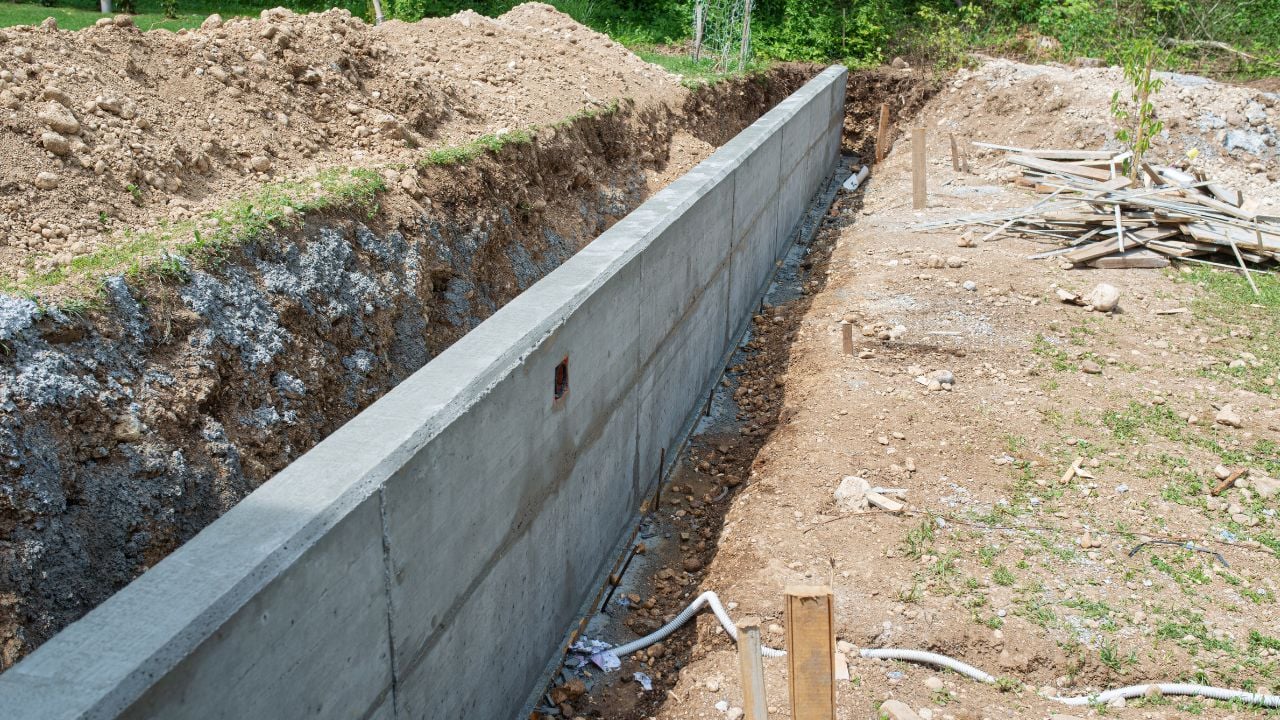
A basement floor has to sit below ground level, and in parts of Florida that can put your floor in groundwater.
Florida’s highest point, Britton Hill, is 345 feet above sea level, according to the U.S. Geological Survey.
In southeast Florida, the Biscayne aquifer includes highly permeable limestone, and its top is at or near the land surface across much of the area mapped.
Permeable rock lets water through.
Inland, the University of Florida’s Institute of Food and Agricultural Sciences says Spodosols, the sandy, acidic soils of the flatwoods, cover about 8.4 million acres, more than any other soil order in the state.
The majority of those soils are poorly or very poorly drained, and seasonally high water tables affect them.
Water Tables That Rise With Rain
If you build a basement in southeast Florida, you’ll face a water table that moves with the weather.
The Geological Survey’s groundwater atlas says the Biscayne aquifer’s water table rises and falls quickly with rainfall.
In one example it gives, 11 inches of rain over 4 hours produced a 4.5-foot rise in the water level at a Miami well within a few hours.
Over a year, those levels can range from 2 to 8 feet, depending mainly on rainfall and pumping.
Extensive flooding also occurs there during periods of greater than average precipitation.
Sand That Holds the Water Table
In much of Florida, the surficial aquifer system is made mostly of sand.
Where the surficial aquifer system is present, its groundwater is under water-table conditions.
The Geological Survey’s groundwater atlas says it consists mostly of beds of loose sand, shelly sand, and shell.
Most of the water entering that system moves quickly along short flowpaths and drains into streams.
The water table generally follows the shape of the land, so it has only slight slopes under broad, flat areas.
Psst! How much do you know about the ground beneath your house? Flip each card and see if you can ace it.
Limestone Underneath
In places, a basement you dug would sit on or near limestone.
The Floridan aquifer system covers all of Florida and is built from a thick sequence of carbonate rock.
In south Florida, that sequence is over 3,000 feet thick.
In west-central Florida, that carbonate rock is limestone and dolomite, according to the Southwest Florida Water Management District.
In the northern part of that region, a mantle of highly permeable sediments 0 to 30 feet thick covers the carbonate rock.
Limestone dissolves in groundwater, and as it does, spaces and caverns develop underground.
Flood Rules
A basement you built in many Florida locations would also have to clear federal flood rules.
Those rules cover new homes in zones with a mapped base flood level, such as AE zones, on a community’s flood map, for communities in the National Flood Insurance Program.
If your home sits in one of those zones, it must have its lowest floor, basement included, at or above the base flood level.
Where the base flood level is at or above the ground, a floor at that level isn’t below ground, so it isn’t a basement.
In coastal high-hazard areas, known as V zones, federal rules call for homes raised on pilings or columns.
The space below the lowest floor has to stay free of obstruction or be closed in only by breakaway walls, lattice, or screening.
Florida’s Extra Foot
Florida’s building code adds one foot to the federal rule on basement floors.
The 2023 Florida Building Code, Residential covers basement floors below grade on all sides in a flood hazard area.
Those floors must be elevated to or above base flood elevation plus 1 foot.
If the design flood elevation is higher, that number applies instead.
In coastal high-hazard areas, the same code prohibits those basement floors outright.
Slab Foundations
Instead of a basement, many new homes in the South Atlantic division sit on a slab, a concrete pad poured at ground level.
The National Association of Home Builders analyzed U.S. Census Bureau data and found 85.7% of new single-family homes in the South Atlantic division were built on slabs in 2024.
Nationwide, slabs were 73% of new single-family homes started that year, full or partial basements were 17%, and crawl spaces were 9.2%.
The Census Bureau’s South Atlantic division runs from Delaware to Florida, so that’s a regional figure, not a Florida-only count.
If you tour new construction in that division, the home builders’ figures point to a slab as the foundation you’ll usually see.
Where Basements Are Common
Basements are common in other parts of the country, and you may be used to having one.
In the same National Association of Home Builders analysis, 62.3% of new single-family homes in West North Central were built with full or partial basements in 2024.
East North Central came in at 50.3%, and the Middle Atlantic at 48.8%.
8 Florida Beach Rules Locals Follow That Are Never Posted

Florida’s beaches have unwritten rules that locals follow without thinking.
Visitors tend to learn those rules the hard way.
8 Florida Beach Rules Locals Follow That Are Never Posted
7 Florida Roadside Attractions Floridians Assume Closed Years Ago

Some roadside stops along Florida’s highways look like they shut down years ago.
Many drivers write them off, and the story behind a few is worth a detour.
7 Florida Roadside Attractions Floridians Assume Closed Years Ago
